Monday, April 29, 2013

Of Gardening and Bees

One of the things I love about gardening is that I get to really see miracles every day. Here is Saturday's miracle:

My zucchini seedlings have pushed up through the surface!

The huge cotyledons (seed leaves) on these baby plants expand out from seeds that are actually pretty small. My friend Becky says that the baby zucchini plants remind her of solar panels - they flatten out when the sun is high but fold closed for nighttime.

Also on Saturday (before the Big Rain started), I was able to plant the rest of the cucumbers and some okra and sunflowers. I still have a long way to go in terms of getting my summer garden planted, but it feels good to have made some headway.

Earlier in the day, Joe and I did our usual couple of hours weeding out at our friends' garden/farm on Dallas Highway, and I was invited on a little field trip to Burnt Hickory Roots Greenhouses to pick up flats of tomato and pepper plants.

I had never been out to that particular greenhouse - and I'll be lucky if I ever find it again, because I had a hilarious tour of Paulding County on the way there. However, the plants, which are grown from seed at the greenhouse, were beautiful and astonishingly affordable.

Joe and I also checked our hive on Saturday afternoon (it was a very full day!). The bees have started to make comb on seven of the bars in our top-bar hive. Here is Joe with one of the just-started combs:

Joe with a comb that is being newly formed by our bees.
 We even found the queen! She has a red dot on her back; otherwise, I wouldn't have noticed her. The closed white cells at the top of this comb contain honey, and the closed yellow cells (we think) are "brood cells," with baby bees inside.
The queen is marked with a dot of red paint.
When Joe built the hive, he put in a viewing window to let us do quick checks on the hive without disturbing the bees as much as when we've opened the hive and pulled out bars to see how the bees are doing. The window has been a good source of reassurance to us new beekeepers that all is still fine.
New comb, seen through the window on the side of the hive.
Every now and then, though, we will need to check on the hive comb-by-comb, to make sure all is as it should be. There are mites and beetles that cause lots of trouble for bees, and we need to keep an eye out for those, and we will need to add more bars to the bee-side of the hive as more comb is built.

Right now, there is a divider in place, keeping the hive space a little cozier until the bees reproduce and need more space.

Hope that everyone else had a great gardening weekend, too!


Monday, April 22, 2013

Garden Update

Does anyone else have sore muscles today from all the garden-work yesterday? I amended and planted two and a half beds and set up the bird bath, and then I bumped up some of the remaining plants into larger pots.

The two completed beds are the two nearest the front door. Now, instead of weeds, the long curved bed has three eggplants, thirteen pepper plants, and some gladiolus bulbs to go with the bee balm that was already there, and the smaller bed shaped like a big slice of pie has six Swiss chard, seeds for zinnias and pickling cucumbers, and the birdbath. When Joe got back in the late afternoon from kayaking on the Etowah River, he was amazed at how different the front yard looked!

The "half" part of the two-and-a-half beds is one that is supposed to get tomatoes planted in it later in the summer, based on my newly-created rotation scheme, but it got a couple of Amish tomato plants early. I need for the Amish tomatoes to be separate from the rest to avoid any further cross-pollination.

Last year's Amish tomatoes looked pretty different from the tomatoes of the first couple of years, and I am hoping that the older seeds (saved from one of the earlier years with this variety) that I used this year will produce plants that are more similar to the original variety. Keeping them in a bed across the yard from the rest should lessen the cross pollination problem.

Other activities for the day included admiring our new bees and cleaning my bunnies' enclosures. My friend Cheryl stopped by to pick up some plastic nursery pots because she needed more of the 3-gallon size (I had plenty under the house) and she brought some bunny salad - which included some wheat plants - from her yard for Moonpie, Tiny, Burrito, and Holstein. They seemed to enjoy the different salad!

I'm expecting to plant most of the rest of the summer garden over the next couple of weeks, completing a little bit each evening after work. The sweet potatoes will be last, because they need reliably warm soil to do well.

Friday, April 19, 2013

Impatience Wins: I Planted Zucchini Seeds

I have been waiting and waiting for warmer weather, but on Wednesday evening I gave in to my impatience and planted some zucchini seeds. Last year, I began harvesting zucchini in May (May!), but this year I will be lucky to bring in zucchini by mid-June.

Even though the past several days have been toasty warm, tonight's forecast includes a swoop down below 40 degrees F. That's why I've been trying so hard to wait on planting the summer veggies. Many of those really don't like temperatures in the thirties.

The forecast includes a frost advisory, and if a frost materializes it would be disastrous for many gardeners at this point. However, back in 2005, our last frost was on April 24; one more dip down to freezing wouldn't be out of the realm of normal.

After that, though, the forecast temperatures trend upward, and I am planning to begin the spring-planting extravaganza on Sunday afternoon. Meanwhile, my yard enjoyed a big rain today, which means those zucchini seeds will be well-hydrated for eventual germination.

Hope everyone else's gardens keep safely un-frosted and growing well!


Sunday, April 14, 2013

Where Do Bees Come From?

Where do bees come from? A box! Pictured below is the box containing our first very-own bees.

Our First Bees
I got a phone call from the post office on Thursday morning, and at the other end of the line a nice lady, in a somewhat tense voice, asked that I please come pick up my bees as soon as possible. Now, actually. Right now.

So I went around to the back door of the post office as instructed and rang the bell, and the one person in the post office who WASN'T freaked out by the bees came to the door. It turned out that the bees were on a shelf outside, because they weren't especially welcome inside. The bees were just as you see them above, in a part wood, part screen container, so it was easy to see (and hear!) all the activity in there.

Joe built a top-bar hive last year to begin our beekeeping adventure, but he was out of town when the bees arrived, which meant that I had to open the box and put the bees into the hive myself.

I had a bee veil that went over a hat, and I put on one of Joe's long-sleeved white shirts and a pair of garden gloves for the big event.

The hardest part was prying the can of sugar-water out of the big hole at the top of the box. The can fit just exactly into the hole, so every time I pried up one bit of the edge, the opposite side slipped down into the box.

I finally got it, though, and was able to pull out the little cage that holds the queen. I hung her up in the hive, then poured all her little worker friends into the hive. They didn't all want to leave the box, so I left it right near the hive entrance, to make it easy for them to find their new home.

When Joe got back into town on Saturday evening, we went to check on the queen. She hadn't made it out of her little cage yet (the exit was blocked with a sugar-cube that the bees are supposed to eat through to release her), so Joe finished poking an exit-hole through the cube for her. A quick look around showed that the bees had been making comb, and we think that's a good sign.

Today, the bees all seem to be still there, which is good news. Sometimes a batch of bees will decide to find a different home than the one they were dumped into, and that would mean we'd have to start over with a new batch of bees. Wish us luck?

Planting "Bunny Salad"

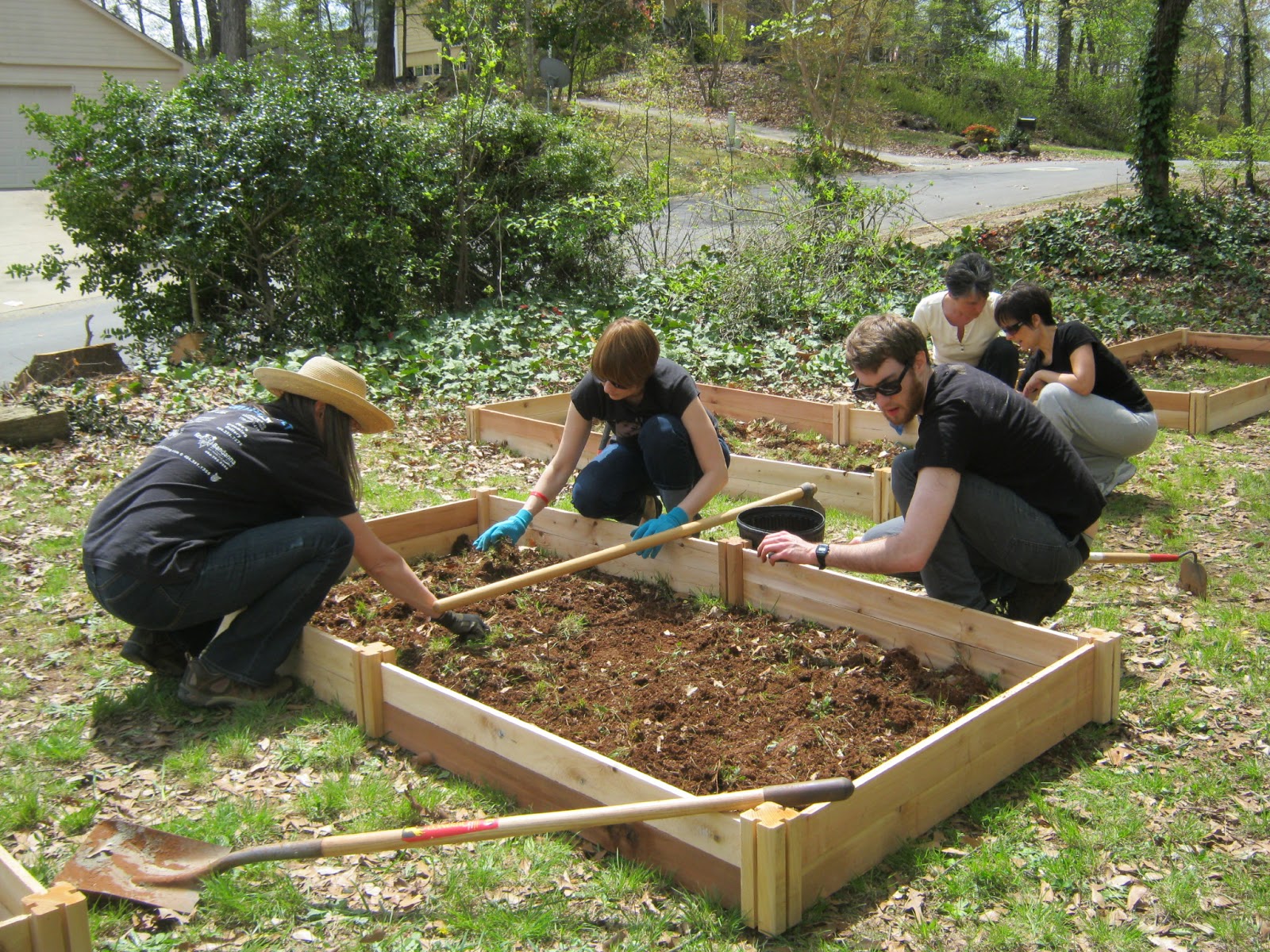
Saturday was sunny and warm, and I spent a large part of the day at the Georgia House Rabbit Society explaining and supervising the planting of raised beds for growing bunny salad.

The mainstay of the diet of domestic rabbits is hay (mostly timothy hay); bunnies also typically are given some pellets that are made of compressed hay with some nutritional supplements added, and bunnies also need some fresh food each day (the rabbit house has a list of good bunny foods on its website).

That fresh part of the diet can get expensive, which makes these new raised bed gardens a potentially great addition to the grounds of the rabbit shelter.

The completed gardens will serve not only as a source of food for the shelter's bunnies, but will also serve as an educational tool, to show new bunny-owners some of the foods that bunnies can eat and that these can be grown at home. 

First, of course, the volunteers who showed up to help put in the gardens had to assemble the beds.
 
One of the big home improvement stores had been having a sale on cedar, raised bed garden kits, and the shelter had bought six of the 4x4 kits for their new gardens.

The kits were designed to allow them to be joined together to create larger beds, and after some discussion and much pounding, we ended up with four 4x8 beds.

I had brought my grub hoe (a favorite tool!), and it was put to good use breaking up the soil in the beds. After the Very Compacted soil was loosened, the volunteers worked on getting the worst of the weeds out of the beds.
Then there was the job of moving all the good garden soil which the shelter had acquired. The soil - which was in two large piles in the yard - was wet and heavy from recent rains, but the volunteers were undeterred. It took some doing, but the beds finally were all filled with the soil.

Then we got to my favorite part - the actual planting. Most of the volunteers hadn't actually planted a garden before, so I showed them how to get the plants out of their pots with as little damage as possible, how to lay them out in the appropriate spacing, and how to set the plants into the ground.

We had transplants for anise hyssop, bronze fennel, parsley, cilantro, lettuces, radicchio, chicory, three different mints, and arugula. We left space for the basil, which needs slightly warmer weather.

I also taught some volunteers how to use the garden rake to make furrows for planting seeds, because we had seeds to plant, too.
We had seeds for more cilantro and lettuce, for radishes, and for peas (bunnies like the stems and leaves of the pea shoots). We also had some seeds for flowers that the bunnies won't be eating - they are just to help make the grounds look more attractive.

Some radishes had been planted in a "gutter planter" around the back deck, too, but I forgot to take a picture of that. One of the regular shelter volunteers had hung guttering around the outside of the railing for the back deck. He had drilled holes for drainage, so it could be used for a planter.

Since bunnies really like radish leaves, we had a small group of volunteers working in the back, filling the gutter-trough-planter with potting mix and then planting radish seeds. There should be plenty of radish leaves for the bunnies in just a few weeks!

A few of the day's volunteers were regulars with the rabbit shelter, but most were with an animal protection group called GARP. This was one of the activities they had chosen to help support other groups that protect animals.

The volunteers also worked on some additional projects at the shelter: they dug out the path to the garden and spread the gravel under-layment that will be the foundation for the bricks that will form the path, and they worked to pull out a very unattractive older planting of low-growing junipers (mixed with honeysuckle vines and assorted other weeds) that lined the front of the property. Then they replanted that area with daylilies and daisies. All of this involved hard, physical labor.

Over the course of the day, the group of twenty-or-so people got a lot done. It was great to see the huge change in the landscape in such a short time!

Monday, April 8, 2013

Kudzu Bug Update

A clearer picture of the impact of the kudzu bug on Georgia's roadsides, farms, and gardens is slowly emerging as information from across the state is gathered and evaluated by personnel at UGA.

The map below shows the speed at which this particular pest is spreading across the Southeast:


At a meeting about four weeks ago, Wayne Gardner, an Entomologist at UGA,  shared some very useful new information about these little stink bugs. It turns out that - so far -  they are most damaging to kudzu and soybeans. They don't seem to damage peanuts, but they have been observed feeding on wisteria.They also are seen on many other legume-family plants, but the amount of damage they inflict on those is unclear.

Gardner listed host plants for the kudzu bugs, and those that are legumes include: Lima beans, pole/string/green beans, lablab beans, pigeon peas, wisteria (both American and Chinese), American Yellowwood, lespedeza, peanut, crimson clover, clover, alfalfa, sicklepod, and black locust.

Non-legume host plants include: alligator weed, black willow, banana, cocklebur, cotton, fig, loquat, muscadine grape, pecan, pine trees, potato, satsuma mandarin, tnagerine, wax myrtle, wheat, and wild blackberry.

On most of the host plants, the bugs are present as adults, but they aren't reproducing on the plants, and the amount of damage done is yet to be established. The kudzu bugs are present in all stages of the lifecycle on soybeans and kudzu, and they damage soybeans and kudzu primarily by feeding on the stems rather than the leaves. 

Gardner reported that kudzu biomass in infested stands is reduced by about one third within a year's time, which is probably good news for our roadsides. For soybean farmers, the average 18% reduction in crop yield is markedly less-than-good news. For urban areas, it may turn out that the worst problems relate to the stink and the staining caused by the little pests, and some people may have a localized allergic reaction to contact with the bugs. Hopefully, the picture will become even more clear this season, as more data are gathered and added to what we already know.

Spring, Sprang, Sprung

We are looking ahead at some very warm weather, according to the forecasts of the last few days. Spring may actually have sprung! However, UGA has published information reminding all us gardeners that the future - especially with regard to the weather -  is uncertain.

The first cautionary note in the April 2 issue of the Georgia FACES newsletter is this one: "The swings in temperature are typical of a neutral pattern with no El Niño or La Niña present in the Pacific Ocean. Producers should keep in mind that in a neutral year, the chance for additional cold periods and a late frost are greater than usual. So planting should be undertaken with caution."

And that note is accompanied by this reminder:  "Once the soil temperatures warm up and the chance of frost is past, there should be plenty of soil moisture available to allow for good germination. However, fungal diseases may be a concern, and water-breeding pests — like mosquitoes — are also likely to be more plentiful this year, as there is ample habitat for them to develop."

I hadn't known that bit about the greater chance for a late freeze when there is no El Niño or La Niña present in the Pacific Ocean. However, I am all-too familiar with the increased odds of fungal diseases in wet weather. It's been relatively cool and damp in the last couple of months, which means that this is likely to be a "good year" for Verticillium Wilt. With that in mind, I will be keeping my most susceptible tomatoes in pots for a while longer. 

So far, I have been mostly getting-ready-to-plant rather than actually planting my summer veggies. I did put in a patch of bush bean seeds, but the rest of my time has been spent in getting the garden ready. It is VERY hard to wait on the planting, and I have some "seedlings" that are getting way beyond the seedling stage and need to be in the ground, but I am going to wait until later this week, rechecking the forecast daily, before I trust that the weather has settled into enough warmth for beginning to plant my tomatoes, peppers, and other summer crops. 

When the planting really begins, it will be with seeds, not transplants. Seeds could take as long as a week to germinate, making it more likely that they wouldn't even have made it above ground if a late frost strikes, and if they are up, they will be easier to cover than large plants.

Monday, April 1, 2013

Wonderful, Beautiful, Productive Weekend

It's been a wonderful, beautiful, productive weekend at my house. One of the things I worked on was bumping up plants. Some of the seedlings (photo below) were a little small, but I wanted them to be in good shape for next Saturday. I'll be giving a talk for beginning gardeners at an event in Douglas County (see day-long veggies program here), and I wanted to bring some little plants to give to attendees.

My original plan was to bring sweet potato slips, but my sweet potatoes aren't cooperating. So far, I have only two sprouts poking up, and I am expecting more than two people to attend. The plants in this photo are  lettuces and dwarf French marigolds.


These were potted up with Faford mix and a little Osmocote. Not exactly organic, but this combination usually works.

Another part of the garden that we worked on this weekend is the bed right in front of the house. When the house was smashed by a tree last summer, the foundation shrubbery was smashed, too. At first, I had thought that I would replace the azaleas with gardenias, but then I thought that I could do something completely different.

We amended the first five foot stretch of compacted clay - lots of lime, compost, and "soil conditioner" - and moved a very large rosemary to that space.  I haven't worked out the whole rest of the bed, but we have a tree-form bay laurel (currently in a pot) that will go there, and if all goes well, I'll find a Provence Lavender to go in (the flower spikes are amazing!).

 Aside from a few evergreen herbs, most of the plants that will be planted in that space will be bee-friendly perennials. Then, when the shade hits that space in mid-winter, most of the plants will be safely underground.

The stretch that we managed to complete required some very hard work in breaking up the clay, so I am guessing that completing the rest of the bed take several weeks.

In yet more good news, the bulbs that were set under the pansies in the big flower pot are up! The daffodils haven't opened, but the three hyacinth bulbs are doing a great job of adding a little more color. The cheerful display brings me an inordinate amount of pleasure.

Hope everyone else's gardens are going well!

Monday, March 25, 2013

Watching the Weather

Georgia gardeners and farmers have a lot to celebrate right now, even though they might not be able to get into their squishy fields to work. Due to last month's record-breaking rainfall, the soil-moisture deficit of the past few years is substantially reduced. There is such a thing as too much rain, but we aren't there yet. 

Weather.com's recent article "Another Warmer-than-Average Winter, New Report Says," summarizes data from a NOAA report about this year's winter weather.  This is the really great part for Georgia: "Parts of the state saw over a foot of rain during the month, and the statewide average was an impressive 9.92 inches, smashing the previous record from 1939 by over an inch."

NOAA's Spring Outlook report notes that the threat of minor flooding from the plentiful rainfall will continue into the spring, but that "Above-normal temperatures this spring are most likely across most of the continental U.S."

This morning, there were snow flurries at dog-walking time, and we are looking ahead at several nights in a row of freezing weather, which makes the looming "above normal temperatures" a little hard to believe. Last year, spring really was toasty warm very early in the season, but this year's spring is having a more-usual beginning: it's cold and windy. 

For local gardeners whose seedlings are busting out of their little pots, it's still to early to put the summer crops (tomato, pepper, squash, cucumber, beans, etc) out into the garden. Last year, the soils warmed up early, and planting time was also early. This year, our soil temperatures, as of today, are still below 50 degrees F, making it WAY too cool for the summer crops. Most of those summer crops will do best with soil temperatures in the 60s and above. We all will just have to watch the weather as closely as we can for a little while longer. I hope my seedlings won't mind hanging out indoors for a few more weeks!

Sunday, March 17, 2013

Garden Schedule for the Next Few Weeks

We are just about four weeks away from the average last frost date for Cobb County, which means that I am counting down to the time when I can really fill the garden again with food-producing plants.  The potatoes and peas are starting to come up, making the garden look a little less bare, but most sections of the garden are looking fairly empty. The spaces that still have some cool-season crops (spinach and green onions, for example) will be cleared over the next few weeks to make room for the next round of plants.

Meanwhile, the seedlings that I've started for spring planting all need tending, including watering and moving to larger containers as needed. I've put sweet potatoes into a flat of sand-plus-potting mix to make slips (which won't be planted until May). Some of the lettuces that I've started indoors will be ready to set out in a week or so, and the parsley might be ready then, too. I'll be putting out seeds for radishes each week through April, because Joe likes radishes and Moonpie LOVES radish leaves.

Depending on how the next couple of weeks go, weather-wise, I might plant a little patch of bush beans when I set out the lettuces. That would be a small gamble, but I have lots of bean seeds for replanting if a freeze knocks out the first round. Otherwise, there's some impatient waiting ahead.

One thing I've been working on while I wait is a more firm crop rotation schedule than I've had in the past. I've assigned numbers to the different planting areas in my yard, to make a six year rotation. However, the most "needed" crops are in two beds each year. This is how it looks so far:

Bed 1 year 1 - Green peas, followed by sweet potatoes, okra, and sunflowers, which come out in October and are replaced by onions, shallots, and garlic.
Bed 2 year 1 - Onion family comes out in June, followed by late tomatoes and Southern peas, followed by a winter cover crop.
Bed 3 year 1 - Zucchini, melons, and cukes, followed by buckwheat cover, followed by carrots, cilantro, and parsley.
Bed 4 year 1 - Corn, underplanted with beans or peanuts, followed by cabbage family plants, followed by green peas (leaving a little space for the early potatoes).
Bed 5 year 1 - Potatoes, tomatoes, peppers, and eggplants, with early potatoes followed by bush beans, then replanted with late potatoes, then mulched.
Bed 6 year 1 - Zucchini, melons, and cukes, followed by buckwheat cover, followed by beets, spinach, and Swiss chard.

What's missing, of course, is a space for the lettuces and chicory. Hopefully, in the next three or four weeks I will have sorted out that little detail. And this year, it will take a little finagling to get the rotation right, because what's in the beds right now doesn't exactly match what I have mapped out.

Part of why I'm working this out is that many of the planting schemes I've seen don't take rotation (moving plant families around the garden) into account, and they don't use succession planting at all. I'm working on getting more cover crops into the rotation but also to keep quite a bit of space in production.  The plan isn't quite right yet, but I'm pretty sure the work will be totally worthwhile.

Saturday, March 16, 2013

Bumping Up the Seedlings, and Other Goings On

We are having some pretty glorious spring weather this weekend in North Georgia, so Joe and I have spent a lot of today outside. We did our usual couple of hours of work on the farm (out on Dallas Highway) this morning, ran a few errands and ate at a Chinese place, but the rest of our day has been out of doors at home. This is some of what I worked on:
I had a lot of veggie-babies that needed to be moved to larger pots. There are still a few left for tomorrow, but I am very happy with the progress of my plants so far. Some plants had been started a couple of weeks earlier than usual, because I wanted to be able to show people at a seed-starting class what the seedlings would look like, and as a result I have some pretty big plants. Usually, I have more smaller plants now, and no big ones. The trio of tomatoes that got bumped up to the one-gallon containers is an especial surprise to me.

I know people who ALWAYS have big plants to set out in April, but that is not typically the case for me. I can only hope that I am able to keep those plants happy for the next few weeks! Most of them won't be planted out to the yard until mid-April. That leaves a lot of "indoor time" left.

Veggies aren't the only plants in my yard. I have been enjoying this pot of pansies all winter long, and soon it will have more color for me to enjoy.


When I was putting in the pansies, I put in a few bulbs first. I had been wondering when I would see them, and I finally have an answer! A couple of hyacinth are coming up now.

The under-planted bulbs in the pot of pansies are a great addition to my yard. If I hadn't been giving talks on container plants last fall, I wouldn't have been motivated enough to make it happen, but I am Very Happy that I took the time to make this happen.

It will be great to see more flowers.


The leaves and flower stalks are on their way. Right now, the flower stalk is just a little nub, but it will be stretching up above the pansies in the next several days.


Something else we worked on today was beginning to clear some space for some Tree Removal Guys to come and take down a loblolly pine tree. Joe cut down a couple of small trees, and I helped trim and stack the branches so that they would be easy for the city workers to take away to be made into mulch.

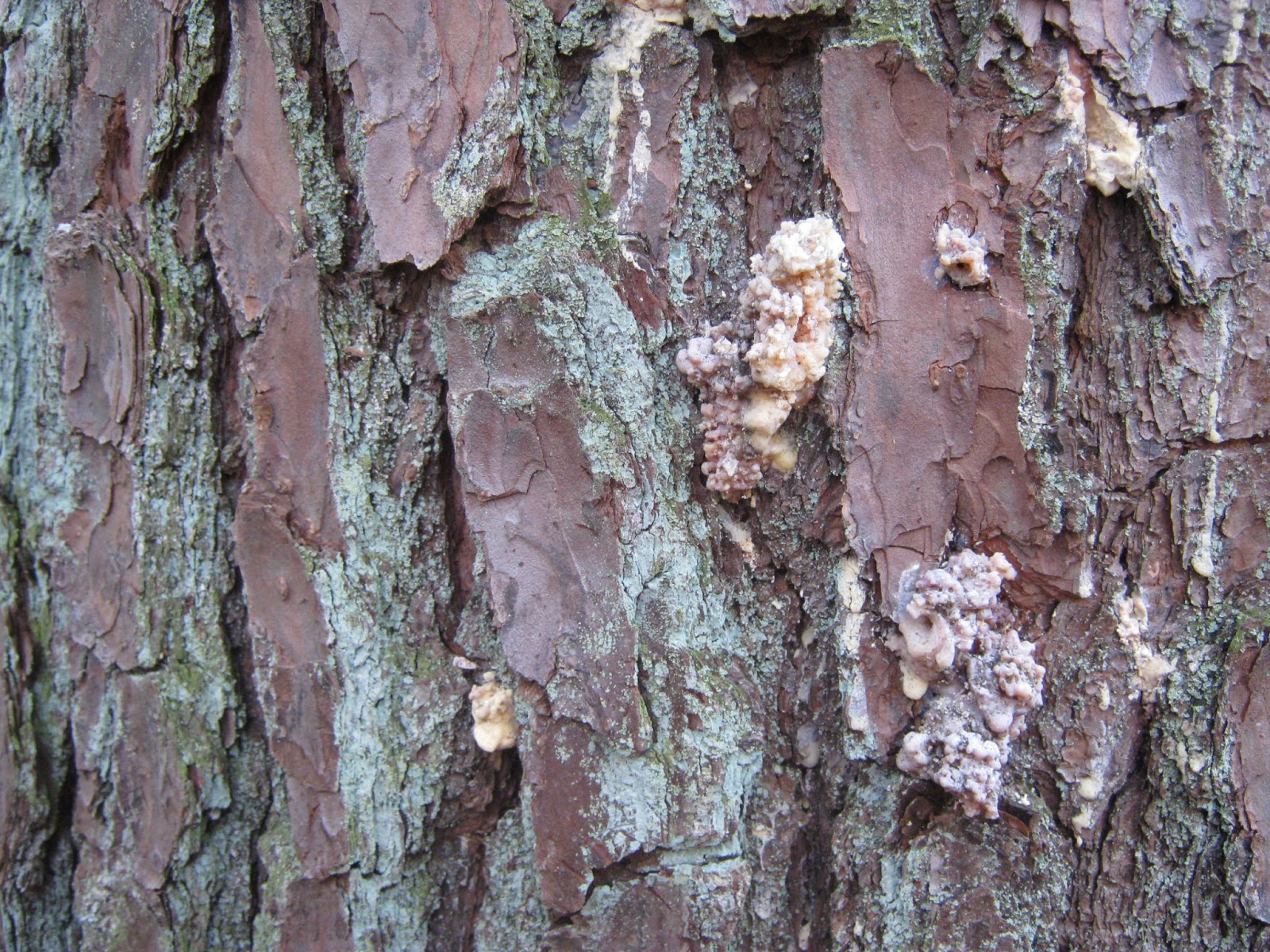
The Loblolly pine is coming down because it is infested with black turpentine beetles. The tree had had an earlier infestation, but this year there are  enough visible pitch tubes on the lower portion of the tree-trunk that I am getting a little concerned about the tree's viability.

Turpentine beetles don't kill a tree with the same speed or certainty as Southern Pine Beetles, but if there are enough beetles the tree can be girdled.

The picture to the right shows the abundance of the pitch tubes. The photo below shows some up close:


And this last photo shows the height of the tree. The guy who came to give us a cost-estimate for the removal of the tree said that this is a big tree. He guessed that it is at least 110 feet high, maybe 115 or more.

Needless to say, the tree's removal won't be cheap, but my front garden will, at least, be getting a little more sun this summer.

We have a little more work to do to get ready for the big tree removal, but we also have some weeding and planting to do in the veggie garden.

The potatoes are in, as are most of the peas, but there is still another patch of peas to go in. That will be part of tomorrow's work.

Hope everyone elses's weekend is going well!

Thursday, March 7, 2013

"Organic" Organic-Matter for the Garden

I spoke with someone this week who wanted to know where to find the absolute BEST compost for her organic garden. She has a compost pile in her own yard, but it doesn't make enough for the whole garden. I suggested that she try  Farmer D's compost, which - even though it is expensive - is locally available and an absolutely beautiful product. It is made partly with leftover produce from multiple Whole Foods stores.

However, she was concerned about pesticide residues, since not all of the produce at Whole Foods is organically grown. She also pointed out -- when I brought up mushroom compost as an alternative -- problems with the substrate that commercial mushrooms are grown on, which then is often made into (some pretty good) compost. Apparently, she had read that sometimes bits of particle board and other pressed wood products, some of which contain formaldehyde, are used as the growing medium.

Many of us are going to be a little less picky about the residues in the compost, since most of the worst chemicals will have broken down into components that (hopefully) are less of a problem, but my friend has some issues with past chemical exposure that have made her understandably wary of bringing any more potentially risky chemicals into her environment.

After discussing and rejecting a couple of other possibilities, it became pretty clear to me that there is almost no way to obtain large quantities of completely non-contaminated, composted organic matter for use in the home garden.

The only good alternative I could think of was intensive use of cover crops to add the needed organic matter. For new ground that can be kept out of food-production for a full year, starting now with some kind of peas (it won't matter which kind), plowing those in then leaving them for a week or so to begin decomposition, followed by buckwheat in May that is plowed in after it has begun to flower, followed by another round of buckwheat or some cowpeas, followed by a winter cover of rye plus either hairy vetch or Austrian winter peas, would get the soil into pretty good shape. The cover crops would, of course, need to be amended following recommendations on soil test results, especially with regard to bringing our area's naturally low soil pH into a better range for the desired plants.

Most organic gardeners here in Cobb County need to incorporate cover crops in the rotation anyway, to keep the soil phosphorus levels in bounds, but to get a big slug of organic matter into the soil using cover crops alone will take some planning.