Showing posts with label herbs. Show all posts

Thursday, November 9, 2017

Gardening Books I Have Loved - Culinary and Salad Herbs

I didn't grow up with gardening. I always loved to be out-of-doors, and I loved plants. When I went to college, still loving plants, I studied botany.

All through my adult life, I have been lucky enough to encounter wonderful books about plants and gardening that have helped me along the way. Some of these books were not strictly "how to" books. When they were, they tended to be for regions of the country (or the world) that have very different conditions than where I live, so the instructions don't 100% work in my yard.

Instead of using them as instruction manuals, as I found them and absorbed what they had to offer, these books engaged my imagination, made me laugh, and showed me new ways of viewing gardening and plants.

This is one of those books:
Culinary and Salad Herbs: Their cultivation and food values with recipes, by Eleanour Sinclair Rohde. 1972, Dover. A republication of the original 1940 book published by Country Life Ltd, London, England.
My first gardening book. PHOTO/Amygwh
My Great Uncle Balfour, a man I had met only a few times in my childhood, lived in the same town where I was in college. One day, when I had walked across town to visit and share a pot of his Darjeeling tea, he gave me this book. He was going blind from macular degeneration and could no longer read, but he loved plants, too.

When his sight had begun to fail, using information from this book, he had replanted most of his garden with herbs. He didn't need to see the herbs to find the right ones for use in the kitchen. Scent was all the guide he needed.

Folded into the book are a couple of sheets of paper, with handwritten notes about the herbs in Uncle Balfour's garden. One sheet contains a seed list. In 1974, he paid 15 cents for a packet of sweet marjoram seeds.

The handwritten notes are a family treasure, but the book itself was a revelation. At that point in my life, I had no idea that people ate dandelions and purslane, but there they were, described in the book as though their use in the kitchen was commonplace. This was news! The book includes recipes for herb teas, herb cheeses, and herb vinegars. It also includes this astonishing bit of information about making a salad:

"James II's head cook considered that there should be at least thirty-two ingredients, and a 'brave sallet' contained more than that, for it was the decorative centerpiece of the table."

For someone whose experience of salad had, up to then, consisted of iceberg lettuce combined with bits of carrot and tomato, topped with some Green Goddess dressing, this requirement strained the brain. However, the rest of the book helped me see possibilities for the other 29 ingredients.

This is the very first gardening book I ever read, and it shone a light on my path forward into both gardening and using my own herbs and vegetables in the kitchen. Anyone else, new to gardening and loving plants, could do worse than to start with a regionally-inappropriate little book like this one.


Monday, May 22, 2017

Summertime Adventure

Anyone who has been reading this blog for very long may have been wondering when I would get around to telling what I've planted in my garden this year. Usually, I spend most of January and February all in a tizzy over seed catalogs, trying to decide what new crops will go into the garden in spring.

This year, I tried not to look too closely at the seed catalogs that arrived in my mailbox, because I knew that I would be away from home for much of the summer. Reading them could have caused a bit of mental conflict!

My food-garden right now has a lot of herbs in it, the big strawberry patch, garlic and shallots planted in early winter, a few lettuces (unless a neighbor has eaten them)
Plenty of strawberries in the yard this year!

View from where I am writing today.

Container gardens: Not many veggies, mostly herbs and flowers.

Wonderful place not far outside of town!
and flowers for the local pollinators. There are no summer crops in the garden because I am in Italy!

I left an assortment of college students in charge of the house and the lawn-mowing, and the only plants they are tending are two houseplants and the big container/planter by the front door.

When I get home, I can start thinking about the fall garden (and a whole lot of weeding, I expect). It has been weird, though, to not plant any vegetables. I have grown vegetables in my yard in NW Georgia every summer since 1991.

I am looking forward, while I am in Italy, to learning more about gardening here. On a walk outside the city walls this weekend I found a large garden center, and even though my Italian language skills are sketchy and the English language skills of the people at the garden center are only a little better, we managed to communicate well enough.

The garden center features many annual and perennial flowers, but I also saw trays of vegetable transplants and pots of herbs. I will be going back again in the next few weeks to see/learn more.

Already I have seen that anyone with even as little open ground as a 5x10 foot patch is growing at least an olive tree. Larger spaces often include other fruits. I've seen quite a few cherry trees (sweet cherries, that don't do well in the humid Southeastern US), a few other fruit trees, and outside the walls of the town and in parks, there are umbrella pines that produce big pine nuts that are good to eat. It is great to find that so many people grow at least a little food!

The center of the hilltop town I am in, Montepulciano, is very paved, which accounts for the large number of container gardens, but farther down the sloped sides of the town there is more unpaved space, and some homes that have little yards. One yard that I saw on Friday includes a chicken coop, some fencing around a planting of tomatoes, a couple of olive trees, and a peach or apricot.

On another walk, I found the local biodynamic farm, Fattoria San Martino. I am hoping to make an official visit soon, complete with lunch reservation, and I will be reporting back on what I learn there.

Hope that all your gardens are doing well! If garden problems crop up, though, please feel welcome to ask about them through the comments link of this blog.

-Amy


Sunday, April 14, 2013

Planting "Bunny Salad"

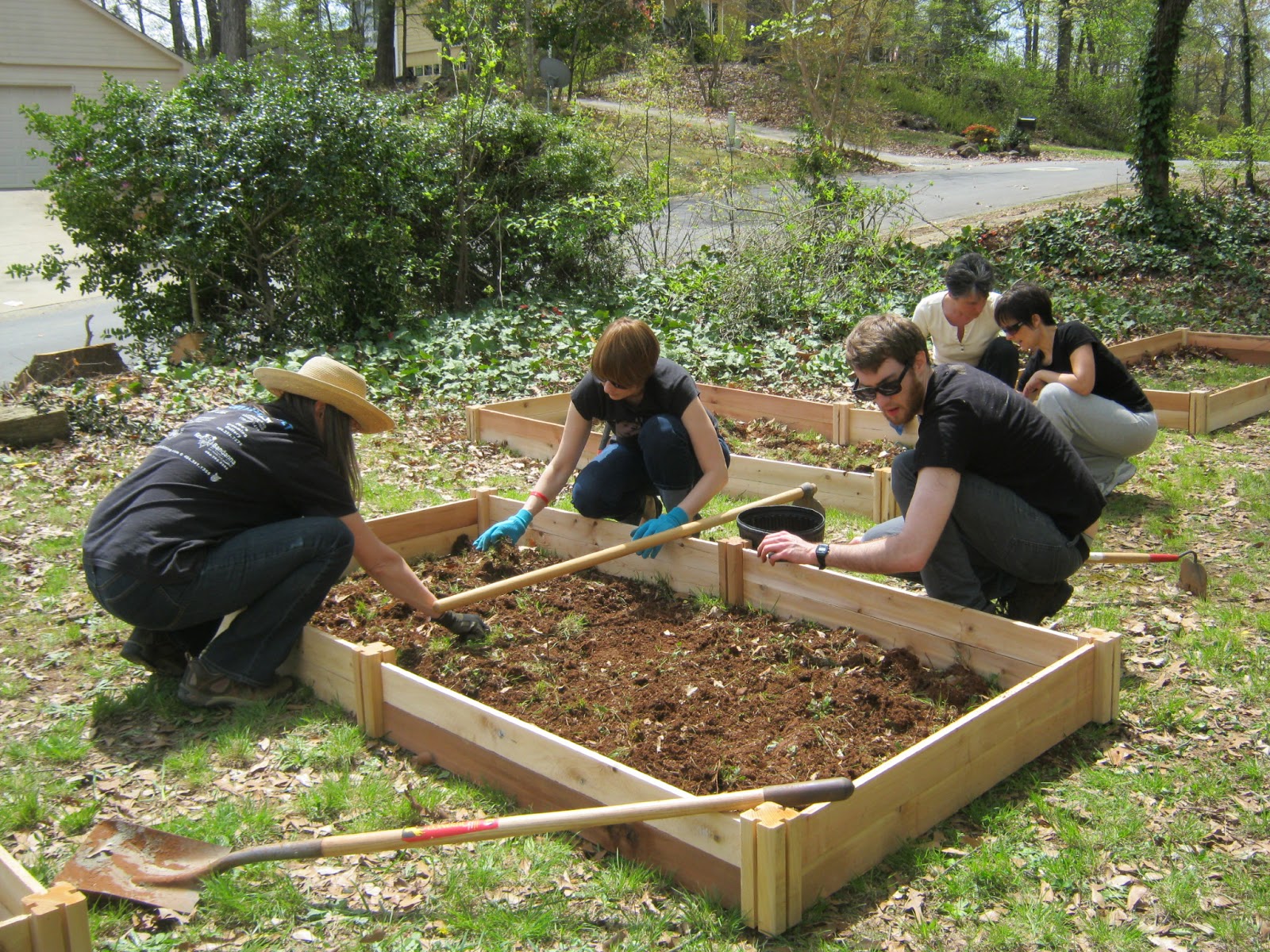
Saturday was sunny and warm, and I spent a large part of the day at the Georgia House Rabbit Society explaining and supervising the planting of raised beds for growing bunny salad.

The mainstay of the diet of domestic rabbits is hay (mostly timothy hay); bunnies also typically are given some pellets that are made of compressed hay with some nutritional supplements added, and bunnies also need some fresh food each day (the rabbit house has a list of good bunny foods on its website).

That fresh part of the diet can get expensive, which makes these new raised bed gardens a potentially great addition to the grounds of the rabbit shelter.

The completed gardens will serve not only as a source of food for the shelter's bunnies, but will also serve as an educational tool, to show new bunny-owners some of the foods that bunnies can eat and that these can be grown at home. 

First, of course, the volunteers who showed up to help put in the gardens had to assemble the beds.
 
One of the big home improvement stores had been having a sale on cedar, raised bed garden kits, and the shelter had bought six of the 4x4 kits for their new gardens.

The kits were designed to allow them to be joined together to create larger beds, and after some discussion and much pounding, we ended up with four 4x8 beds.

I had brought my grub hoe (a favorite tool!), and it was put to good use breaking up the soil in the beds. After the Very Compacted soil was loosened, the volunteers worked on getting the worst of the weeds out of the beds.
Then there was the job of moving all the good garden soil which the shelter had acquired. The soil - which was in two large piles in the yard - was wet and heavy from recent rains, but the volunteers were undeterred. It took some doing, but the beds finally were all filled with the soil.

Then we got to my favorite part - the actual planting. Most of the volunteers hadn't actually planted a garden before, so I showed them how to get the plants out of their pots with as little damage as possible, how to lay them out in the appropriate spacing, and how to set the plants into the ground.

We had transplants for anise hyssop, bronze fennel, parsley, cilantro, lettuces, radicchio, chicory, three different mints, and arugula. We left space for the basil, which needs slightly warmer weather.

I also taught some volunteers how to use the garden rake to make furrows for planting seeds, because we had seeds to plant, too.
We had seeds for more cilantro and lettuce, for radishes, and for peas (bunnies like the stems and leaves of the pea shoots). We also had some seeds for flowers that the bunnies won't be eating - they are just to help make the grounds look more attractive.

Some radishes had been planted in a "gutter planter" around the back deck, too, but I forgot to take a picture of that. One of the regular shelter volunteers had hung guttering around the outside of the railing for the back deck. He had drilled holes for drainage, so it could be used for a planter.

Since bunnies really like radish leaves, we had a small group of volunteers working in the back, filling the gutter-trough-planter with potting mix and then planting radish seeds. There should be plenty of radish leaves for the bunnies in just a few weeks!

A few of the day's volunteers were regulars with the rabbit shelter, but most were with an animal protection group called GARP. This was one of the activities they had chosen to help support other groups that protect animals.

The volunteers also worked on some additional projects at the shelter: they dug out the path to the garden and spread the gravel under-layment that will be the foundation for the bricks that will form the path, and they worked to pull out a very unattractive older planting of low-growing junipers (mixed with honeysuckle vines and assorted other weeds) that lined the front of the property. Then they replanted that area with daylilies and daisies. All of this involved hard, physical labor.

Over the course of the day, the group of twenty-or-so people got a lot done. It was great to see the huge change in the landscape in such a short time!

Monday, April 1, 2013

Wonderful, Beautiful, Productive Weekend

It's been a wonderful, beautiful, productive weekend at my house. One of the things I worked on was bumping up plants. Some of the seedlings (photo below) were a little small, but I wanted them to be in good shape for next Saturday. I'll be giving a talk for beginning gardeners at an event in Douglas County (see day-long veggies program here), and I wanted to bring some little plants to give to attendees.

My original plan was to bring sweet potato slips, but my sweet potatoes aren't cooperating. So far, I have only two sprouts poking up, and I am expecting more than two people to attend. The plants in this photo are  lettuces and dwarf French marigolds.


These were potted up with Faford mix and a little Osmocote. Not exactly organic, but this combination usually works.

Another part of the garden that we worked on this weekend is the bed right in front of the house. When the house was smashed by a tree last summer, the foundation shrubbery was smashed, too. At first, I had thought that I would replace the azaleas with gardenias, but then I thought that I could do something completely different.

We amended the first five foot stretch of compacted clay - lots of lime, compost, and "soil conditioner" - and moved a very large rosemary to that space.  I haven't worked out the whole rest of the bed, but we have a tree-form bay laurel (currently in a pot) that will go there, and if all goes well, I'll find a Provence Lavender to go in (the flower spikes are amazing!).

 Aside from a few evergreen herbs, most of the plants that will be planted in that space will be bee-friendly perennials. Then, when the shade hits that space in mid-winter, most of the plants will be safely underground.

The stretch that we managed to complete required some very hard work in breaking up the clay, so I am guessing that completing the rest of the bed take several weeks.

In yet more good news, the bulbs that were set under the pansies in the big flower pot are up! The daffodils haven't opened, but the three hyacinth bulbs are doing a great job of adding a little more color. The cheerful display brings me an inordinate amount of pleasure.

Hope everyone else's gardens are going well!

Monday, November 1, 2010

One (Almost) Tidied Garden Bed

I have been working a little at a time on getting the garden tidied up for winter, but I am about to run out of time. Our first freeze will be here in a week or two. Anything the least bit "tender" that's left in the garden when that happens is going to turn to mush. (Yesterday, that first freeze looked like it would arrive this weekend, but the forecast has changed since then.)

I worked on this bed over the weekend:


In the foreground is a patch of chard; to the right are potted herbs; to the left are some red-veined sorrel that are probably too small to see (a gift from Cheryl - thanks!); across the "near-back" are a couple of different varieties of chicories; and behind those are nasturiums (left) and thyme.

Everything except the nasturtiums - they will turn to mush - should do just fine all winter long, especially since the herbs are portable.

It may seem a bit odd that I've planted the pots of herbs (rosemary and bay), but there is a reason for this. Last year, we had an unusually long stretch of very cold weather, and some of our potted herbs didn't survive. They always had made it through the winter before, so I hadn't done anything to protect them. This summer, I had to replace the bay and the rosemary.

I could actually plant the herbs, but we like to have the bay on the back deck in summer, and planted rosemary can get very large here. The pot helps keep it in bounds. My thinking is that, this year, if a freakishly long freeze sets in, I can pop those pots out of the ground and put them in the garage for the duration. When the freeze ends, they can go back into their holes.

I know that a lot of people have good luck bringing their herbs into the house for the winter, but I am not one of those people. Indoor herbs die in this house.

Saturday, October 23, 2010

Horehound Surprise

One of the herbs in my garden is horehound. This is not a delicious culinary herb; it is a bitter, medicinal herb traditionally used as a treatment for coughs and sore throats.

When I was growing up, this is one of the bad-tasting medicines that my father brought out when I complained about a sore throat. If I had an unhappy tummy, he mixed a teaspoon of baking soda in a glass of water and told me to drink it. This tasted worse than horehound, which at least was in candy form, so there was the consolation of a little sugar. Needless to say, there were very few minor health complaints at our house. None of us wanted to risk the bad-tasting home remedies!

Weirdly enough, I have grown to like horehound (but not the baking-soda and water).


One year, I made horehound candy with my own horehound, but I didn't know that the pieces absolutely had to be individually wrapped. I've made other hard candies before (cinnamon and anise flavors) and they kept just fine in a jar. When I put my horehound candy in a jar, though, it merged into one solid mass in the jar in just a couple of weeks.

This year, I'm going to pass on the candy-making, and just use the leaves for tea. There is a lot of horehound, so I've put some leaves in the freezer, and some are set out to dry.

The job turned out to be a bigger adventure that I expected; when I was out in the garden snipping leaves off the horehound, I found carrots!


The horehound grew really well this year, flopping over the space where last spring's carrots came out. I had harvested all the carrots that I could see months ago, but the horehound seems to have sheltered some seeds that hadn't germinated with the rest of the crop. If I had been a better weeder, these probably wouldn't have made it to maturity!

Monday, December 28, 2009

Some Garden Economics

Today I made rosemary focaccia using the recipe from the blog Stephen Cooks. I heard about the recipe first, though, through Farmgirl Fare.

The rosemary I used was from my yard, and it’s a good thing that my plant is large, because the recipe calls for 4 tablespoons of chopped rosemary. Until I saw the growing pile of stems on the counter, I didn’t realize how many little leaves it was going to take to get to 4 tablespoons of chopped herb. However, chopping the leaves was more fun than I expected.

Since rosemary from the grocery store costs $1.99/oz, for the kind that isn’t grown following organic farming practices, this is one of those times when growing my own saves money in addition to tasting great.

The Cheap Vegetable Gardener reported in his blog last winter about some research he did into the economic value of garden crops, and his study showed that herbs and salad greens in general give a good dollar return on the space they take up.

To calculate economic values, he used someone else’s list of production values per square foot for the different crops and then went to his grocery store (Safeway) to find prices for the organically grown versions of the crops to use in calculating monetary production per square foot of garden space.

Of course, rosemary isn’t on the list of garden crops that were evaluated, probably because it is a perennial shrub that isn’t usually included in food gardens, but plenty of other herbs are on his list.

While his method of determining values may not be the way Arizona Extension conducted their research into the economic value of garden crops, and the list likely isn’t perfect for every gardener since the data for production per square foot are from Seattle (P-Patch garden) and prices per unit of veggie/herb vary somewhat across the country, The Cheap Vegetable Gardener’s list is fairly extensive and provides information that can be used by ordinary gardeners in making decisions about what to grow when dollar value of the food produced is an important factor in choosing what to grow.

The Cheap Vegetable Gardener’s list (note that prices in some cases are for ounces rather than pounds):

“Vegetable USD Value/SF
Cilantro $ 21.20
Arugula-Roquette $ 20.92
Green Salad Mix $ 17.55
Chives $ 16.40
Dill $ 16.40
Lettuce $ 16.20
Tomato, Cherry, small & medium $ 15.57
Turnip $ 9.90
Tomato, large $ 9.50
Squash, Winter $ 8.40
Tomatillo $ 8.00
Cucumber $ 7.74
Basil $ 6.63
Radish, Red $ 6.22
Pumpkin $ 6.20
Chard, Swiss $ 6.14
Celery $ 6.00
Squash, Summer $ 5.96
Choi $ 5.70
Peas, Snow $ 4.50
Pepper, JalapeƱo $ 4.50
Squash, Summer, Zucchini $ 4.17
Onion, Bunching $ 4.14
Pepper, Bell $ 3.60
Brussels Sprouts $ 3.59
Carrots $ 3.56
Rhubarb $ 3.25
Squash, Winter, Butternut $ 3.20
Kale $ 3.07
Grass, Lemon $ 3.00
Peas, English $ 3.00
Onion, Bulb $ 2.63
Radish, White $ 2.60
Bean, Bush $ 2.51
Peas, Edible Pod $ 2.50
Artichoke, Globe $ 2.40
Cabbage, Chinese Napa $ 2.24
Squash, Winter, Delicata $ 2.10
Spinach, Spring/Fall $ 1.80
Leeks $ 1.75
Potatoes $ 1.50
Parsnips $ 1.50
Garlic $ 1.37
Squash, Summer, Yellow $ 1.34
Parsley $ 1.31
Corn $ 1.25
Squash, Winter, Acorn $ 1.20
Squash, Winter, Hubbard $ 1.20
Eggplant $ 1.10
Greens, Mustard $ 1.10
Rutabaga $ 1.00
Beet $ 0.89
Cabbage, Savoy $ 0.80
Broccoli $ 0.80
Kohlrabi $ 0.75
Cauliflower $ 0.60
Broccoli, Chinese $ 0.60
Cabbage $ 0.50


Now, most of us are not going to live on, say, cilantro alone, so some common sense will have to be used along with the list in making decisions, but I am glad to have confirmation that the bits of space in my garden given over to herbs like parsley and cilantro are space well-used in economic terms.

Wednesday, October 28, 2009

Saffron


Many herbs are useful enough to deserve some dedicated space out in the yard, and this pretty purple flower is one of the herbs I give space to; it is a saffron crocus. The saffron crocus in the picture has come up in a space other than the one I planted it in, the way bulbs do around here. It is under a blueberry bush, along with a whole lot of sheep-sorrel that I need to pull up!

One great feature of the saffron crocus is that, in my yard anyway, it appears around Halloween, reliably, when other plants are shutting down and turning into masses of dead foliage. The flowers are a welcome sight.

The parts used in cooking are the stigmas, the three, bright red, thread-like bits that are the female parts inside each flower. To harvest, I just pick the stigmas out by hand and dry them on a paper towel for a few days before storing.

The plant itself really is a type of crocus, growing from similar corms, with similar planting depth and spacing, and it does best in zones 6-8 here in the Southeast. In colder areas, the corms might not survive the winter. The White Flower Farms website shows that, in the Western U.S., the best growing zones are 6-9.

I tend to think of saffron as a Mediterranean, near-Eastern, and Asian spice, but this article from the Kitchen Gardener magazine archive made available through the Vegetable Gardener website explains that saffron has been used in Lancaster County, PA, for a very long time as an important ingredient in many foods—one familiar example is chicken potpie.