Showing posts with label pollinators. Show all posts

Sunday, August 20, 2017

Pollinator Symposium, September 23

Most gardeners have a pretty good idea of how much their gardening success depends on insect-visitors to the garden that pollinate our garden crops. Without those pollinators, we would have less good food to eat!
Monarch Butterfly laying eggs on Swamp Milkweed. PHOTO/Amygwh

Learning more about the many kinds of pollinators, how to attract them, and how to protect them, can help us all keep that good food coming into the kitchen.

An upcoming Pollinator Symposium, set for September 23 at the Monastery of the Holy Spirit in Conyers, GA, will provide an opportunity for us to learn more. I am on the Monarchs Across Georgia committee that is organizing the symposium, so I will be there, of course.

Even though this will not be a veggie-focused event, I am looking forward to learning more and figuring out how to apply the information in my own yard.

Speakers include Sonia Altizer, from UGA, on Monarch Butterflies; Nancy Lee Adamson, from the Xerces Society and USDA, on native bees; Kim Bailey, from Milkweed Meadows Farm, on hummingbirds; and Keren Giovengo, UGA Marine Extension, on gardening for pollinators.

After the talks, there are additional activities for participants to engage in. Options include butterfly walks on the grounds of the Monastery, led by Phil Delestrez of Georgia Parks and by Father Francis Michael Stiteler of the Monastery; a nature walk led by Robby Astrove, Park Ranger at Davidson-Arabia Mountain Nature Preserve; Monarch butterfly tagging with Monarch Watch; and learning to participate in a citizen science project with Project Monarch Health.

Registration is $75 (a lot, I know), and the registration deadline is September 16. The Monastery conference center is not huge, so space is limited. If you are interested in attending, registering soon, through the Monarchs Across Georgia Events page online, would be a good idea.

The registration fee includes a box lunch and one-year of membership to the Environmental Education Alliance.

The Monastery will have milkweed and other plants-for-pollinators for sale at its Abbey Garden Store.

I am looking forward to spending the day learning from experts and hanging out with gardeners and others (foodies, maybe?) who want to do more to support our pollination helpers!

See you there?

Tuesday, August 15, 2017

Starting Again in August

New little patch of Joanie Beans, for a late crop. PHOTO/Amygwh
My little patch of the heirloom Joanie Beans, planted a couple of weeks ago, has come up. If all goes well, the plants should start providing beans for our meals before the end of September.

It is very strange to have spent so long away from the garden and to not have summer crops coming in from the yard. We are visiting the local farmers market for many of our veggies instead, and that is a very good substitute, but I do like to grow some our our own food.

In the good-news category, my friend Cheryl has been helping a local farmer, Lynn, at her weekend market booth, for several years, and she gets to take home a box of leftover veggies after the market closes on Sunday.

This past Sunday, my friend shared some of those veggies with us, so my dehydrator is full of chopped peppers and sliced tomatoes. Thank you Friend Cheryl and Farmer Lynn!

Caterpillar of a Monarch Butterfly on swamp milkweed. PHOTO/Amygwh
To make sure that at least some of my veggies this fall come from the yard, I already have started a batch of seeds in a tray. I will be starting more this weekend, since seedlings are often eaten by pests, burned up in the hot sun, or pounded to smithereens in summer storms, which makes growing some extra a good idea, but I am happy to have made the start.

In the first tray, there are a few each of kale, winter radishes, mini bok choy, beets, and collards, and a short row of green bunching onions. The next tray will have more of the above, plus lettuces. I won't start the spinach until in September, because it is so finicky about hot weather.

More good news - my milkweed is doing exactly what I hoped it would do: host some monarch butterfly caterpillars. Of course, there are also a bunch of weird orange aphids and milkweed bugs, but the caterpillars were the goal, and they are there.


Thursday, May 4, 2017

Supporting Pollinators

Without pollinators, our meals would be a lot less interesting. Fruit and vegetable options, in particular, would be much more limited, and some of those that provide flavor to almost every dinner would be gone from the table. (Unless I am the only one who cooks with carrots and onions pretty much every day?)

One way I have chosen to support pollinators, besides gardening organically and avoiding the use of even organic pesticides, is to participate in a group called Monarchs Across Georgia. Even though the group focuses on one special insect, the practices it advocates help a whole lot more pollinators than just Monarch Butterflies.

On Saturday, May 13, the group will be selling native plants that support pollinators at the Wildlife and Rain Garden in Marietta. Naturally, native milkweeds, food of Monarch caterpillars, will be featured. The sale is in conjunction with the Annual Garden Tour of the Master Gardener Volunteers of Cobb County. Buying tickets for the tour is not a requirement for stopping by the Wildlife and Rain Garden to buy some milkweed, but the tour is always great. For information about the tour, see the website of the Cobb Master Gardeners.

Plant sale details:

Cobb County Rain and Wildlife Garden
Saturday, May 13, 2017
10am - 5pm
Cobb County Water System's Wildlife & Rain Garden
662 S Cobb Dr, Marietta, GA 30060

Also, be sure to save the date for a screening of "Flight of the Butterflies". This film shows the annual journey of the millions of Monarch Butterflies, telling how the mystery of where these butterflies go each fall was solved. Reservations for the movie can be made through the Events page of Monarchs Across Georgia.  If you missed the chance to buy native milkweeds in May, there is another chance at this event, in the theater foyer after the showing. 

Details here:

Saturday, June 17, 2017
11am to 12:15pm
Midtown Art Cinema
931 Monroe Drive NE, Atlanta, GA 30808

The movie will be shown  in celebration of National Pollinator Week. Your price of admission is a donation to the Environmental Education Alliance of Georgia. Seating is limited.


Tuesday, March 14, 2017

'There Never Was a Spring Like This'


Peach flowers opened in February. PHOTO/AmyGWh
The flowers pictured to the right were on a peach tree at the community garden on the grounds of a church in Marietta. I took the picture a couple of weeks ago, at the very end of February.

On warm-enough days, I sometimes take my lunch to eat at a picnic table by that garden. It isn't too far from the office, and it is a beautiful place.

These flowers are beautiful, too, but I was not as happy to see them as I might have been in another spring.

The problem is that the flowers opened too soon, triggered, I would guess, by a February that felt a lot like April. Unfortunately, we are about to have two nights in a row of temperatures around 25 degrees F.

Even though bees and other tiny insects buzzed all around the open flowers, working their pollinator magic, the little fruits forming as a result of that work are at a high risk of damage from the impending cold. Apple and plum trees in my neighborhood have done the same thing, blooming too soon.

This is one of those times when I think of the poet Countee Cullen, and the poem that starts "I cannot hold my peace, John Keats; There never was a spring like this." Of course, he meant it differently, but this is definitely a spring that I have not seen before.


Tuesday, June 7, 2016

A Movie for Pollinator Week (3rd week in June)


One aspect of vegetable gardening that sometimes surprises new gardeners is finding out that many insects and other small creatures provide important support to the garden's health and productivity. Most gardeners are not "in it" for the bugs! 

However, as a gardener,  I have learned a whole lot about insects and other critters. Some of these are pretty strange-looking and may seem a bit unlovable, but quite a lot of people appreciate the beauty of butterflies. 

Monarchs Across Georgia, a group that has a mission to study Monarch butterflies and restore butterfly habitat, is hosting a viewing of the Disneynature movie Wings of Life as part of its celebration of National Pollinator Week. The movie, which is rated G, runs 77 minutes.

To defer costs, the group is asking for a donation to the Environmental Education Alliance of Georgia (the group's "parent").

The movie will be shown on Saturday, June 25, 11:00 a.m., at the Midtown Art Cinema in Atlanta (931 Monroe Drive, NE, 30308). A theater seat can be reserved online.

The description of the movie included in the ad-copy on the MAG website is this:

Released as part of Walt Disney Studios' Disneynature banner, filmmaker Louis Schwartzberg's documentary employs macrophotography in order to show moviegoers a world they have likely never experienced. The secret lives of bats, butterflies, hummingbirds, and bumblebees come to life before our eyes as Schwatrzberg and his talented team highlight how the determination and interdependence of these diminutive creatures keep our chaotic world in balance.

An Educator's Guide webpage for the movie offers a download-able activity booklet and lessons designed for grades 2-4, and additional film clips are available there, too.  


At the theater, native Georgie milkweeds, the host plants of the Monarch butterfly, will be available for purchase.

See you there?
 

Wednesday, November 4, 2015

Fruit of the Season, Beautiful Fruit

Ichi Ki Ke Jiro, fruiting abundantly. 

Where there are no pumpkins...
The yard keeps tossing food our way, and we keep enjoying it. It doesn't hurt that some of the food is lovely to behold.

The orange fruits of the Asian persimmon are some of the loveliest. They will show up even brighter when the leaves have fallen, but they already are very visible against the dark green foliage.

When we were trying to decide "what to do about decorating a pumpkin" this year, we ended up decorating a few of our persimmons instead, because we have lots, and they are orange.

The original plan was to just paint scary faces on a couple, then set them out by the door to stand-in for jack-o-lanterns. Joe carved one, though, and he found that the fruits already are delicious.

On Halloween, a few of our neighbors even realized that our "jacks" were persimmons!

We have not yet had a frost in our yard, but one of my friends just a little further north, in Canton, GA, has woken up to a frosty yard twice so far this fall. The distance between our homes is not huge, but there is a lot of cooling woodland in between; my town is more nearly continuous with the enormous heat-sink that is Atlanta.
One of many bees, happy that the salvia still blooms.

The local bees are happy with our current frost-free state, because flowers are still everywhere. When the first frost hits, the bees will have a bit more trouble finding pollen and nectar, because the masses of salvia and zinnia currently blooming in our yard will be gone.

Luckily for the bees, we have plenty of other plants in the yard that will bloom most of the winter, including chickweed, violets, and dandelion. Our weedy lawn supports a lot of pollinators!

Meanwhile, we have gotten so much rain that the ground is mushy. I am glad that I set my new strawberry plants in garden beds that are mounded up a bit above ground level, because those shallow-rooted plants do  not do well in soggy conditions. So far, they all look good.

From the rest of the garden, we are bringing in lettuces, kale, a whole rainbow of radishes, bok choy, cilantro, parsley, and beets, and we still have one pepper plant (a "chocolate bell") providing fresh peppers. The spinach is a bit small for bringing in, as are the cabbages, broccoli, and carrots.

I hope that all is well in other gardens!

Saturday, June 20, 2015

Eye of the Beholder - Bumblebee Love and Garden Update

Bumblebee on dahlia that also has fed thrips and Japanese beetles.
The bumblebee in the picture to the right doesn't care that the petals of the dahlia have been ruined by thrips and Japanese beetles. The bee is after the abundant pollen, and the petals are relatively unimportant compared to the sweet spot in the center of that amazing flower.

Wednesday, June 10, 2015

Insect Activity This Week

Insect activity in the garden can be good, and it can be unwelcome, depending on the insect. This weekend, I made the first sighting of the season of a most unwelcome moth, the squash vine borer. She is pretty, but her babies devour the insides of squash vines, eventually leading to the demise of the plants.

Squash vine borer adult. The red can be viewed as a warning to gardeners!

Saturday, April 11, 2015

What's In Season Now?

Onion family crops to harvest in June.  Tulip to enjoy now.
I spoke with a guy last week who was looking for farm-fresh produce for a project at a local Senior Center. He was hoping for tomatoes and corn, and it was hard to get across the idea that those crops are not currently in season.

When we finally had that notion sorted, he asked about yellow squash. Let me just say now that the conversation went on in that vein for several minutes.

Monday, August 25, 2014

Pollination Station at a Hummingbird Banding Event

On Saturday morning, I helped at the "Pollination Station" at the Hummingbird Banding event at Smith Gilbert Gardens in Kennesaw. Earlier in the week, an email plea for additional help had landed in my inbox, and I jumped right in. This was an upbeat way to close what had seemed like an unusually hard week at work.

Alan, Master Gardener volunteer, is in the green shirt.
Alan, one of our Master Gardener Extension Volunteers, had put together the display, and another volunteer had helped him with the laminated photos. I brought Extension information to give away.

Hummingbird banding was going on under the tent near the flags.
UGA has a lot of great publications about pollinators, both native and imported (honeybees); it also has a nice publication about attracting birds. These were all big hits with people who stopped by our area to learn more about pollinators.

Clemson Univ. Extension has a publication about creating an inviting environment for hummingbirds, and I was able to bring copies of that, too.
Many of the younger crowd went away with colorful hummingbird "tattoos."

Kids also made these cute little hummingbirds to take home. The body is a peanut.
Based on comments from people who stopped by with questions about pollinators, plenty of people are ready to do what they can to support pollinators. It was great to visit with so many people about bees, wasps, butterflies, bats, birds, flies, beetles, flowers, and more!

The event had plenty of activities for the younger crowd, including hummingbird "tattoos," a learning table, and a couple of "make your own" hummingbird crafts.

The craft that I hadn't seen before involved making little hummingbirds out of peanuts. They were super-cute! I was told that a lot of adults wanted to make these, too, but there weren't enough prepared peanut bodies for more than just the kids to make these.

The peanuts had been pre-painted with white paint, a toothpick had been stuck into a hole to be the beak, and little tulle wings had been tied with twine and hot-glued on. The kids needed to determine whether their bird would be male or female, and paint the peanut accordingly.

The very last picture in the set is included for my Mom, who needs to use her walker more. She has a hairline fracture in her lower leg that resulted from a fall a couple of weeks ago.

Several people made use of walkers at the event. They were well-prepared for the uneven ground and a morning outside in the August heat.


Sunday, August 17, 2014

Harvesting Summer to Make Room for Fall

About 2/3 of my butternut squash harvest.    PHOTO/Amy W.
It's been a busy weekend in the garden. To start, I harvested most of the remaining butternut squash. Six had already been brought inside, because the vine they were on looked "done."

These in the photo to the right were also on some pretty dead-looking vines, but there are three more immature butternut squash out in the garden. After tracing their vines so I could determine whether they had a chance of further ripening, I left their vines behind when I removed the other, browned-out plants. So far, I have brought in about 25 pounds of butternut squash. That has opened up some space in the garden.

Browned vascular tissue caused by a tomato wilt disease.  PHOTO/ Amy W.
I also harvested all the remaining Amish tomatoes, even the green ones. In last week's post I had mentioned that the plant had a lot of yellowed, drooping foliage, and it was time to pull up that plant.

After slicing through the stem to check on what had caused the trouble, it was easy to see the gunked-up vascular system, which often is caused by Fusarium wilt. A healthy stem would have been white or whitish-green all the way through, rather than being ringed inside with brown!

As space has opened up in the garden, I've planted some more seeds. Today I planted some kale, collards, lettuces, nasturtiums, and English peas. If they don't do well from seed at this time, it won't be a disaster, because I have started some of those in a flat already.

Caterpillar of the Gulf fritillary butterfly.  PHOTO/Amy W.
The English peas are part of yet another experiment. I harvested most of the popcorn, and as I was cutting the stalks down to chop up for the compost pile, I decided to leave them cut at about 3.5-4 feet high, for peas to climb up. The peas are planted in the rows between the cornstalks. It will be interesting to see how that space goes as the summer/fall progresses.

Elsewhere in the garden, we have some surprisingly unattractive caterpillars. They are dark orange with black spines, and they are busy defoliating the passionflower vine.

Bees loving a passionflower to smithereens. PHOTO/Amy W.
The caterpillars are the babies of the Gulf fritillary butterfly which also is orange, but it seems a lot prettier.

The passionflower vine is getting a lot of insect activity. In addition to being host to the spiky caterpillars, it also is host to some big, shiny carpenter bees that spend most of their days, it seems, loving on the purple flowers.

All that bee-loving action has resulted in the formation of a lot of "may-pops" on the passionflower vines. I am looking forward to trying those fruits!

Tuesday, December 24, 2013

Dahlias for the Bees

One of my friends grew a lot of dahlias this past year. When she dug them up to store for the winter, the ones she liked the least - all the cactus-flowered yellow ones - had produced more tubers than she was willing to keep.

However, those had nice, open centers that had made the flowers a favorite with bees, which meant she would be able to find a good home for the tubers without too much trouble. Lots of people want to help bees!

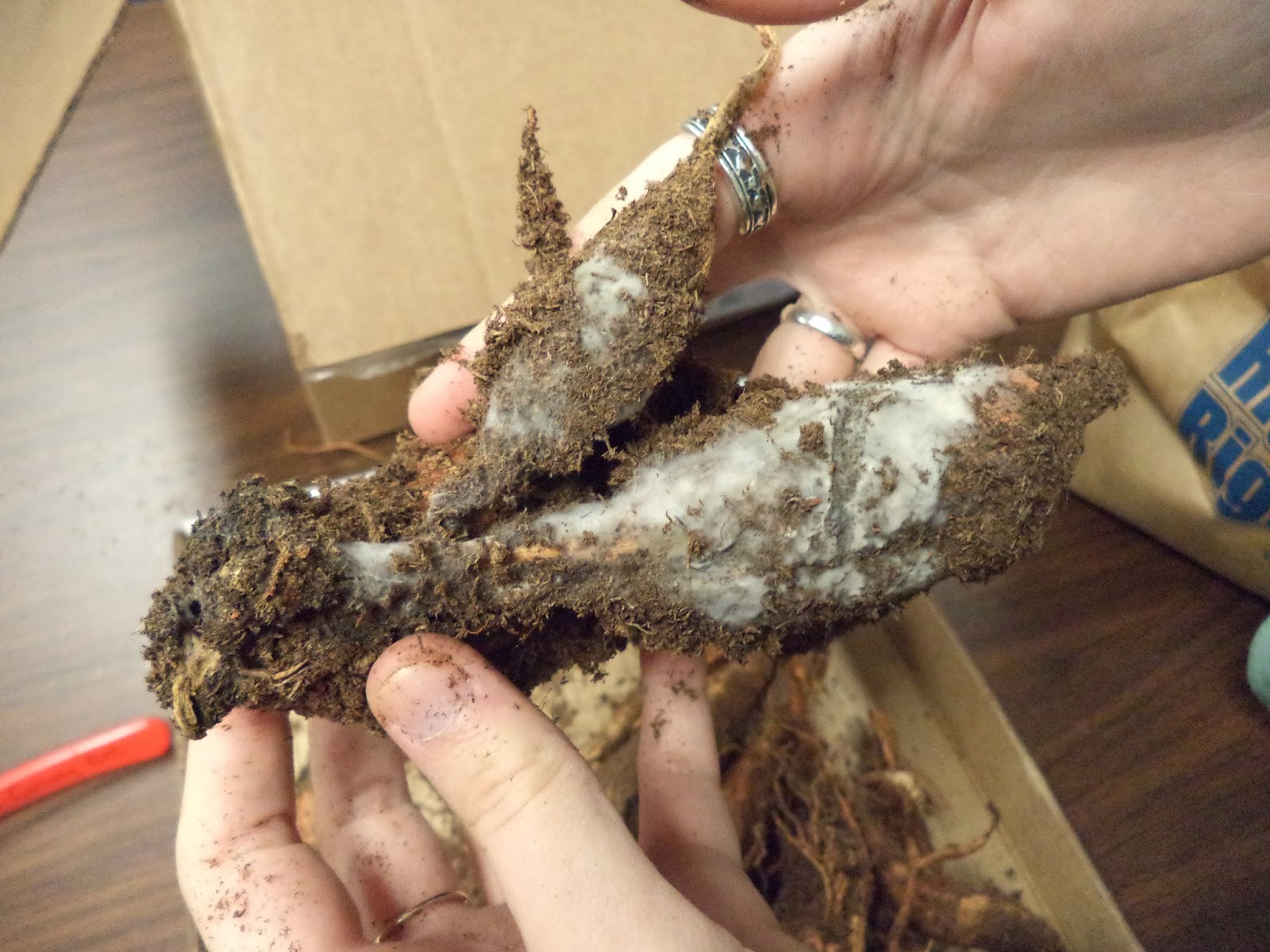
She tucked the tubers from those yellow-flowered plants into paper bags with peat moss, then put those in the car to deal with later. A month went by before she was able to pass them along. By the time the tubers made it to the office, some of them had developed problems. Luckily, a local dahlia expert -- my friend Maddie -- was in the office at exactly the right time. Of course, she was supposed to be working on her Senior DPA portfolio for 4-H!

It didn't take long for Maddie to sort through the tubers, trim away excess bits, and toss the bad ones.

Each bag held several plants'-worth of tubers, buried in the peat moss.

Some of the dahlia tubers were very obviously too far gone to keep.


She showed us the slimy innards of a tuber that had felt only a little bit soft from the outside.

This little dahlia tuber already has a nice big eye; it's a keeper!
One of the great things about my workplace is the number of plant-experts who stop by. We get to learn from all of them!

Tuesday, November 12, 2013

Where the Pollinators and Predators Hang Out

The picture below isn't from my yard. Joe and I walked around our local park last Saturday, and there were butterflies, bees, wasps, and other great insects on all the flowering weeds.

Not my yard, but great to see a Monarch butterfly near home
It made me wonder how much my own garden's success depends on the city's not mowing edge-to-edge in my local parks.

When food gardens have a problem with low productivity, it sometimes can be traced to a scarcity of pollinators. A lot of newer neighborhoods are border-to-border monoculture lawns. These yards are pretty low on habitat that would support useful populations of pollinators and other beneficial insects.

Most gardeners understand that this is a problem, and they follow guidelines like those in  UGA's publication Beyond Butterflies: Gardening for Native Pollinators to plant small-flowered herbs and other pollen-and nectar-rich flowers that attract pollinators and useful predators, but if the insects don't have a good place to reproduce and to survive the winter, there might never be an abundance of these useful critters.

My garden crops typically don't have a problem with lack of pollination, and there seem to be plenty of great predatory insects, too, but, like all those other gardeners, I do what I can to attract a diverse community of insects and other small creatures to my own yard. Also, I am lucky in that my yard backs up to a small patch of woods and that it has a creek -- with associated native vegetation -- running along one side. I am sure that all helps.

According to a recent article posted at Southern Region IPM News, The Right Habitat and Food Source Key for Beneficial Insects, that describes findings of entomologists at North Carolina State University, the parasitic wasp Telemonus podisi (it kills stink bug embryos) overwinters more often in leaf litter than in cracks of tree bark:
“The number of parasitic wasps, for example, was four times greater in leaf litter than those overwintering in tree bark,” said Lahiri. “This data, combined with lab studies, suggest the importance of woodland field borders with leaf litter from hardwood trees as a refuge area during winter for the parasitoids.”
I do have some woodland edge, but -- even combined with the right garden flowers -- the wild spaces in my one yard may not be enough to support all the beneficial insects that help out in my garden.

Wouldn't it be something if the unmowed and uncleared edges of city and county parks were the best refuges for our beneficial insect populations?


Sunday, April 14, 2013

Where Do Bees Come From?

Where do bees come from? A box! Pictured below is the box containing our first very-own bees.

Our First Bees
I got a phone call from the post office on Thursday morning, and at the other end of the line a nice lady, in a somewhat tense voice, asked that I please come pick up my bees as soon as possible. Now, actually. Right now.

So I went around to the back door of the post office as instructed and rang the bell, and the one person in the post office who WASN'T freaked out by the bees came to the door. It turned out that the bees were on a shelf outside, because they weren't especially welcome inside. The bees were just as you see them above, in a part wood, part screen container, so it was easy to see (and hear!) all the activity in there.

Joe built a top-bar hive last year to begin our beekeeping adventure, but he was out of town when the bees arrived, which meant that I had to open the box and put the bees into the hive myself.

I had a bee veil that went over a hat, and I put on one of Joe's long-sleeved white shirts and a pair of garden gloves for the big event.

The hardest part was prying the can of sugar-water out of the big hole at the top of the box. The can fit just exactly into the hole, so every time I pried up one bit of the edge, the opposite side slipped down into the box.

I finally got it, though, and was able to pull out the little cage that holds the queen. I hung her up in the hive, then poured all her little worker friends into the hive. They didn't all want to leave the box, so I left it right near the hive entrance, to make it easy for them to find their new home.

When Joe got back into town on Saturday evening, we went to check on the queen. She hadn't made it out of her little cage yet (the exit was blocked with a sugar-cube that the bees are supposed to eat through to release her), so Joe finished poking an exit-hole through the cube for her. A quick look around showed that the bees had been making comb, and we think that's a good sign.

Today, the bees all seem to be still there, which is good news. Sometimes a batch of bees will decide to find a different home than the one they were dumped into, and that would mean we'd have to start over with a new batch of bees. Wish us luck?

Monday, April 1, 2013

Wonderful, Beautiful, Productive Weekend

It's been a wonderful, beautiful, productive weekend at my house. One of the things I worked on was bumping up plants. Some of the seedlings (photo below) were a little small, but I wanted them to be in good shape for next Saturday. I'll be giving a talk for beginning gardeners at an event in Douglas County (see day-long veggies program here), and I wanted to bring some little plants to give to attendees.

My original plan was to bring sweet potato slips, but my sweet potatoes aren't cooperating. So far, I have only two sprouts poking up, and I am expecting more than two people to attend. The plants in this photo are  lettuces and dwarf French marigolds.


These were potted up with Faford mix and a little Osmocote. Not exactly organic, but this combination usually works.

Another part of the garden that we worked on this weekend is the bed right in front of the house. When the house was smashed by a tree last summer, the foundation shrubbery was smashed, too. At first, I had thought that I would replace the azaleas with gardenias, but then I thought that I could do something completely different.

We amended the first five foot stretch of compacted clay - lots of lime, compost, and "soil conditioner" - and moved a very large rosemary to that space.  I haven't worked out the whole rest of the bed, but we have a tree-form bay laurel (currently in a pot) that will go there, and if all goes well, I'll find a Provence Lavender to go in (the flower spikes are amazing!).

 Aside from a few evergreen herbs, most of the plants that will be planted in that space will be bee-friendly perennials. Then, when the shade hits that space in mid-winter, most of the plants will be safely underground.

The stretch that we managed to complete required some very hard work in breaking up the clay, so I am guessing that completing the rest of the bed take several weeks.

In yet more good news, the bulbs that were set under the pansies in the big flower pot are up! The daffodils haven't opened, but the three hyacinth bulbs are doing a great job of adding a little more color. The cheerful display brings me an inordinate amount of pleasure.

Hope everyone else's gardens are going well!