There is a lot of confusion about the availability of Genetically Modified (GMO) seeds for use in home gardens. The source for some of that is a misunderstanding of what hybrid seeds are as compared to GMO seeds.
In hybrid seeds, the patented genetics are a result of crosses created by moving pollen from one variety of a particular species of a plant to the stigma (female part) of a different variety of the same kind of plant. For example, the pollen from a disease resistant tomato plant might be placed on the female flower parts of another kind of tomato that has better flavor, resulting in seeds that reliably become disease resistant plants that make tasty tomatoes. This is a controlled version of something that could actually happen in nature.
In genetically modified seeds, bits of DNA from one kind of organism are spliced into DNA of another completely different kind of organism. For example, a bit of bacterial DNA might be added to the DNA of corn, with the goal of managing a persistent problem with corn ear worms in a way that requires a lot less pesticide than usual.
Since the process for development and production of the GMO seeds is costly, the companies that make these seeds have placed all kinds of restrictions on how they are sold and managed. Farmers who want to grow these seeds have to sign great piles of paperwork and promise to not save seeds to grow for next year's crop. I have a hard time imagining that this level of control is going to be feasible in the market of home gardeners. We tend to be a little unruly and to not always follow instructions!
However, we could end up growing GMO crops by accident. Several seed companies that sell to the gardening public have taken a "safe seed pledge," and they are testing their seed for inclusion of GMO contamination. Baker Creek Heirloom Seeds reports (in its 2013 catalogue) that it has found GMO contamination in some batches of garden crop seed (that it then rejected).
Technically, it probably would be illegal to grow that seed, even if the genetically engineered parts were there accidentally and unknowingly, because those special genetic combinations are owned by the corporations that developed them.
Any gardener looking to avoid growing GMO crops should probably buy the most-likely-to-be-affected seeds from a company that is testing seeds specifically for that accidental contamination. I've been looking for a comprehensive list of GMO crops currently being grown and haven't found one, but I do know that the list includes corn, soybeans, beets, zucchini, potatoes, rice, wheat, eggplants, canola, cotton, alfalfa, plums and papayas (not really row-crops), and probably more.
Many of these are not being grown in people's yards, but gardeners sometimes grow some pretty odd things. I , for one, have grown both rice and wheat, just for the experience, and alfalfa is sometimes used as a long-term cover crop.

Monday, January 28, 2013


Wednesday, January 23, 2013
Garden Update
Last week we had a series of wet days that resulted in our getting about 4 inches of rain. I am hoping that the deeper soils are benefiting from all that moisture! This week, though, we were supposed to have actual winter - with overnight lows in the low twenties.
On Monday, having seen the forecast, I spent a little time getting the garden ready. There is second a patch of broccoli that was planted very late, and the plants never did get very large, but they all finally developed little heads of florets on top. Temperatures in the low twenties likely would have damaged the little heads, so I harvested them. I didn't want to lose the good food, even though it wasn't much. If these plants had been purchased only for food, this would have been a total bust in terms of payback, but these plants were used in a demonstration about raised bed gardening, so I'm not especially unhappy with the outcome. The plants were dual-purpose! Even better, the little harvest provided some very tasty broccoli for last night's stir-fry.
 We've been getting fairly continuous harvests of side-shoots from the earlier-planted broccoli, but on Monday I pulled that all up. Over time, the flavor of the little shoots on these older plants had declined, becoming less sweet and more sulfur-y (not a word, I know). Since outstanding flavor from food in the garden is important, deciding to pull the plants up wasn't hard.
I also harvested the last of the cabbage. There were six small-ish heads all in good shape, and two that should have been harvested a week or two back. The outer leaves on those two had gone brown and a little slimy.
Sometimes, it can be hard to know when to harvest a crop -- the inclination is to leave it out in the garden just a little longer, so the plants can develop just a little more -- and I certainly fell into that trap with regard to the cabbage this year.
 However, we only lost two cabbages. The rest are now either in "cold storage" (in the garage) or in the big fermenting jar becoming sauerkraut.
The only plants I covered up in advance of the forecast cold are the beets. I really like the tops for greens, and I didn't want them to turn mushy/slimy in the lower temperatures.
 The garlic is growing well, and it didn't need any cold protection. The shallots and multiplier onions are also up and cheerily green, and a later planting of carrots, the winter radishes, some spinach and a bit of lettuce (that's started to turn bitter), one plant of Swiss chard, one plant of Kale, and an interesting assortment of weeds are all still providing variety in the meals of ourselves and of my bunnies. I'm not especially keen on bitter lettuce, but Moonpie and her babies love it!
As it turned out, the forecast actual winter failed to arrive. If the lack-of-really-cold-weather keeps up, we all will need to brace ourselves for another buggy and disease-filled gardening year.
 Meanwhile, indoors, I am planning for spring. I've been putting seed orders together, and the orders include what seems like a crazy number of packets for such a small gardening space, but when I look back over the lists of everything I've harvested in the past year the numbers seem more reasonable.
I'm also planning a seed-starting talk that will be given in February, and I am making decisions about varieties to bring to that talk, too (there will be a hands-on activity for people who show up). Have I mentioned lately that I love my job? It lets me think about gardening and plants pretty much all the time!
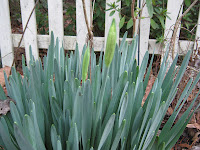
Like last year, the daffodils have decided to herald the beginning of spring in January. I do enjoy the sunny flowers, but it's a bit discombobulating to see them so near bloom so early in the year.
They aren't alone in acting as though we are nearing February's end rather than January's end. Leaves of the Spanish bluebells are several inches high, and one of my hardy amaryllis has pushed leaves up into the air, too. Looks like we could have another very interesting gardening year!
On Monday, having seen the forecast, I spent a little time getting the garden ready. There is second a patch of broccoli that was planted very late, and the plants never did get very large, but they all finally developed little heads of florets on top. Temperatures in the low twenties likely would have damaged the little heads, so I harvested them. I didn't want to lose the good food, even though it wasn't much. If these plants had been purchased only for food, this would have been a total bust in terms of payback, but these plants were used in a demonstration about raised bed gardening, so I'm not especially unhappy with the outcome. The plants were dual-purpose! Even better, the little harvest provided some very tasty broccoli for last night's stir-fry.

I also harvested the last of the cabbage. There were six small-ish heads all in good shape, and two that should have been harvested a week or two back. The outer leaves on those two had gone brown and a little slimy.
Sometimes, it can be hard to know when to harvest a crop -- the inclination is to leave it out in the garden just a little longer, so the plants can develop just a little more -- and I certainly fell into that trap with regard to the cabbage this year.

The only plants I covered up in advance of the forecast cold are the beets. I really like the tops for greens, and I didn't want them to turn mushy/slimy in the lower temperatures.

As it turned out, the forecast actual winter failed to arrive. If the lack-of-really-cold-weather keeps up, we all will need to brace ourselves for another buggy and disease-filled gardening year.

I'm also planning a seed-starting talk that will be given in February, and I am making decisions about varieties to bring to that talk, too (there will be a hands-on activity for people who show up). Have I mentioned lately that I love my job? It lets me think about gardening and plants pretty much all the time!

Like last year, the daffodils have decided to herald the beginning of spring in January. I do enjoy the sunny flowers, but it's a bit discombobulating to see them so near bloom so early in the year.
They aren't alone in acting as though we are nearing February's end rather than January's end. Leaves of the Spanish bluebells are several inches high, and one of my hardy amaryllis has pushed leaves up into the air, too. Looks like we could have another very interesting gardening year!
Thursday, January 10, 2013
Tomato Varieties Update
Since it's time to think about what to grow this year, I spent part of
one evening this week going through my seeds, tossing the oldest
packets and noting what I needed to find more of for this year's
garden. I am still waiting on the Last Seed Catalogue, the one from my favorite seed source - Sand Hill Preservation Center - before submitting any seed orders, but I have just about worked out what I want to plant. When I have the varieties all chosen, I'll post those, but this post is about Tomatoes.
In April of 2010, I wrote a post that listed most of the tomato varieties I had tried in my garden, along with a note about each variety's relative success in my yard. Going through my stash of seeds reminded me that I should probably update the list.
These are the tomato varieties for which I found seed packets (some of which were empty) and that I have grown two or more plants of since the last tomato variety update:
Akers Plum - Large paste-type tomato that produced well and remained healthy in my yard.
Wuhib - My favorite paste/plum tomato. Amazing productivity and disease resistance.
Old Ferry Morse Beefsteak - Good flavor, reasonable productivity (only grown one year so far). Will grow it again this year to verify its hardiness.
Jaune Flammee - Orange-red tomato, medium size, not super productive in my yard, and its flavor, though pretty good, didn't beat the flavor of some of my favorites.
Yellow Out Red In - An heirloom long-keeper, but I liked Burpee's Winter Red Hybrid better.
Burpee's Long Keeper - Its name says it all, but I liked Burpee's Winter Red Hybrid better.
Burpee's Winter Red Hybrid - The one I will continue to include in my last planting of tomatoes in June, to provide tomatoes into November and beyond.
Rutgers - Reliable, productive, and good to eat.
Costoluto Genovese - I tried a packet from Cook's Garden, and it wasn't like the original I had tried many years ago. It may be that the entire strain has changed, but I might try to find yet another packet from another source..
Cherokee Purple - The seeds I got from Fedco weren't quite as hardy in my garden as seeds I had used previously (from Sand Hill Preservation, I think). I'm going to go back to a different (non-Maine) supplier.
Olivette Jaune - A cherry-sized, yellow, plum-looking tomato. Very tasty, but the plants don't survive beyond the end of August in my yard. I will probably be trying a different cherry-type this year. There are so many from which to choose!
Red Chinese - Died in my yard.
Yellow marble - A tart, yellow, cherry tomato. Hardy and productive, but I think I'm going to look for something a little sweeter to try. One very good thing about the yellow varieties is that the color confuses some potential competitors for the fruits - birds and children both seem to be looking for that red ripeness indicator!
Amish - These are seeds I saved, from plants given to me by a tomato-growing friend in Kennesaw. He has saved seeds for this variety for more than thirty years. The tomatoes are yellow with red swirls; they are large, meaty, and delicious, but they are not very productive. However, I will be growing them every year for the foreseeable future. Did I mention the amazing flavor?
.
In April of 2010, I wrote a post that listed most of the tomato varieties I had tried in my garden, along with a note about each variety's relative success in my yard. Going through my stash of seeds reminded me that I should probably update the list.
These are the tomato varieties for which I found seed packets (some of which were empty) and that I have grown two or more plants of since the last tomato variety update:
Akers Plum - Large paste-type tomato that produced well and remained healthy in my yard.
Wuhib - My favorite paste/plum tomato. Amazing productivity and disease resistance.
Old Ferry Morse Beefsteak - Good flavor, reasonable productivity (only grown one year so far). Will grow it again this year to verify its hardiness.
Jaune Flammee - Orange-red tomato, medium size, not super productive in my yard, and its flavor, though pretty good, didn't beat the flavor of some of my favorites.
Yellow Out Red In - An heirloom long-keeper, but I liked Burpee's Winter Red Hybrid better.
Burpee's Long Keeper - Its name says it all, but I liked Burpee's Winter Red Hybrid better.
Burpee's Winter Red Hybrid - The one I will continue to include in my last planting of tomatoes in June, to provide tomatoes into November and beyond.
Rutgers - Reliable, productive, and good to eat.
Costoluto Genovese - I tried a packet from Cook's Garden, and it wasn't like the original I had tried many years ago. It may be that the entire strain has changed, but I might try to find yet another packet from another source..
Cherokee Purple - The seeds I got from Fedco weren't quite as hardy in my garden as seeds I had used previously (from Sand Hill Preservation, I think). I'm going to go back to a different (non-Maine) supplier.
Olivette Jaune - A cherry-sized, yellow, plum-looking tomato. Very tasty, but the plants don't survive beyond the end of August in my yard. I will probably be trying a different cherry-type this year. There are so many from which to choose!
Red Chinese - Died in my yard.
Yellow marble - A tart, yellow, cherry tomato. Hardy and productive, but I think I'm going to look for something a little sweeter to try. One very good thing about the yellow varieties is that the color confuses some potential competitors for the fruits - birds and children both seem to be looking for that red ripeness indicator!
Amish - These are seeds I saved, from plants given to me by a tomato-growing friend in Kennesaw. He has saved seeds for this variety for more than thirty years. The tomatoes are yellow with red swirls; they are large, meaty, and delicious, but they are not very productive. However, I will be growing them every year for the foreseeable future. Did I mention the amazing flavor?
.
Friday, January 4, 2013
Tracking the Harvest: December 2012

The grand total harvested weight (for what I remembered to weigh) of food from the yard for 2012 was 199.4 kg., which converts to 439 pounds, 9 oz.
Here is the breakdown, in kilograms, for what was harvested in the final month of the year:
Dec.
Cauliflower
|
4.35
|
Carrots
|
2.45
|
Bok Choy
|
0.4
|
Cabbage
|
0.9
|
Lettuce
|
1.75
|
Radish, winter
|
0.6
|
Persimmons, Asian
|
1.35
|
Broccoli
|
0.45
|
spinach
|
0.4
|
beets plus greens
|
0.4
|
Kale
|
0.2
|
I'm always a little conflicted about using weight as a benchmark for gardening success, since there is so much more to celebrate about good food than how much it weighs. Some crops that don't add much to the weight total at all, considering the large space they occupy, are totally worth growing because of their amazing flavor. Raspberries are among the low-yielding, highly-treasured space-hogs in my yard.
Popcorn is another crop that produces relatively little in terms of pounds per square foot of crop, but I think it's totally worth growing in my garden. If all my crops had that same characteristic of low yield in terms of final, harvested weight, I'd still think my garden was a big success.
Also, if I met a local gardener who'd managed to bring in a great crop of celery, regardless of what else was grown or how much it all weighed, I would count that as a huge success!
My current variety of Bok Choy produces plenty per square foot. The plant (harvested yesterday) in the photo at the top of this post weighed 1.5 kg., which is almost too much for us to eat before it wilts. Some of this plant ended up in the freezer, but bok choy freezes less-well than some other greens.
Next year, I'm thinking about changing to a variety that stays more consistently smaller. That could bring the total harvested weight down, but the amount of food harvested at one time would be more appropriate for my family's use.
I think that my point (if there is one) is that determining what-constitutes-success for an individual gardener can be a little complex. As we start a New Gardening Year, I hope that all of us gardeners are as successful as we hope to be, in the multiple ways that we measure success!

Thursday, December 27, 2012
Indoor Blueberry Babies
It's taken awhile, but a couple of the blueberry seeds that I planted in November have sprouted. If all goes well, several more will come up in the next few weeks. However, if this is all I get, I can't really complain.
The seeds were from berries that had been in the freezer, from the rabbiteye blueberry bushes in the front yard. When the house was smashed by the tree this past summer, the berries probably experienced more freeze/thaw cycles than were good for the seeds' eventual ability to germinate.
 The baby plants are super-tiny, with stems thinner than sewing thread and cotyledons sized to match. For the rest of the winter, these will grow fairly slowly, and I will be keeping them under flourescent lights, repotting as necessary, until the weather moderates enough that they can go outside. Then, as many as there are will go into a "nursery bed" outside until they are big enough to pot up for sharing. One of the great things about gardening is that I get to see everyday miracles like the one of such tiny plants growing to become full-sized bushes!
Since the winter garden is slowing down, and the weather has turned decidedly colder, I am very happy to have some new plants to tend indoors.
I hope that everyone else's winter-garden adventures are going well!
The seeds were from berries that had been in the freezer, from the rabbiteye blueberry bushes in the front yard. When the house was smashed by the tree this past summer, the berries probably experienced more freeze/thaw cycles than were good for the seeds' eventual ability to germinate.
 The baby plants are super-tiny, with stems thinner than sewing thread and cotyledons sized to match. For the rest of the winter, these will grow fairly slowly, and I will be keeping them under flourescent lights, repotting as necessary, until the weather moderates enough that they can go outside. Then, as many as there are will go into a "nursery bed" outside until they are big enough to pot up for sharing. One of the great things about gardening is that I get to see everyday miracles like the one of such tiny plants growing to become full-sized bushes!
To separate the seeds from the blueberry pulp, I followed instructions from University of Maine's Cooperative Extension, which has published a very useful "how to" called "Growing Blueberries from Seed."
I started these seeds as part of my "eHow" adventure. This is the video about how to plant the seeds:
Since the winter garden is slowing down, and the weather has turned decidedly colder, I am very happy to have some new plants to tend indoors.
I hope that everyone else's winter-garden adventures are going well!
Monday, December 17, 2012
Crazy for (or because of) Cauliflower
The cauliflower season at my house is short, which makes it (in theory, anyway) all the sweeter. I've been growing my cauliflower from transplants purchased at a standard garden-supply-type store, and it probably is a good thing that the transplants aren't available as early in the fall as I'd like to plant them.
When planted too soon, the heads mature in weather that is too warm - which leads to weirdness. A Q and A on the University of Illinois website tells exactly what happens:
As a gardener who has seen this in action in her own yard, I know firsthand that this outcome is a huge disappointment, mostly because the flavor is affected, too. This is what can happen when cauliflower is planted in August. However, later plantings run the risk of not having enough time to mature before colder weather sets in. The window of opportunity is a small one, and it can be hard to gage.
Have you ever been driving down the road when a squirrel races out right in front of your car, and then while you are busy applying your brakes and mentally urging the squirrel to keep going - please! - the squirrel makes a heart-stopping dramatic pause smack in front of the car, and then, at the last second, when the car is so close that you can't actually see the little animal anymore, it darts onward, but the only way you know it finally raced away is that you didn't feel its little body go under the wheels?
Growing cauliflower can seem a little like that. Lives aren't at stake (thank goodness), but the drama is there, unfolding in slow motion. This year, I ended up with a decent amount of good cauliflower and a little weird cauliflower.
In other words, my timing wasn't perfect, but it wasn't awful, either.
Some of this year's weird cauliflower turned pink. I've done quite a bit of searching for possible causes, and it turns out that some cauliflower has more pinkish-purple pigmentation than other cauliflower.
According to the University of Illinois (see earlier link, above), if I had done a better job of pulling leaves over the heads to keep the sunlight off as they formed, the pink might not have appeared at all. In other words, the pink was unexpected, but it's not outside of the realm of normal for cauliflower.
When planted too soon, the heads mature in weather that is too warm - which leads to weirdness. A Q and A on the University of Illinois website tells exactly what happens:
Q. What causes leaves in the head and separation of the head into loose, smaller curds?
A. These conditions are caused when cauliflower matures during hot weather. Try to time maturity dates of cauliflower to minimize the risk of extreme heat as the heads form.
As a gardener who has seen this in action in her own yard, I know firsthand that this outcome is a huge disappointment, mostly because the flavor is affected, too. This is what can happen when cauliflower is planted in August. However, later plantings run the risk of not having enough time to mature before colder weather sets in. The window of opportunity is a small one, and it can be hard to gage.
 |
| The cauliflower in the lower left corner is pink and "curdled." |
Have you ever been driving down the road when a squirrel races out right in front of your car, and then while you are busy applying your brakes and mentally urging the squirrel to keep going - please! - the squirrel makes a heart-stopping dramatic pause smack in front of the car, and then, at the last second, when the car is so close that you can't actually see the little animal anymore, it darts onward, but the only way you know it finally raced away is that you didn't feel its little body go under the wheels?
Growing cauliflower can seem a little like that. Lives aren't at stake (thank goodness), but the drama is there, unfolding in slow motion. This year, I ended up with a decent amount of good cauliflower and a little weird cauliflower.
In other words, my timing wasn't perfect, but it wasn't awful, either.
Some of this year's weird cauliflower turned pink. I've done quite a bit of searching for possible causes, and it turns out that some cauliflower has more pinkish-purple pigmentation than other cauliflower.
According to the University of Illinois (see earlier link, above), if I had done a better job of pulling leaves over the heads to keep the sunlight off as they formed, the pink might not have appeared at all. In other words, the pink was unexpected, but it's not outside of the realm of normal for cauliflower.
Tuesday, December 11, 2012
Adventures in eHow
Several weeks ago I spent part of one day working with a video guy who produced educational films for Demand Media Studios, which had a deal to post them in eHow. In about five hours we made 17 little films about various gardening topics.
He got paid, but I didn’t, even though I worked hard, too. However, it was a very interesting experience. I had wondered about the whole eHow thing, and now I know a bit more about how it works.
The topics had to be chosen from a list provided by Demand Media Studios, and the wording wasn’t allowed to vary. For example, if the topic had the phrase “blueberry tree” in it, those exact words had to be in the introduction to the video. At first, this seemed a little weird to me, but it turns out to be a way to reach the audience where it is in terms of gardening knowledge, and the audience is full of people who might not yet know that blueberries grow on bushes rather than trees.
The experience also helped me understand why some eHow videos seem incomplete. We were given a pretty tight time limit for each video. There was only enough time for the "bare bones" of each topic, which meant that I had to leave out some potentially useful information. Also, because the filmmaker/videographer needed to have at least 15 little films lined up to make his trip out to my garden at all profitable, and because we had to choose from a somewhat eclectic list of topics, we were not quite “in season” for all the topics being filmed.
The good news is that the list included enough topics for which I had actual, real-life experience that we were able to pull the project together. Here is one example from the set:
When I started this blog, one main motivation was to share information - that might actually be helpful - about growing food in gardens here in the South. The Atlanta area in particular is packed with people who are not originally from here. I’m a perfect example: grew up in Oklahoma, but previously gardened in other states, including the Eastern Shore of Virginia, where growing food was super easy.
It would be pretty safe to bet that I am not the only person who has found gardening here a bit more of a challenge than it was in my previous yard.
I don’t know yet whether making eHow videos is at all helpful to gardeners who are new either to this area or to gardening itself, so I don't know whether I'll be making more of these, but I am happy to have been able to participate in this little project.
(Note: The videos are on an assortment of topics, including raspberries, blueberries, fertilizers, transplanting, plant propagation, and soil preparation; hence, the long list of "Labels" attached to this blog post.)
He got paid, but I didn’t, even though I worked hard, too. However, it was a very interesting experience. I had wondered about the whole eHow thing, and now I know a bit more about how it works.
The topics had to be chosen from a list provided by Demand Media Studios, and the wording wasn’t allowed to vary. For example, if the topic had the phrase “blueberry tree” in it, those exact words had to be in the introduction to the video. At first, this seemed a little weird to me, but it turns out to be a way to reach the audience where it is in terms of gardening knowledge, and the audience is full of people who might not yet know that blueberries grow on bushes rather than trees.
The experience also helped me understand why some eHow videos seem incomplete. We were given a pretty tight time limit for each video. There was only enough time for the "bare bones" of each topic, which meant that I had to leave out some potentially useful information. Also, because the filmmaker/videographer needed to have at least 15 little films lined up to make his trip out to my garden at all profitable, and because we had to choose from a somewhat eclectic list of topics, we were not quite “in season” for all the topics being filmed.
The good news is that the list included enough topics for which I had actual, real-life experience that we were able to pull the project together. Here is one example from the set:
When I started this blog, one main motivation was to share information - that might actually be helpful - about growing food in gardens here in the South. The Atlanta area in particular is packed with people who are not originally from here. I’m a perfect example: grew up in Oklahoma, but previously gardened in other states, including the Eastern Shore of Virginia, where growing food was super easy.
It would be pretty safe to bet that I am not the only person who has found gardening here a bit more of a challenge than it was in my previous yard.
I don’t know yet whether making eHow videos is at all helpful to gardeners who are new either to this area or to gardening itself, so I don't know whether I'll be making more of these, but I am happy to have been able to participate in this little project.
(Note: The videos are on an assortment of topics, including raspberries, blueberries, fertilizers, transplanting, plant propagation, and soil preparation; hence, the long list of "Labels" attached to this blog post.)
Monday, December 3, 2012
Tracking the Harvest: Nov. 2012
I'm pretty sure I've picked a lot more lettuce than is recorded here. I bring some in several days each week for the bunnies, but by the time it hits the kitchen it's mixed with chickweed, violet leaves, dandelions and chicory, bits of dill and fennel that are still green, parsley, and other bunny-friendly weeds and herbs.
The harvest total is suffering a little as a result, but the bunnies are doing great!
As always, the recorded weights are in kilograms:
I found a couple more good sweet potatoes when I was digging over the space for multiplying onions. They were an unexpected treat! I am sure I'm not the only gardener to uncover more spuds - of any kind - weeks after the initial harvest.
Overall, the November harvest was not especially large, but it was varied. November's harvest total is 7.85 kg, which equals 17 pounds, 4.9 oz.
The harvest total is suffering a little as a result, but the bunnies are doing great!
As always, the recorded weights are in kilograms:
Nov.
Persimmons, Asian
|
0.8
|
Radish, winter
|
0.3
|
Lettuce
|
0.45
|
spinach
|
0.3
|
Broccoli
|
1.85
|
Cabbage
|
1.75
|
Carrots
|
0.45
|
Bok Choy
|
0.85
|
Potatoes, sweet
|
0.35
|
Onions, green
|
0.15
|
Potatoes
|
0.65
|
I found a couple more good sweet potatoes when I was digging over the space for multiplying onions. They were an unexpected treat! I am sure I'm not the only gardener to uncover more spuds - of any kind - weeks after the initial harvest.
Overall, the November harvest was not especially large, but it was varied. November's harvest total is 7.85 kg, which equals 17 pounds, 4.9 oz.
The running total for 2012, Jan. through Nov., is
189.2 kg, or about 417 pounds.
I can't complain, but I also think I can do better. Maybe in 2013 I'll be 100% consistent about recording the weights of absolutely everything that I bring in from the yard, including the bunny salad, and maybe I'll do better at planning (and implementing the plan) to not let any space go empty.
The future is hard to predict, so I won't make any guarantees, but I am hoping to do better next year!
Sunday, December 2, 2012
Carrots, Catalogues, and a Mixed Up Plant

The carrots in the yard are extra-sweet, too. These look like they are probably a Danvers-type, but when I planted carrots I had a little bit each of several kinds. I'm not sure when I'll run across a Chanteney or a Nantes, but that will happen eventually, if any of them germinated (some seeds were fairly old).
Other good news is that the seed catalogues have begun to arrive. Seeds Of Change hit the mailbox before Thanksgiving, and Fedco came today. The Fedco catalogue is especially wonderful this year because it contains poems and quotes by Wendell Berry (bio here and a great poem here), one of my favorite writers.
Neither of these first two catalogues is my main source of seeds (that would be Sand Hill Preservation), but they are great for the beginning of planning next year's garden.
Yet more good - or at least interesting - news, is that my key lime tree, a.k.a. "Old Spikey," is in bloom. The plant is a month or two ahead of its usual flowering schedule, but the year has been weird. How can I be surprised?
Plenty of beautiful, warm weather is forecast for the upcoming week, so we've rolled Old Spikey out of the dining room - its winter home - and out onto the back deck. For the next week, anyway, we will be able to maneuver around the dining room without the risk of being raked by two-inch spines.

Outside this afternoon, Old Spikey was host to some honeybees that must have been grateful, in their own little honeybee way, for some fresh pollen and nectar. The whole plant was haloed with scent and sound - a honeybee oasis!
I hope that everyone else's gardens are lively and productive, too!
Monday, November 26, 2012
Asian Persimmon - Ichi Ki Kei Jiro
I planted this Asian Persimmon tree four years ago. It set a few fruits last year, but they didn't stay on the tree long enough to ripen. This is the first year for us to harvest any of these.
 Ichi Ki Kei Jiro is one of the persimmons that is supposed to be completely devoid of that usual persimmon-astringency. That has turned out to be absolutely true for the fruits on this little tree.
After years of eating native persimmons, it's a little strange to bite into a hard persimmon without its biting back, but these fruits can be eaten when they are hard like apples. They are an odd color for "apples," but when they turn orange, even if they are still quite firm, they are sweet and non-astringent.
However, just because they CAN be eaten when hard, that doesn't mean it's the best plan.
 We tried a couple of these when they were still as firm as apples, and they were fine, but then we waited for one to soften some, to see what that would be like, and the wait was totally worthwhile.
The mushy-soft persimmon had a lot more flavor than just sugary sweetness. We sliced it in half and ate the soft pulpy innards out with a spoon, and the flavor approached the "food of the gods" aspect of native persimmons that their Latin name implies.
The rest of these bright orange fruits aren't coming into the kitchen until they start turning brown and mushy and looking like they might be "going bad," because that is when they will just be getting good.

After years of eating native persimmons, it's a little strange to bite into a hard persimmon without its biting back, but these fruits can be eaten when they are hard like apples. They are an odd color for "apples," but when they turn orange, even if they are still quite firm, they are sweet and non-astringent.
However, just because they CAN be eaten when hard, that doesn't mean it's the best plan.

The mushy-soft persimmon had a lot more flavor than just sugary sweetness. We sliced it in half and ate the soft pulpy innards out with a spoon, and the flavor approached the "food of the gods" aspect of native persimmons that their Latin name implies.
The rest of these bright orange fruits aren't coming into the kitchen until they start turning brown and mushy and looking like they might be "going bad," because that is when they will just be getting good.
Sunday, November 25, 2012
First Frost in Our Yard!
We heard that there was a frost coming, but very few of the plants currently out there needed protection. However, I was hoping to be able to help the potatoes through the night; they are very tender.
 I piled leaves around the stems and draped a flannel sheet over the patch, but the freeze was deeper than just a little dip down to 32 degrees.
In the end, the measures I took weren't enough. The stems of the potato plants (and the nasturtiums) turned to mush.
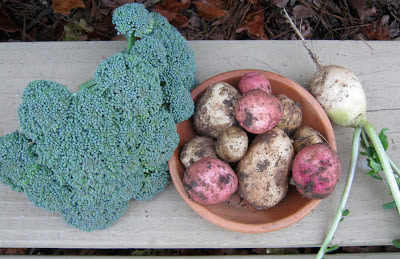
The good news is that, even though most of the spuds had only pushed plants up out of the ground a month or so ago, a couple had come up earlier, and there was a little harvest to dig up today.
When I had dug up last spring's potatoes, I had saved some of the little ones in the fridge to replant in August. I was hoping to trick the little spuds into thinking that their dormancy period was over, but the trick only worked on a couple of them. I'll have to rethink the plan next summer to figure out a way to get a more abundant autumn harvest. I'm pleased enough that the couple of early-birds produced a few spuds for us, and we are looking forward to eating them.
Along with the spuds, I brought in some broccoli to serve with tonight's supper and a winter radish to have sliced thin and salted with our pre-dinner snacks. The potatoes will be for another day.
 The freeze wasn't hard enough to harm the cauliflower, which is good, because they are the most tender of the brassicas out in the yard. Broccoli and cabbages can take much lower temperatures without harm.
 We had one of the cabbages - the first of the season! - with our Thanksgiving Day meal. There are more that are getting close to harvest-size.
 Elsewhere in the garden, the garlic are still all below ground, but the shallots are coming up.
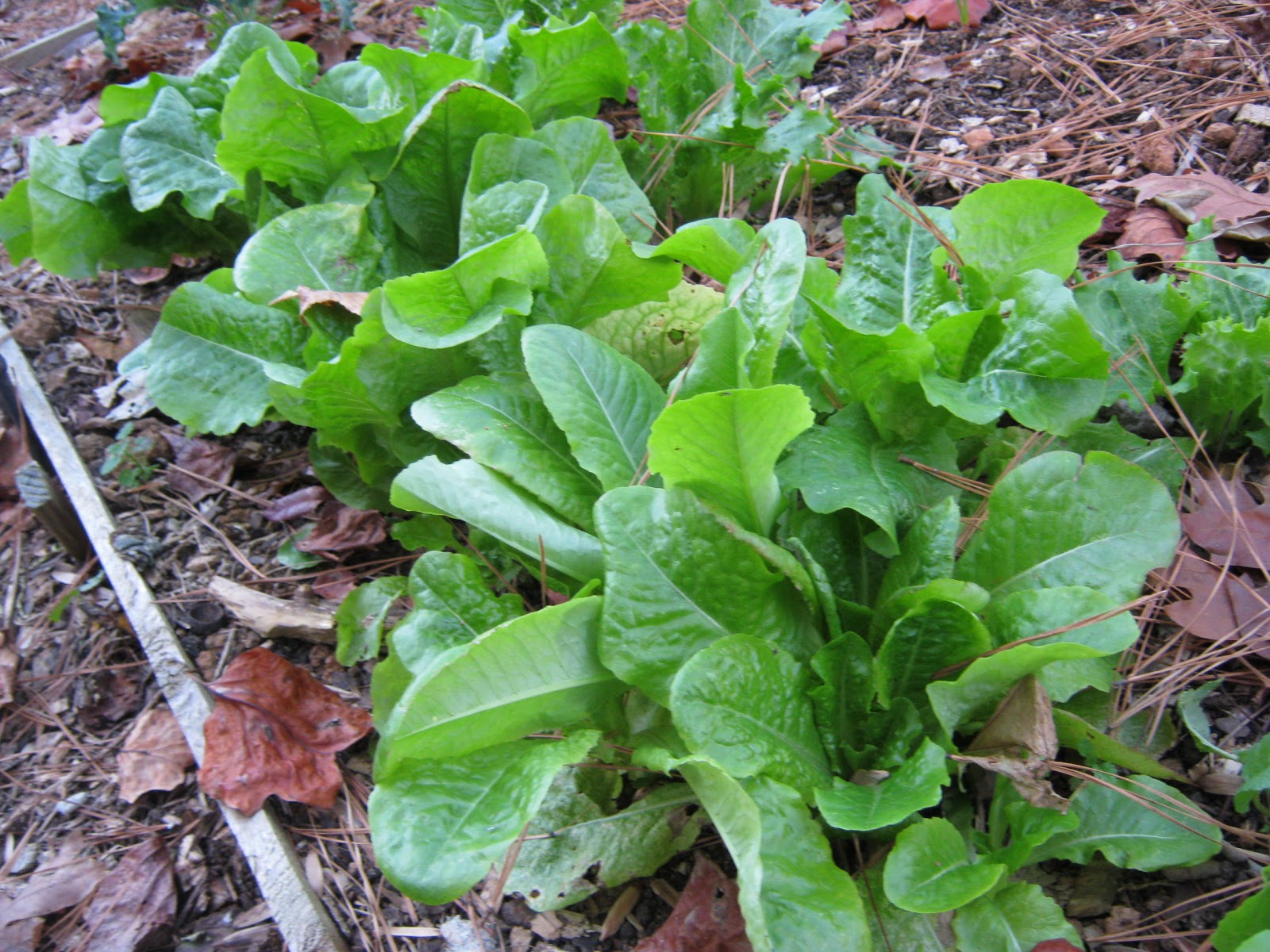
 The lettuces are still perking away - but we've had a lot less of these than my bunnies have. Moonpie and her babies are pretty big lettuce-eaters.
 Overall, I'd have to say that the yard made it through this first very late frost in good shape. The weird part is that it Really Was the First Frost! I think that the official UGA weather station in Dallas, GA, recorded a frost about a week ago, but it was on a night for which the temperatures were patchy - my yard made it through that earlier "frost" without any frost at all. Last night - the night of Nov. 24 - was the first for my yard.
I'm not going to complain (I usually expect a first frost around the end of October), but I will say that it's weird.

In the end, the measures I took weren't enough. The stems of the potato plants (and the nasturtiums) turned to mush.
The good news is that, even though most of the spuds had only pushed plants up out of the ground a month or so ago, a couple had come up earlier, and there was a little harvest to dig up today.
When I had dug up last spring's potatoes, I had saved some of the little ones in the fridge to replant in August. I was hoping to trick the little spuds into thinking that their dormancy period was over, but the trick only worked on a couple of them. I'll have to rethink the plan next summer to figure out a way to get a more abundant autumn harvest. I'm pleased enough that the couple of early-birds produced a few spuds for us, and we are looking forward to eating them.
Along with the spuds, I brought in some broccoli to serve with tonight's supper and a winter radish to have sliced thin and salted with our pre-dinner snacks. The potatoes will be for another day.


I'm not going to complain (I usually expect a first frost around the end of October), but I will say that it's weird.
Tuesday, November 20, 2012
Transplant without Trauma
My friend pictured below, Mr. Collins, knows I'm nuts about gardening, and he brought another of his really great ideas into the office to show me what he'd worked out. He grows plants from seeds to transplant into his garden, but he had been having trouble with the loose potting mix he was using.
When he moved the plants from the pots to the garden, the loose mix would fall away from the rootball, resulting in some damage to the root system. This happened often enough that he spent some time thinking about ways to get around that problem. He wanted to "Transplant without Trauma."
 He actually was working with more than one idea. The one that seemed most successful was lining the pot with an old mesh produce bag. After fitting the bag into place, he adds the potting mix and baby plant. When it's time to move the plant into the garden, he just lifts the whole shebang out of the pot by the edge of the mesh that is sticking out of the pot and plants it, mesh bag and all. The roots grow through the mesh with no trouble. The planting mix doesn't shift, and the roots remain undisturbed.
 Another idea had been to put an old jar lid - that has a big spikey nail sticking up higher than the sides of the pot - into the bottom of the pot before adding the potting medium and baby plant. The theory had been that he would just have to pull the spikey nail up and the plant would come with it, but on its own this wasn't enough to hold the soil together. However, combined with a mesh bag, it works as a 'helper" mechanism.
 Another very simple tool that he brought was the blue lid in the photo above. He made the cut-away portion large enough to fit easily around the stem of the plant he needed to remove from its pot - the slit in the rim is designed to open up the space to wrap this around the stem. When the blue lid is in place, right against the soil, the pot is turned upside down to pop the plant out. The blue lid holds the soil and plant together better than when he does this the usual way - with just his hand across the top of the pot. The lid stops the jolting fall of the soil/root mass into his hand.
It was really great of Mr. Collins to stop by with his ideas. I am sure I am not the only person who has a stash of those mesh bags waiting to be re-purposed. Usually, I scrunch/knot them up to use as scrubbies in the kitchen, but they are very long lasting, and I have a pile of spares.

Out in my garden now, I have some broccoli that experienced the traumatic version of transplanting, because I bought the plant babies in a nine-pack from a garden-supply store. The good news is that it all seems to have recovered well enough.
Ditto for the cabbages and the cauliflower. I think, though, that if I had been growing my own from seed, and if I were starting them a little late (not an unusual occurance), that I would want to find a way to reduce trauma to the plants so they would be more likely to experience less of a slow-down in their growth. I think I will be looking around for some more mesh bags to keep on hand, just in case.

In places other than my yard, pecans have been dropping to the ground. I hope I'm not the only person who finds herself at the end of the day with a pocketfull of pecans that have been picked up on, say, a noon walk.
I've been picking up a half-dozen or so most days, and even though there are barely enough for a pie at this point, I am looking forward to a peaceful few evenings of cracking pecans by the fireplace later in the winter.
There's not much to complain about these days - I have family, friends, pets, an un-smashed house, an interesting job, pecans making lumps in my pocket, good food growing out in the yard, and more. I plan to spend the next several days being extra-thankful.
I hope that you all have a great Thanksgiving!
When he moved the plants from the pots to the garden, the loose mix would fall away from the rootball, resulting in some damage to the root system. This happened often enough that he spent some time thinking about ways to get around that problem. He wanted to "Transplant without Trauma."


It was really great of Mr. Collins to stop by with his ideas. I am sure I am not the only person who has a stash of those mesh bags waiting to be re-purposed. Usually, I scrunch/knot them up to use as scrubbies in the kitchen, but they are very long lasting, and I have a pile of spares.

Out in my garden now, I have some broccoli that experienced the traumatic version of transplanting, because I bought the plant babies in a nine-pack from a garden-supply store. The good news is that it all seems to have recovered well enough.
Ditto for the cabbages and the cauliflower. I think, though, that if I had been growing my own from seed, and if I were starting them a little late (not an unusual occurance), that I would want to find a way to reduce trauma to the plants so they would be more likely to experience less of a slow-down in their growth. I think I will be looking around for some more mesh bags to keep on hand, just in case.

In places other than my yard, pecans have been dropping to the ground. I hope I'm not the only person who finds herself at the end of the day with a pocketfull of pecans that have been picked up on, say, a noon walk.
I've been picking up a half-dozen or so most days, and even though there are barely enough for a pie at this point, I am looking forward to a peaceful few evenings of cracking pecans by the fireplace later in the winter.
There's not much to complain about these days - I have family, friends, pets, an un-smashed house, an interesting job, pecans making lumps in my pocket, good food growing out in the yard, and more. I plan to spend the next several days being extra-thankful.
I hope that you all have a great Thanksgiving!
Subscribe to:
Posts (Atom)