Back in 1990, when my little family first moved to Georgia, I already knew a bit about gardening. However, in spite of having gardened successfully elsewhere (and having a degree in Botany), I had trouble growing food here. Part of the problem -- very tall trees surrounding and shading the backyard -- was resolved through moving the veggies to the sunny front yard. I needed, though, to learn more about the rhythms of planting and harvesting for this area.
To help with that, we bought a copy of the go-to guide of the time, Don Hastings' book "Gardening in the South: Vegetables and Fruits." Hastings' book contains sections for each kind of vegetable grown in the area, with timing and fertilizing information, which is what I needed. It also contains what I now consider to be "the usual advice" about choosing the garden site, planting, amending the soil, and generally tending to the garden.
Most of that basic information can be found in other gardening books, but some parts of the book still stand out as being particularly memorable. One great narrative thread is about the author's working with farmers in Egypt and the Philippines. Details relating to these adventures pop up throughout much of the book. Another is about his family's variety of corn.
The Hastings family had developed a variety of sweet corn that performed well in the Southeast. In the part of the book about growing corn, Hastings tells that his neighbors were still growing Hastings sweet corn long after his family had switched to Silver Queen, which they decided was a better variety for their purposes. There's probably a little lesson in the tale, but I still haven't figured out what that might be.
Another part of the book that I especially remember is about the author's return to Georgia after a couple of years away. His prize flower bed, which had always had the very best soil of all his planting beds, had typically been amended with organic matter a couple of times each year. As a result, the soil there was usually wonderfully dark and rich with humus. In just that short time of being left on its own, the bed had reverted to solid red clay. That story provides great incentive for continuing to add organic matter to my gardens each season!
Of course, I am sitting here writing without having the Hastings book in
front of me to double check my memory; it's possible that I've
gotten some details wrong. This is pretty close, though.
A newer book (2007/2008) for Georgia gardeners is Walter Reeves and Felder Rushing's "Guide to Georgia Vegetable Gardening." This book contains the same basic information as the Hastings book and adds some newer weather and pest details. All the information is solid, researched, and reasonably up-to-date, and it includes names of recommended vegetable varieties that weren't available at the time Hastings wrote his book.
What the Reeves and Rushing book is missing is the thread of personal stories and asides (such as the note in Hastings' parsnip section in which he quite honestly says that he neither likes nor grows them!) that keep a reader interested. In other words, the Reeves and Rushing book is good for reference, whereas Hastings' book is good for both reference and recreation. Also, I've just checked the listings on Amazon, and it turns out
that the Reeves & Rushing book is out of print, with used copies
listed as selling for $99. The Hastings book is still both readily available and affordable.
Books aren't commonly addressed on this blog, but I decided to write about books for several reasons. One is that it lets me think about gardening while it is still too soon to do much planting (it's a useful distraction!). Another is that other gardeners new to the area might be looking for a resource, like I was those many years ago, that addresses the rhythms of gardening in this area. Another is that a friend has loaned me a new book for the South - Ira Wallace's "Guide to Vegetable Gardening in the Southeast" - and I'd like to have the other basic books in my mind as I read it. A review of that book will be coming soon.

Friday, February 28, 2014


Monday, February 24, 2014
Tilling, or Not
One of the most pervasive images in garden magazines and advertisements is of gardeners working their gardens with tillers of one kind or another. However, even though tilling seems, at first, to be a worthy and useful activity, it isn't always.
Tilling brings oxygen down into the soil, which sounds good, but that increased oxygen can stimulate the growth of soil micro-organisms that then get busy with their main job of breaking down organic matter, which releases nutrients. If crops are planted to absorb and use those nutrients, then that release of nutrients from tilling can be good. Here we are, though, with winter still at hand and no (or few) crops available to use those nutrients. Releasing them now would result in waste.
However, a gardener planning to plant potatoes in mid-March might want to till in a cover crop now, to get the decomposition on that foliage started.
This topic is on my mind because I actually turned one garden bed this past weekend, when we had some beautiful, warm, spring-like weather. It was a bed that had a cover crop on it (more chickweed and deadnettle than winter peas, but it held the soil well), and I want to plant some lettuces into that bed.
This was a case of turning under a cover crop to get a bed ready for planting. (I don't actually "till," since I don't own a tiller, but I do an equivalent activity with my grub hoe and spading fork.)
In my own garden, I try to not turn the soil in each of my garden beds more than once per year. The big turning is usually in spring, and when it's time to pull out an old crop and plant a new one, I tend to just use a tined cultivator to loosen the top few inches for planting any seeds.
One reason for minimal tilling is that breaking up the soil also breaks up the underground communities of bacteria, fungi, and other little life-forms that help keep crops healthy. Here in Cobb County, I talk with plenty of gardeners who think that the soil isn't in good shape if they haven't pulverized it to a fine powder, when the truth is that their powdered soil has had the life pretty much beat out of it.
Potentially good reasons to till or turn the soil include mixing in amendments and turning under a cover crop. Some gardeners use a tiller to weed the paths between rows in row-cropped gardens, and some till to break a crusted soil for planting seeds. Those are probably ok reasons, as long as the gardener understands the risks.
Reasons to avoid frequent tilling include maintaining the biological community and avoiding release of nutrients at the wrong time, plus that pulverizing the soil can - paradoxically - lead to compaction of the soil as the powdered bits settle, plus that using an actual tiller for tilling can cause the garden to develop a "hard pan" below the tilled layer of soil. Also, tilling when the soil is too wet, which is a danger for all of us impatient gardeners, can cause the soil to form rock-hard clods that are difficult to break up later in the season.
As always with gardening, there is a lot to think about!
Tilling brings oxygen down into the soil, which sounds good, but that increased oxygen can stimulate the growth of soil micro-organisms that then get busy with their main job of breaking down organic matter, which releases nutrients. If crops are planted to absorb and use those nutrients, then that release of nutrients from tilling can be good. Here we are, though, with winter still at hand and no (or few) crops available to use those nutrients. Releasing them now would result in waste.
However, a gardener planning to plant potatoes in mid-March might want to till in a cover crop now, to get the decomposition on that foliage started.
This topic is on my mind because I actually turned one garden bed this past weekend, when we had some beautiful, warm, spring-like weather. It was a bed that had a cover crop on it (more chickweed and deadnettle than winter peas, but it held the soil well), and I want to plant some lettuces into that bed.
This was a case of turning under a cover crop to get a bed ready for planting. (I don't actually "till," since I don't own a tiller, but I do an equivalent activity with my grub hoe and spading fork.)
In my own garden, I try to not turn the soil in each of my garden beds more than once per year. The big turning is usually in spring, and when it's time to pull out an old crop and plant a new one, I tend to just use a tined cultivator to loosen the top few inches for planting any seeds.
One reason for minimal tilling is that breaking up the soil also breaks up the underground communities of bacteria, fungi, and other little life-forms that help keep crops healthy. Here in Cobb County, I talk with plenty of gardeners who think that the soil isn't in good shape if they haven't pulverized it to a fine powder, when the truth is that their powdered soil has had the life pretty much beat out of it.
Potentially good reasons to till or turn the soil include mixing in amendments and turning under a cover crop. Some gardeners use a tiller to weed the paths between rows in row-cropped gardens, and some till to break a crusted soil for planting seeds. Those are probably ok reasons, as long as the gardener understands the risks.
Reasons to avoid frequent tilling include maintaining the biological community and avoiding release of nutrients at the wrong time, plus that pulverizing the soil can - paradoxically - lead to compaction of the soil as the powdered bits settle, plus that using an actual tiller for tilling can cause the garden to develop a "hard pan" below the tilled layer of soil. Also, tilling when the soil is too wet, which is a danger for all of us impatient gardeners, can cause the soil to form rock-hard clods that are difficult to break up later in the season.
As always with gardening, there is a lot to think about!
Thursday, February 13, 2014
It's Magical Outside
The title words for this post are the words I woke up to this morning. It was insanely early in the morning, but Joe was right. Snow was everywhere, covering the ice that had coated everything yesterday. Magical. We don't get to see the landscape so transformed very often here in Kennesaw.
.JPG) After Joe took our old coonhound out for a brief slide around in the yard (her back legs aren't very stable these days), we took our younger dog for a long, pre-dawn walk. Snowflakes were still falling, and no one else was out.
After Joe took our old coonhound out for a brief slide around in the yard (her back legs aren't very stable these days), we took our younger dog for a long, pre-dawn walk. Snowflakes were still falling, and no one else was out.
We've spent a couple of days at home since Georgia declared a state of emergency over the winter weather, and I've been contemplating the coming spring for much of that time. I've plotted the crop rotations for the year, put in my last seed order, and hovered over a flat of seeds so recently planted that only the lettuces are visible above ground. The tomatoes should appear in a few days, but the peppers and eggplants could be much slower.
I've also done a bit of small-farm research for a new farmer who came to the office on Tuesday, and I've been reading more about community gardens, permaculture, and agro-ecology. If it sounds like I've had a great couple of days, well, it's all true!
In the news, there was talk of widespread power outages, so we have kept the woodstove going. Yesterday we had a pot of crowder peas (harvested and shelled out late last summer) on that stove most of the day; today we have vegetable soup on the woodstove, and I've made bread. Power at our house has stayed on, but a transformer "blew" up the street, leaving some of our neighbors without electricity for a while. Luckily, repairs already seem to have been completed.
For me, it's been a pleasant couple of days, complete with garden thinking-and-reading, phone calls from concerned relatives (in Oklahoma, Texas, and Louisiana), text updates from local friends, cozy moments with my pet bunnies, magical moments with Joe, and comfort-foods hot off the woodstove. I hope that other gardeners have also found ways to enjoy the break from their usual routine!
We've spent a couple of days at home since Georgia declared a state of emergency over the winter weather, and I've been contemplating the coming spring for much of that time. I've plotted the crop rotations for the year, put in my last seed order, and hovered over a flat of seeds so recently planted that only the lettuces are visible above ground. The tomatoes should appear in a few days, but the peppers and eggplants could be much slower.
I've also done a bit of small-farm research for a new farmer who came to the office on Tuesday, and I've been reading more about community gardens, permaculture, and agro-ecology. If it sounds like I've had a great couple of days, well, it's all true!
In the news, there was talk of widespread power outages, so we have kept the woodstove going. Yesterday we had a pot of crowder peas (harvested and shelled out late last summer) on that stove most of the day; today we have vegetable soup on the woodstove, and I've made bread. Power at our house has stayed on, but a transformer "blew" up the street, leaving some of our neighbors without electricity for a while. Luckily, repairs already seem to have been completed.
For me, it's been a pleasant couple of days, complete with garden thinking-and-reading, phone calls from concerned relatives (in Oklahoma, Texas, and Louisiana), text updates from local friends, cozy moments with my pet bunnies, magical moments with Joe, and comfort-foods hot off the woodstove. I hope that other gardeners have also found ways to enjoy the break from their usual routine!
Monday, February 10, 2014
DIY Potting Mixes and Seed Starting
Many of my gardening friends have complained in the past few years about the quality of the standard potting mixes that are available in most garden-stores. One friend in particular, who starts a thousand or more plants each spring for school gardens, community gardens, and a Plant-a-Row-for-the-Hungry garden, has lost many hundreds of plants as a result of "burning" from a bad potting mix.
Last year, my friend used a bag of a professional potting mix, Faford brand, that she bought from a greenhouse supply store up in Ballground. The mix did not include fertilizer, so she was able to regulate the amount of nutrients that were available to the plants and to avoid burning her seedlings, which are so very sensitive to the salts in conventional fertilizers.
In my own shopping for potting mixes, I've also noticed the variable quality issue, even in seed starting mixes that are no-fertilizer-added products. Some are just very finely textured peat, and some are the finely textured peat plus perlite and possibly something else. For seed starting, the finely-textured aspect plays an important role in keeping very small seeds from washing too deeply into the soil to push their seed-leaves up into the light.
This year, I've started some seeds in Jiffy Pellets, but yesterday I also mixed up a batch of my own mix, filled a flat, and planted some seeds. The recipe I used is based on one from ATTRA, from its publication "Potting mixes for certified organic production." If you go the webpage to view (or download!) the publication, the recipes are way down toward the end, in appendix 3.
My mix is equal parts compost and peat moss and a quarter-part of perlite. This mix filled a 5-gallon bucket about 2/3 full. To these main components, I added a couple of Tablespoons of an organic fertilizer mix. If my compost had been "heavier," I would have used more perlite. Also, if I'd had vermiculite in my supply area rather than perlite, I might have used that, instead. Basically, I used what I had on hand.
For those who might not want to sort through the numerous mixes in the ATTRA publication, Organic Gardening offers a pared-down list that was gleaned from the ATTRA set.
Last year, my friend used a bag of a professional potting mix, Faford brand, that she bought from a greenhouse supply store up in Ballground. The mix did not include fertilizer, so she was able to regulate the amount of nutrients that were available to the plants and to avoid burning her seedlings, which are so very sensitive to the salts in conventional fertilizers.
In my own shopping for potting mixes, I've also noticed the variable quality issue, even in seed starting mixes that are no-fertilizer-added products. Some are just very finely textured peat, and some are the finely textured peat plus perlite and possibly something else. For seed starting, the finely-textured aspect plays an important role in keeping very small seeds from washing too deeply into the soil to push their seed-leaves up into the light.
This year, I've started some seeds in Jiffy Pellets, but yesterday I also mixed up a batch of my own mix, filled a flat, and planted some seeds. The recipe I used is based on one from ATTRA, from its publication "Potting mixes for certified organic production." If you go the webpage to view (or download!) the publication, the recipes are way down toward the end, in appendix 3.
My mix is equal parts compost and peat moss and a quarter-part of perlite. This mix filled a 5-gallon bucket about 2/3 full. To these main components, I added a couple of Tablespoons of an organic fertilizer mix. If my compost had been "heavier," I would have used more perlite. Also, if I'd had vermiculite in my supply area rather than perlite, I might have used that, instead. Basically, I used what I had on hand.
For those who might not want to sort through the numerous mixes in the ATTRA publication, Organic Gardening offers a pared-down list that was gleaned from the ATTRA set.
Sunday, February 2, 2014
What Can I Plant Now?
Gardeners have been calling the Extension office, from the beginning of January, wanting to know what they can plant NOW. Even when the ground was frozen and the forecast was for a drop down around 10 degrees F, the lengthening days, like a siren song that they couldn't tune out, made them pick up the phone, call, and ask. Luckily, they ended up speaking with me, another gardener gone deaf to nearly all except the need to begin the new year of planting.
For those who can't wait, I've assembled a couple of timetables. The first one is pulled from UGA's Vegetable Planting Chart. The dates on the original chart are for "middle Georgia" (somewhere around Macon); I've shifted the dates by a couple of weeks to reflect our later warming here in Cobb County.
The second timetable, though not actually in table form, is from John Jeavons' book "How to Grow MoreVegetables ..."
6-8 weeks before last frost ( Feb 15 - March 1), start in flats:
A careful reader might notice that the two timetables don't exactly match. This means that a gardener will need to experiment a little and choose for him or herself the best planting times.
One of the helpful features of the Jeavons' timetable is that it includes times for bumping up and transplanting seedlings, very useful information for those of us who DIY our garden transplants. One of the hilarious features is the inclusion of carrots as a crop to transplant. I've tried it --- it's possible -- but the carrots come out all bent and mangled.
Also, I usually bump up my tomatoes - and start my peppers - much earlier than indicated in his timetable. (He bumps up tomatoes - from the flat to pots - on the last frost date, which I count as about April 12-15.)
For my yard, parts of the UGA timetable seem a little early, but my yard is in a hole and stays cooler longer than much of the rest of the county. Other parts of the UGA schedule seem late. For example, I can't imagine planting collard greens as late as April 1!
For peas, I use an indicator plant; I plant peas when the trout lilies are blooming in my yard. The leaves of those native wildflowers aren't even poking up above the soil yet, so this year the peas may get planted a little later than normal. Irish potatoes usually get planted in my yard in mid-March, and my onions and garlic get planted in late October or early November.
Based on both timetables, and all the possible timetables gleaned from other, local gardeners, there is plenty to start working with in terms of spring planting, beginning now. I hope the information is helpful!
For those who can't wait, I've assembled a couple of timetables. The first one is pulled from UGA's Vegetable Planting Chart. The dates on the original chart are for "middle Georgia" (somewhere around Macon); I've shifted the dates by a couple of weeks to reflect our later warming here in Cobb County.
Crop
|
UGA planting dates
|
Asparagus
|
Feb 1- April 1
|
Beets
|
Mar 1 – Apr 15
|
Broccoli
|
Mar 1 – Apr 1
|
Cabbage
|
Mar 1 – Apr 1
|
Carrot
|
Feb 1 – Apr 5
|
Cauliflower
|
Mar 15 - Apr 15
|
Collards
|
Feb 15 – Apr 1
|
Kale
|
Feb 15 – Mar 25
|
Lettuce
|
Feb 1 – Mar 15
|
Onions, green
|
Jan 15 – Apr 1
|
Onions, dry bulb
|
Jan 15 – Apr 1
|
Peas, garden
|
Feb 1 – Mar 1
|
Peas, edible pod
|
Feb 1 – Mar 1
|
Potatoes, Irish
|
Feb 1 – Mar 15
|
Radish
|
Feb 1 – Apr 15
|
Spinach
|
Feb 1- April 1
|
Turnip
|
Feb 1 – Apr 15
|
The second timetable, though not actually in table form, is from John Jeavons' book "How to Grow MoreVegetables ..."
6-8 weeks before last frost ( Feb 15 - March 1), start in flats:
broccoli, Brussels sprouts,
cabbage, cauliflower, lettuce, parsley, tomatoes
5 weeks before last frost (Mar 1- 15), start in flats:
carrot, beets
bump up the lettuce
seedlings to larger containers
4 weeks before last frost (5-20 March):
sprout/chit potatoes
bump up the parsley
3 weeks before last frost (15-30 March), start in flats:
peas, spinach
bump up seedlings for
broccoli, Brussels sprouts, cabbage, cauliflower
2 weeks before last frost (25 Mar – 1 Apr), start in flats:
dill, eggplants, peppers
transplant to garden:
broccoli, Brussels sprouts,
peas, cabbage, carrots, cauliflower, beets, lettuce, spinach
plant garlic, onions,
radishes
A careful reader might notice that the two timetables don't exactly match. This means that a gardener will need to experiment a little and choose for him or herself the best planting times.
One of the helpful features of the Jeavons' timetable is that it includes times for bumping up and transplanting seedlings, very useful information for those of us who DIY our garden transplants. One of the hilarious features is the inclusion of carrots as a crop to transplant. I've tried it --- it's possible -- but the carrots come out all bent and mangled.
Also, I usually bump up my tomatoes - and start my peppers - much earlier than indicated in his timetable. (He bumps up tomatoes - from the flat to pots - on the last frost date, which I count as about April 12-15.)
For my yard, parts of the UGA timetable seem a little early, but my yard is in a hole and stays cooler longer than much of the rest of the county. Other parts of the UGA schedule seem late. For example, I can't imagine planting collard greens as late as April 1!
For peas, I use an indicator plant; I plant peas when the trout lilies are blooming in my yard. The leaves of those native wildflowers aren't even poking up above the soil yet, so this year the peas may get planted a little later than normal. Irish potatoes usually get planted in my yard in mid-March, and my onions and garlic get planted in late October or early November.
Based on both timetables, and all the possible timetables gleaned from other, local gardeners, there is plenty to start working with in terms of spring planting, beginning now. I hope the information is helpful!
Wednesday, January 29, 2014
Crazy Icy Roads
This blog post is totally not garden-related, but - holy cow! - we are having a time here in North Georgia. It all started yesterday at around 10 a.m., when the first flurry of snow started coming down, and instead of melting on the roads, it glazed them all with ice.
I left the office to run some errands on my lunch break, noticed how slick the roads already had become, then returned and started making calls to cancel my evening Seed Saving class (I've rescheduled for two nights). By then, local schools had all announced that they would be sending kids home two hours ahead of the usual schedule, and parents all headed home so kids wouldn't be left in empty houses.
Just about that same time, county employees (of which I am one) were told that they could leave early if they needed to, but that they would have to use annual leave (vacation time!) to cover that absence. By 2 p.m., my office was down to three employees. I stayed until 4:15 p.m. (those vacation hours are precious), but I wanted to make at least part of the drive in daylight. It took an hour and a half to go the first mile. Some areas were covered up in cars that couldn't go anyplace, and navigating between them was a little bit hair-raising.
I saw an astounding number of pedestrians, which at first I thought was pretty cool, but then I figured out that most of those people were walking because they had abandoned their cars -- which were now blocking roads all over the place.
I am one of the lucky ones. My drive took a little less than five hours (it's a nine mile commute), and I only had trouble twice. The first time, the driver of a Marietta Schools bus helped me get my car moving over a slick patch. He had no passengers at that time, and based on all the reports I've heard of schools filled with stranded kids, I am sure he needed to be somewhere else.
The second time, I was stuck on a hill that provided about as much traction as greased glass, and other cars began to go around mine. I had about a quart of dirt in a container in the back of the car (I am a gardener, after all), and I tossed a little behind and in front of my front wheels, and that gave me enough of a boost to continue up the icy hill.
Of course, this was the first time in a very long time that I accidentally had left my cell phone in the dining room when I headed for work in the morning. Phone-less, I had no way to let Joe know where I was or how I was doing.
When I finally got home, I could see that I had been constantly on his mind. Not only did he run out in his socks to give me a long, hard hug, but he also had shoveled out tracks on the driveway so I would have an easy stop (rather than a slide into the garage doors) at the end of my journey. Those tracks were like a big, non-icy welcome mat! He said he had been less than 15 minutes from getting into the Jeep to come look for me.
Other people who work in my office ran into a lot more trouble on the road. One who lives just another mile or so beyond me had a seven hour drive home; two got home at five this morning; one still wasn't home when I heard last at 10 a.m.; a couple others got home after midnight.
One of Joe's coworkers drove for nine hours, then had to leave his car and walk the last mile and a half. Others didn't make it more than a mile from work and walked away from their stranded vehicles to the nearby home of a friend, where they all still are. My next door neighbor just got home about an hour ago, around 1:00 p.m.
I had a call this morning, early, from my boss, with the message that county offices would be opening at noon today. By 10 a.m., though, the county website announced that county offices would remain closed for the entire day (good call). I have no idea what tomorrow will bring, the website doesn't say yet, but at two in the afternoon the road in front of my house is still providing some excellent sledding. I'm thinking that's not a good sign for any of us who might be asked to report to work in the morning.
I hope that all of the rest of my gardening friends are safe, warm, well-fed, and able to enjoy at least part of the craziness!
I left the office to run some errands on my lunch break, noticed how slick the roads already had become, then returned and started making calls to cancel my evening Seed Saving class (I've rescheduled for two nights). By then, local schools had all announced that they would be sending kids home two hours ahead of the usual schedule, and parents all headed home so kids wouldn't be left in empty houses.
Just about that same time, county employees (of which I am one) were told that they could leave early if they needed to, but that they would have to use annual leave (vacation time!) to cover that absence. By 2 p.m., my office was down to three employees. I stayed until 4:15 p.m. (those vacation hours are precious), but I wanted to make at least part of the drive in daylight. It took an hour and a half to go the first mile. Some areas were covered up in cars that couldn't go anyplace, and navigating between them was a little bit hair-raising.
I saw an astounding number of pedestrians, which at first I thought was pretty cool, but then I figured out that most of those people were walking because they had abandoned their cars -- which were now blocking roads all over the place.
I am one of the lucky ones. My drive took a little less than five hours (it's a nine mile commute), and I only had trouble twice. The first time, the driver of a Marietta Schools bus helped me get my car moving over a slick patch. He had no passengers at that time, and based on all the reports I've heard of schools filled with stranded kids, I am sure he needed to be somewhere else.
The second time, I was stuck on a hill that provided about as much traction as greased glass, and other cars began to go around mine. I had about a quart of dirt in a container in the back of the car (I am a gardener, after all), and I tossed a little behind and in front of my front wheels, and that gave me enough of a boost to continue up the icy hill.
Of course, this was the first time in a very long time that I accidentally had left my cell phone in the dining room when I headed for work in the morning. Phone-less, I had no way to let Joe know where I was or how I was doing.
When I finally got home, I could see that I had been constantly on his mind. Not only did he run out in his socks to give me a long, hard hug, but he also had shoveled out tracks on the driveway so I would have an easy stop (rather than a slide into the garage doors) at the end of my journey. Those tracks were like a big, non-icy welcome mat! He said he had been less than 15 minutes from getting into the Jeep to come look for me.
 |
| Two cleared tracks like a welcome mat, shoveled from our slippery driveway. |
Other people who work in my office ran into a lot more trouble on the road. One who lives just another mile or so beyond me had a seven hour drive home; two got home at five this morning; one still wasn't home when I heard last at 10 a.m.; a couple others got home after midnight.
One of Joe's coworkers drove for nine hours, then had to leave his car and walk the last mile and a half. Others didn't make it more than a mile from work and walked away from their stranded vehicles to the nearby home of a friend, where they all still are. My next door neighbor just got home about an hour ago, around 1:00 p.m.
I had a call this morning, early, from my boss, with the message that county offices would be opening at noon today. By 10 a.m., though, the county website announced that county offices would remain closed for the entire day (good call). I have no idea what tomorrow will bring, the website doesn't say yet, but at two in the afternoon the road in front of my house is still providing some excellent sledding. I'm thinking that's not a good sign for any of us who might be asked to report to work in the morning.
I hope that all of the rest of my gardening friends are safe, warm, well-fed, and able to enjoy at least part of the craziness!
Sunday, January 26, 2014
When the Garden Gets Slammed By a Very Hard Freeze
I have a friend who says that gamblers should skip going to Vegas and just plant a garden, instead -- letting those weather dice roll and taking odds on what will yield well, what will do poorly, and what will be a total fail.
In the past bunch of winters, broccoli, cabbages, and nearly all the cool-season greens have produced right through until spring. Gardeners in North Georgia are accustomed to the success of those crops, so, back in October, we all would have said the likelihood of those crops surviving the winter was fairly high. This year, the usual winter crops pretty much ended a few weeks ago when the temperature dropped down near 5 degrees F.
It seemed like it might be useful to have a list of the hardiest crops, for future reference when planning the fall/winter garden, so what follows is such a list:
The perennial herbs also seem to be struggling with the cold. Most years in winter I can find enough fresh oregano down under the browned stems to use for cooking, but today I could find only a few, tiny leaves. The sage has some good leaves, and I found some usable thyme under the tangle of old stems of that plant, but the rosemary looks pretty rough.
Also, since so many of the weeds that I depend upon for bunny food were bitten back by the hard freeze, I've been growing wheat greens indoors to feed to my pet bunnies. Without these greens, my bunny-food bill would be much higher!
We've been growing sprouts in the kitchen for ourselves, too, to add some fresh, home-grown greens to our meals. With the loss of many of the outdoor crops, we are lucky to have options for continued "gardening" indoors.
If other gardeners can let me know of additional crops that have done well in the cold, we can add them to the list, to help in planning next winter's garden. Hope you all are keeping warm!
In the past bunch of winters, broccoli, cabbages, and nearly all the cool-season greens have produced right through until spring. Gardeners in North Georgia are accustomed to the success of those crops, so, back in October, we all would have said the likelihood of those crops surviving the winter was fairly high. This year, the usual winter crops pretty much ended a few weeks ago when the temperature dropped down near 5 degrees F.
It seemed like it might be useful to have a list of the hardiest crops, for future reference when planning the fall/winter garden, so what follows is such a list:
multiplying onionsI'm guessing that parsnips would be ok, too, but I didn't plant any this year.
shallots
garlic
carrots
winter radishes
green onions
cilantro
spinach
Brussels Sprouts (report from another local gardener)
The perennial herbs also seem to be struggling with the cold. Most years in winter I can find enough fresh oregano down under the browned stems to use for cooking, but today I could find only a few, tiny leaves. The sage has some good leaves, and I found some usable thyme under the tangle of old stems of that plant, but the rosemary looks pretty rough.
Also, since so many of the weeds that I depend upon for bunny food were bitten back by the hard freeze, I've been growing wheat greens indoors to feed to my pet bunnies. Without these greens, my bunny-food bill would be much higher!
We've been growing sprouts in the kitchen for ourselves, too, to add some fresh, home-grown greens to our meals. With the loss of many of the outdoor crops, we are lucky to have options for continued "gardening" indoors.
If other gardeners can let me know of additional crops that have done well in the cold, we can add them to the list, to help in planning next winter's garden. Hope you all are keeping warm!
Sunday, January 19, 2014
Garden Plans and Events
After my very eventful December, it has taken some time for the pattern of my days to seem familiar again. I realized this afternoon, though, while hoeing out a few weeds and spreading more mulch in the onion/shallot/garlic bed, that everything feels just about normal. Parts of the garden even LOOK normal, in spite of the drop to 5 degrees Fahrenheit a week or so back.
The onions, garlic, and shallots mostly are vibrantly green, firm and growing. Nearly every other crop above ground has gone to mush - even the chickweed that I feed to my bunnies! Underground crops, the carrots and winter radishes, seem to have survived the unusual cold pretty well. Only some individual plants that poked up out of the ground were affected.
At the little farm where we volunteer, the winter greens all look very damaged, except for the spinach. That bit of information is probably worth remembering, for future winter gardens.
Tomorrow I'll be working more in the yard. My compost pile is stacked pretty high with nearly-finished compost that I plan to move onto one of my garden beds, rather than risk letting the nutrients wash out across the back yard. I'd rather have them soaking into my garden! I hope to spend some time planning what to grow where, too.
My last, most favorite seed catalog finally arrived, which means I can place a seed order for my garden whenever I've completed the plan. I'll also be ordering seeds for a Seed Starting class that I'll be giving in February. Those seeds will all be UGA-recommended varieties, some of which are heirloom. I'm planning to order from a source that sells untreated seeds, so that organic gardeners won't have to worry about accidentally introducing unknown fungicides or systemic pesticides into their gardens.
The first class I am planning for this year, though, is a Planning for Seed Saving class. It's scheduled for the 28th at the Extension office, and I'll have some seeds to share at that class, too, in honor of National Seed Swap Day, which falls each year on the last Saturday in January (this year it's on the 25th).
I always enjoy meeting more gardeners, so I am really looking forward to both of these classes!
The onions, garlic, and shallots mostly are vibrantly green, firm and growing. Nearly every other crop above ground has gone to mush - even the chickweed that I feed to my bunnies! Underground crops, the carrots and winter radishes, seem to have survived the unusual cold pretty well. Only some individual plants that poked up out of the ground were affected.
At the little farm where we volunteer, the winter greens all look very damaged, except for the spinach. That bit of information is probably worth remembering, for future winter gardens.
Tomorrow I'll be working more in the yard. My compost pile is stacked pretty high with nearly-finished compost that I plan to move onto one of my garden beds, rather than risk letting the nutrients wash out across the back yard. I'd rather have them soaking into my garden! I hope to spend some time planning what to grow where, too.
My last, most favorite seed catalog finally arrived, which means I can place a seed order for my garden whenever I've completed the plan. I'll also be ordering seeds for a Seed Starting class that I'll be giving in February. Those seeds will all be UGA-recommended varieties, some of which are heirloom. I'm planning to order from a source that sells untreated seeds, so that organic gardeners won't have to worry about accidentally introducing unknown fungicides or systemic pesticides into their gardens.
The first class I am planning for this year, though, is a Planning for Seed Saving class. It's scheduled for the 28th at the Extension office, and I'll have some seeds to share at that class, too, in honor of National Seed Swap Day, which falls each year on the last Saturday in January (this year it's on the 25th).
I always enjoy meeting more gardeners, so I am really looking forward to both of these classes!
Saturday, January 4, 2014
Endings and Beginnings
Never before have I experienced a changing-of-the-year that so emphatically has an embodied ending and beginning. As the old year closed, I gained a daughter-in-law, a beautiful start for the year! While we were in Texas for the wedding, though,
my mother-in-law (a.k.a. "Grandma") had some serious health problems, and she has passed
away. Her life on earth and the relationships she nurtured - in the form we know - with friends and family are at an end. The events and emotions involved are all complex and varied.
Endings can be extremely difficult. Luckily for me, the endings I usually deal with in the garden -- the changing of seasons, the maturity and decline of a round of crops -- these all are much easier to accept. They come without fail; the loss is familiar, and looking toward the beginning of a new season brings a sense of excitement.
Right now in the yard, we are anticipating the onset of very cold weather. I barely remember the last time we experienced a drop below 8 degrees Fahrenheit -- schools were closed (because families here in Georgia don't invest in cold-weather gear that is needed only once in a decade), and I wasn't worried about the garden because I hadn't begun growing so many cool-weather crops in the fall.
I will be interested to see how the carrots fare in this unusual cold. The broccoli and cabbages that I didn't harvest before last week already have been turned to mush by a hard freeze. Someone asked me just a few weeks ago why some gardeners in the area were so set on putting protective coverings over their crops when our winters are generally fairly mild -- I think what's coming is why.
Part of the appeal of gardening is that there is always something new to look forward to, even when "what's new" is a bout of freakishly cold weather! For many gardeners, seed and plant catalogs are piling up, plans are being made to try new varieties or to try a new technique or method, and the anticipation of growing favorite varieties alongside the new ones builds an eagerness to begin as the next growing season approaches. I hope that the coming year brings the joy of new beginnings and happiness in productive gardening to us all!
Endings can be extremely difficult. Luckily for me, the endings I usually deal with in the garden -- the changing of seasons, the maturity and decline of a round of crops -- these all are much easier to accept. They come without fail; the loss is familiar, and looking toward the beginning of a new season brings a sense of excitement.
Right now in the yard, we are anticipating the onset of very cold weather. I barely remember the last time we experienced a drop below 8 degrees Fahrenheit -- schools were closed (because families here in Georgia don't invest in cold-weather gear that is needed only once in a decade), and I wasn't worried about the garden because I hadn't begun growing so many cool-weather crops in the fall.
I will be interested to see how the carrots fare in this unusual cold. The broccoli and cabbages that I didn't harvest before last week already have been turned to mush by a hard freeze. Someone asked me just a few weeks ago why some gardeners in the area were so set on putting protective coverings over their crops when our winters are generally fairly mild -- I think what's coming is why.
Part of the appeal of gardening is that there is always something new to look forward to, even when "what's new" is a bout of freakishly cold weather! For many gardeners, seed and plant catalogs are piling up, plans are being made to try new varieties or to try a new technique or method, and the anticipation of growing favorite varieties alongside the new ones builds an eagerness to begin as the next growing season approaches. I hope that the coming year brings the joy of new beginnings and happiness in productive gardening to us all!
 | |
| My beautiful family. I'm a lucky mom! |
Tuesday, December 24, 2013
Dahlias for the Bees
One of my friends grew a lot of dahlias this past year. When she dug them up to store for the winter, the ones she liked the least - all the cactus-flowered yellow ones - had produced more tubers than she was willing to keep.
However, those had nice, open centers that had made the flowers a favorite with bees, which meant she would be able to find a good home for the tubers without too much trouble. Lots of people want to help bees!
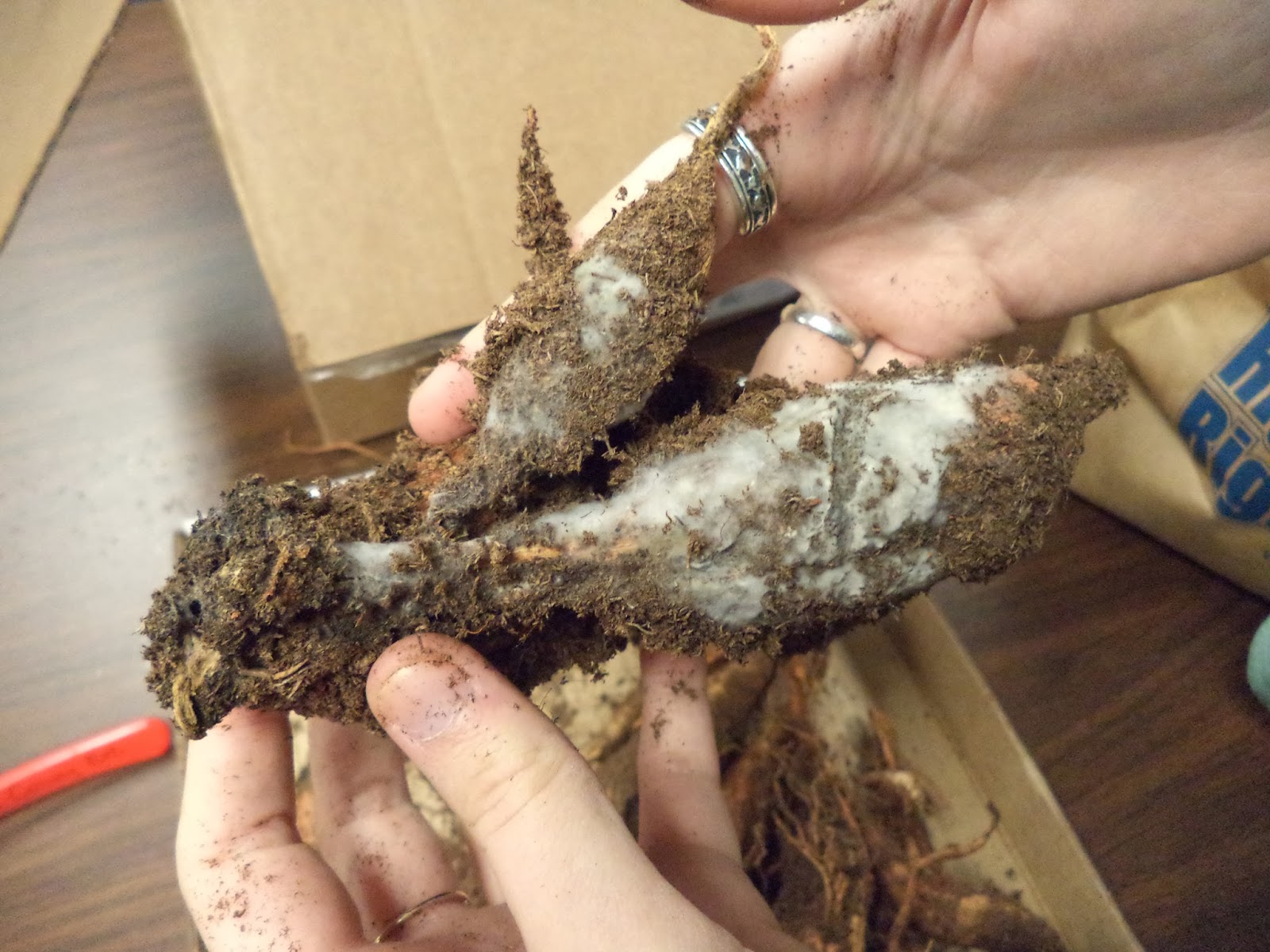
She tucked the tubers from those yellow-flowered plants into paper bags with peat moss, then put those in the car to deal with later. A month went by before she was able to pass them along. By the time the tubers made it to the office, some of them had developed problems. Luckily, a local dahlia expert -- my friend Maddie -- was in the office at exactly the right time. Of course, she was supposed to be working on her Senior DPA portfolio for 4-H!
It didn't take long for Maddie to sort through the tubers, trim away excess bits, and toss the bad ones.
One of the great things about my workplace is the number of plant-experts who stop by. We get to learn from all of them!
However, those had nice, open centers that had made the flowers a favorite with bees, which meant she would be able to find a good home for the tubers without too much trouble. Lots of people want to help bees!
She tucked the tubers from those yellow-flowered plants into paper bags with peat moss, then put those in the car to deal with later. A month went by before she was able to pass them along. By the time the tubers made it to the office, some of them had developed problems. Luckily, a local dahlia expert -- my friend Maddie -- was in the office at exactly the right time. Of course, she was supposed to be working on her Senior DPA portfolio for 4-H!
It didn't take long for Maddie to sort through the tubers, trim away excess bits, and toss the bad ones.
 |
| Each bag held several plants'-worth of tubers, buried in the peat moss. |
 |
| Some of the dahlia tubers were very obviously too far gone to keep. |
 |
| She showed us the slimy innards of a tuber that had felt only a little bit soft from the outside. |
 |
| This little dahlia tuber already has a nice big eye; it's a keeper! |
Monday, December 16, 2013
Tracking the Harvest: October and November, 2013
The big surprise is that, in spite of the monsoon-like quality of much of the year and the ravenous appetites of the local chipmunks, my yard has managed to provide more than 400 pounds of food in 2013 to this point. Harvests in the next few months will be pretty lean, but that's why we put away surpluses of crops like tomatoes, peppers, and beans when we have them in summer.
I've also been enjoying the butternut squash, which, like the sweet potatoes, keep just fine on their own without any work in "putting up" the harvest. They just sit around in baskets until I'm ready to use them. A lot of the butternut squash has been baked until squishy, then whirled in the blender (without seeds and skins) with some almond milk, black pepper, and sauteed onion and garlic -- quick and easy butternut soup! It just requires the forethought to have put the squash into the oven.
Weights below for the past two months are in kilograms:
October
Tomatoes, ripe 2.4
radishes 1.3
okra 1
Peppers 6.15
November
Persimmons, Asian 0.65
Radish, winter 2.15
Peppers 0.55
Carrots 0.4
Bok Choy 0.75
Potatoes 0.5
October 10.85 kg = 23 pounds, 14 ounces
November 5 kg = 11 pounds
Running total January through November = 181.95 kg = 401 pounds, 1 ounces
I've also been enjoying the butternut squash, which, like the sweet potatoes, keep just fine on their own without any work in "putting up" the harvest. They just sit around in baskets until I'm ready to use them. A lot of the butternut squash has been baked until squishy, then whirled in the blender (without seeds and skins) with some almond milk, black pepper, and sauteed onion and garlic -- quick and easy butternut soup! It just requires the forethought to have put the squash into the oven.
Weights below for the past two months are in kilograms:
October
Tomatoes, ripe 2.4
radishes 1.3
okra 1
Peppers 6.15
November
Persimmons, Asian 0.65
Radish, winter 2.15
Peppers 0.55
Carrots 0.4
Bok Choy 0.75
Potatoes 0.5
October 10.85 kg = 23 pounds, 14 ounces
November 5 kg = 11 pounds
Running total January through November = 181.95 kg = 401 pounds, 1 ounces
Friday, December 6, 2013
What Gardeners Think About in Winter
Just to start, two more seed catalogs arrived at my house this week: Vermont Bean and Totally Tomatoes. This means that the planning part of the gardening year is here. I will hazard a guess that I am not the only gardener who already has begun thinking forward to the next round of planting.
This means thinking about which varieties to grow for each vegetable, about how much space to give to each crop, about the best-yet-cheapest ways to add organic matter to the soil, about the crop rotation sequence, about planning for seed saving, about seed starting and whether the fluorescent fixture needs a new bulb. Really, there is just no end to the garden thinking that goes on in winter.
There also, here in the South, are vegetables still in the yard to harvest and eat. In my yard, I have carrots, winter radishes, broccoli, and cabbage that are at a good stage for eating, and there are vegetables that didn't make it to maturity before the cold set in for me to watch and keep weeded, so they can return to growing as the soil begins to warm again in March. This all takes some thinking, too.
And if, like me, you have a parallel life as a spouse, a parent and a person who has a full-time job, all that thinking has to fit in the spaces between the rest of it. In my own life, the "spaces between" have shrunk down to just cracks for the moment -- next week, my youngest son graduates from college, and in three weeks my oldest son is getting married (THREE WEEKS!!!)--- but that doesn't seem to stop my brain from turning toward the garden.
This means thinking about which varieties to grow for each vegetable, about how much space to give to each crop, about the best-yet-cheapest ways to add organic matter to the soil, about the crop rotation sequence, about planning for seed saving, about seed starting and whether the fluorescent fixture needs a new bulb. Really, there is just no end to the garden thinking that goes on in winter.
There also, here in the South, are vegetables still in the yard to harvest and eat. In my yard, I have carrots, winter radishes, broccoli, and cabbage that are at a good stage for eating, and there are vegetables that didn't make it to maturity before the cold set in for me to watch and keep weeded, so they can return to growing as the soil begins to warm again in March. This all takes some thinking, too.
And if, like me, you have a parallel life as a spouse, a parent and a person who has a full-time job, all that thinking has to fit in the spaces between the rest of it. In my own life, the "spaces between" have shrunk down to just cracks for the moment -- next week, my youngest son graduates from college, and in three weeks my oldest son is getting married (THREE WEEKS!!!)--- but that doesn't seem to stop my brain from turning toward the garden.
Subscribe to:
Posts (Atom)