The big surprise is that, in spite of the monsoon-like quality of much of the year and the ravenous appetites of the local chipmunks, my yard has managed to provide more than 400 pounds of food in 2013 to this point. Harvests in the next few months will be pretty lean, but that's why we put away surpluses of crops like tomatoes, peppers, and beans when we have them in summer.
I've also been enjoying the butternut squash, which, like the sweet potatoes, keep just fine on their own without any work in "putting up" the harvest. They just sit around in baskets until I'm ready to use them. A lot of the butternut squash has been baked until squishy, then whirled in the blender (without seeds and skins) with some almond milk, black pepper, and sauteed onion and garlic -- quick and easy butternut soup! It just requires the forethought to have put the squash into the oven.
Weights below for the past two months are in kilograms:
October
Tomatoes, ripe 2.4
radishes 1.3
okra 1
Peppers 6.15
November
Persimmons, Asian 0.65
Radish, winter 2.15
Peppers 0.55
Carrots 0.4
Bok Choy 0.75
Potatoes 0.5
October 10.85 kg = 23 pounds, 14 ounces
November 5 kg = 11 pounds
Running total January through November = 181.95 kg = 401 pounds, 1 ounces

Showing posts with label winter squash. Show all posts
Showing posts with label winter squash. Show all posts
Monday, December 16, 2013


Sunday, August 18, 2013
Squash, Melon Update
The melons have pretty much been a bust this year. I have brought one into the kitchen, but the rest of what I would normally expect to harvest from the plants in the garden either never formed, were bored/gnawed into by bugs/caterpillars, or are just beginning to form now, when the vines are far enough gone with Downy Mildew that the fruits are not going to reach maturity before the vines die.
This will add another year to my de-hybridization project for the canary melons, but at least I got to enjoy one of my favorite melons this year. I am saving seed from my lone melon, with a note that it was produced in a horrifically wet, cool summer. These seeds may be useful someday.
Considering how rough the summer has been on the melons, I am happy to be able to report that the butternut squash seem to be doing well enough. From the three vines, I've brought in six squash, lost a few to pickleworms, and there are a few more on the way.
Butternut is one of the confusing category of squashes called "Winter squash." It isn't grown in the winter; it is planted in spring, pretty much when the zucchini go in the ground. The name comes from the way the squash keep through the winter without much special help. They just need a cool, out of the way spot to hang out, and they will be in good shape well into February and beyond.
In truth, they won't even be that great to eat until they've done some of that "hanging out" for awhile. The sugars develop over time, and it can take a month or so for them to reach their flavor peak.
Soon, I will be clearing the bed that currently holds the melon and butternut squash plants, regardless of whether all the squash have matured. It's time to get more of my cool-season seeds into the ground!
This will add another year to my de-hybridization project for the canary melons, but at least I got to enjoy one of my favorite melons this year. I am saving seed from my lone melon, with a note that it was produced in a horrifically wet, cool summer. These seeds may be useful someday.
Considering how rough the summer has been on the melons, I am happy to be able to report that the butternut squash seem to be doing well enough. From the three vines, I've brought in six squash, lost a few to pickleworms, and there are a few more on the way.
 |
| Butternut changes from green, to whitish, and then to tan when mature. |
In truth, they won't even be that great to eat until they've done some of that "hanging out" for awhile. The sugars develop over time, and it can take a month or so for them to reach their flavor peak.
Soon, I will be clearing the bed that currently holds the melon and butternut squash plants, regardless of whether all the squash have matured. It's time to get more of my cool-season seeds into the ground!
Monday, July 15, 2013
Squash Downy Mildew
It has been hilariously rainy here, and the garden is having some of the expected disease problems that go along with all the wet soil and humid conditions. For example, a volunteer butternut squash plant growing among the tomatoes is showing signs of downy mildew on its oldest leaves.
The front of the leaf looks unwell, but not spectacularly bad: it is yellowing and is showing some small brown spots inside bright yellow halos. This alone would not be enough to really nail down a diagnosis. (Sorry for the quality of the photos - I was having trouble with the lighting.)
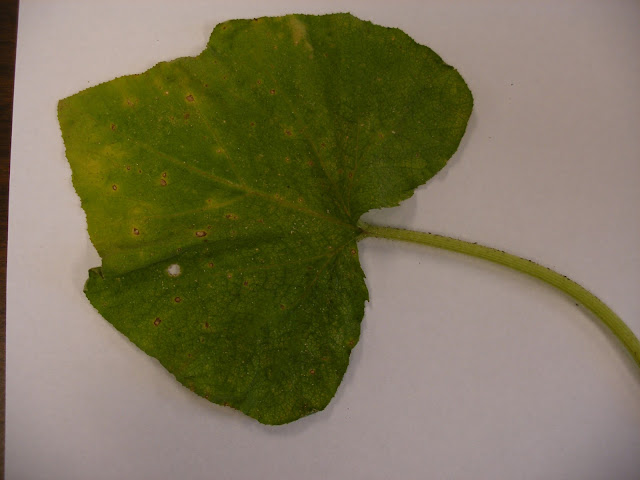
The backside of the leaf is the clincher: it shows the development of the purplish spores of the mildew.

A 2009 article about Downy Mildew, by Debbie Roos, out of NCSU's Growing Small Farms program, includes a useful set of suggestions for managing downy mildew in cucurbits (cucumbers, squash, melons) using organic-growing methods:
It is a little too late to plant resistant varieties this year, but if anyone has a garden that is particularly plagued by this fungus, selecting a resistant variety for next year might be a good idea. The bad news is that I have been unable to find a good list of resistant cultivars. Apparently, several cucumbers have decent resistance to Downy Mildew, but very few squash do.
However, it is still possible to improve air circulation around existing plants, by pruning or removing nearby other vegetation, even though we can't do much about the rain.
I would whine about how the weather this year is unusually bad for gardening, but it seems to be bad, in one way or another, pretty much every year. There will be a deluge, or a drought, crazy high winds, unusual high temperatures, or unusual cool temperatures, tornadoes, hurricanes or their remnants, hail, falling trees that come across the top of the house and smash parts of the garden.... you get the picture. No year will be The Perfect Gardening Year. Amazingly, we still get plenty of good food out of the garden, and I still love to be working in the yard on my little patches of crops.
Hope that all the other gardens and gardeners out there are growing well!
The front of the leaf looks unwell, but not spectacularly bad: it is yellowing and is showing some small brown spots inside bright yellow halos. This alone would not be enough to really nail down a diagnosis. (Sorry for the quality of the photos - I was having trouble with the lighting.)

The backside of the leaf is the clincher: it shows the development of the purplish spores of the mildew.

A 2009 article about Downy Mildew, by Debbie Roos, out of NCSU's Growing Small Farms program, includes a useful set of suggestions for managing downy mildew in cucurbits (cucumbers, squash, melons) using organic-growing methods:
"Cultural strategies can help prevent downy mildew. Plant resistant varieties. Plant in locations with good air circulation. Use drip irrigation to minimize leaf wetness.Notice the mention of weather that is "warm and wet and humid"? That is exactly what we have going this month, so this one volunteer squash might not be the only plant in Cobb County to be experiencing the problem. It may be helpful (though disheartening) to know that Powdery Mildew isn't the same as Downy Mildew, so that treatments that work for Powdery Mildew, which many local gardens dealt with last summer, might not work on this different mildew/fungus. (The ATTRA article on Downy Mildew in cucurbits, by George Kuepper, offers similar suggestions to those in the above NCSU article, with caveats that don't appear in the Roos' version, in case anyone is interested in looking at an additional source.)
There are a number of OMRI-listed products purported to help control downy mildew in cucurbits: copper, neem, biofungicides (e.g., Serenade®), peroxides (e.g., OxiDate®), and bicarbonates (e.g., Kaligreen®). According to Dr. Louws, research has shown that copper is the best organic option, but only on the crops that show little to no symptoms. He said if the infection is far along not to bother spraying because it wouldn’t do much good. Spray early in the morning to avoid phytotoxicity problems caused by spraying in the heat of the day. If the disease is present on the farm, a prophylactic application of a copper product can be made to curcurbit crops that show mild or no symptoms. If the weather does not favor the disease (which likes it warm and wet and humid), then the copper is more likely to suppress the disease. In other words, the copper may help but it may not be enough. (See Pesticide Use Guidelines)."
It is a little too late to plant resistant varieties this year, but if anyone has a garden that is particularly plagued by this fungus, selecting a resistant variety for next year might be a good idea. The bad news is that I have been unable to find a good list of resistant cultivars. Apparently, several cucumbers have decent resistance to Downy Mildew, but very few squash do.
However, it is still possible to improve air circulation around existing plants, by pruning or removing nearby other vegetation, even though we can't do much about the rain.
I would whine about how the weather this year is unusually bad for gardening, but it seems to be bad, in one way or another, pretty much every year. There will be a deluge, or a drought, crazy high winds, unusual high temperatures, or unusual cool temperatures, tornadoes, hurricanes or their remnants, hail, falling trees that come across the top of the house and smash parts of the garden.... you get the picture. No year will be The Perfect Gardening Year. Amazingly, we still get plenty of good food out of the garden, and I still love to be working in the yard on my little patches of crops.
Hope that all the other gardens and gardeners out there are growing well!
Monday, August 20, 2012
Four Little Squashes
When I went out to check on the garden after work today, I realized that the little butternut squashes had changed. They had become both more tan and less shiny - indicators that the squashes might actually be mature, even though it is still fairly early in the season.
 They've been growing for long enough, though, so I went ahead and cut them off the vine.
The NCSU extension publication Storing Winter Squash and Pumpkins explains that, normally, winter squashes will do better in storage if they first have a curing time of one to two weeks at fairly high (>80 degrees F) temperature and similarly high humidity.
I have found that butternut squashes, like sweet potatoes, get a little sweeter after curing, too. The good news is that my garage has just about perfect conditions for curing the squashes in, so after I am done admiring them for a day or two they will be parked in the garage for a couple of weeks, before being brought back into an air-conditioned space.
They won't sit around for long, though. When I have time, I will probably go ahead and roast them and then mash them to freeze for something like pie.
Elsewhere in the garden, plants are still producing. My house is still pretty much in chaos, and I couldn't find a pretty container/basket/bowl for posing my veggies in, so the photo shows them in the bag I had carried through the yard for harvesting.
It's not a huge pile of food, but it will still make a nice addition to our meals, to the pile of frozen veggies (bagged) in the freezer, and to the dehydrated veggies in jars on the storage shelves.

The tomatoes and peppers are assorted varieties. Underneath those are some Pigott Family cowpeas. We've already harvested a full quart of those (shelled-out and fully dried) Southern peas, but there are plenty more out in the garden.
As the cool-weather crops, the lettuces, other greens, carrots and more are making their slow beginning, it's nice to have the anchor of the summer crops still producing.

The NCSU extension publication Storing Winter Squash and Pumpkins explains that, normally, winter squashes will do better in storage if they first have a curing time of one to two weeks at fairly high (>80 degrees F) temperature and similarly high humidity.
I have found that butternut squashes, like sweet potatoes, get a little sweeter after curing, too. The good news is that my garage has just about perfect conditions for curing the squashes in, so after I am done admiring them for a day or two they will be parked in the garage for a couple of weeks, before being brought back into an air-conditioned space.
They won't sit around for long, though. When I have time, I will probably go ahead and roast them and then mash them to freeze for something like pie.
Elsewhere in the garden, plants are still producing. My house is still pretty much in chaos, and I couldn't find a pretty container/basket/bowl for posing my veggies in, so the photo shows them in the bag I had carried through the yard for harvesting.
It's not a huge pile of food, but it will still make a nice addition to our meals, to the pile of frozen veggies (bagged) in the freezer, and to the dehydrated veggies in jars on the storage shelves.

The tomatoes and peppers are assorted varieties. Underneath those are some Pigott Family cowpeas. We've already harvested a full quart of those (shelled-out and fully dried) Southern peas, but there are plenty more out in the garden.
As the cool-weather crops, the lettuces, other greens, carrots and more are making their slow beginning, it's nice to have the anchor of the summer crops still producing.
Subscribe to:
Posts (Atom)