Tuesday, December 24, 2013

Dahlias for the Bees

One of my friends grew a lot of dahlias this past year. When she dug them up to store for the winter, the ones she liked the least - all the cactus-flowered yellow ones - had produced more tubers than she was willing to keep.

However, those had nice, open centers that had made the flowers a favorite with bees, which meant she would be able to find a good home for the tubers without too much trouble. Lots of people want to help bees!

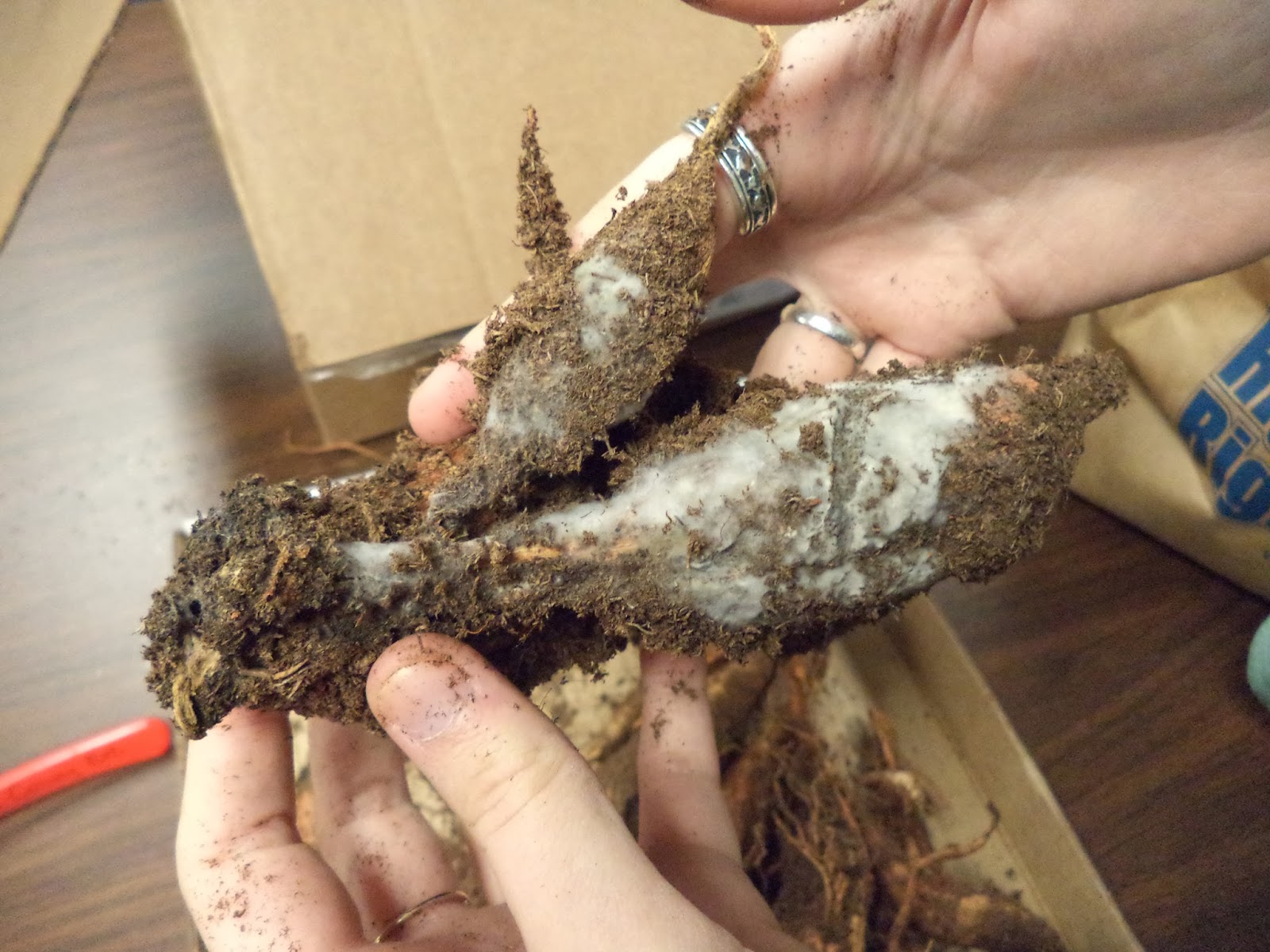
She tucked the tubers from those yellow-flowered plants into paper bags with peat moss, then put those in the car to deal with later. A month went by before she was able to pass them along. By the time the tubers made it to the office, some of them had developed problems. Luckily, a local dahlia expert -- my friend Maddie -- was in the office at exactly the right time. Of course, she was supposed to be working on her Senior DPA portfolio for 4-H!

It didn't take long for Maddie to sort through the tubers, trim away excess bits, and toss the bad ones.

Each bag held several plants'-worth of tubers, buried in the peat moss.

Some of the dahlia tubers were very obviously too far gone to keep.


She showed us the slimy innards of a tuber that had felt only a little bit soft from the outside.

This little dahlia tuber already has a nice big eye; it's a keeper!
One of the great things about my workplace is the number of plant-experts who stop by. We get to learn from all of them!

Monday, December 16, 2013

Tracking the Harvest: October and November, 2013

The big surprise is that, in spite of the monsoon-like quality of much of the year and the ravenous appetites of the local chipmunks, my yard has managed to provide more than 400 pounds of food in 2013 to this point. Harvests in the next few months will be pretty lean, but that's why we put away surpluses of crops like tomatoes, peppers, and beans when we have them in summer.

I've also been enjoying the butternut squash, which, like the sweet potatoes, keep just fine on their own without any work in "putting up" the harvest. They just sit around in baskets until I'm ready to use them. A lot of the butternut squash has been baked until squishy, then whirled in the blender (without seeds and skins) with some almond milk, black pepper, and sauteed onion and garlic -- quick and easy butternut soup! It just requires the forethought to have put the squash into the oven.

Weights below for the past two months are in kilograms:

October
Tomatoes, ripe 2.4
radishes 1.3
okra 1
Peppers 6.15

November
Persimmons, Asian 0.65
Radish, winter 2.15
Peppers 0.55
Carrots 0.4
Bok Choy 0.75
Potatoes 0.5


October 10.85 kg = 23 pounds, 14 ounces
November 5 kg = 11 pounds

Running total January through November = 181.95 kg = 401 pounds, 1 ounces


Friday, December 6, 2013

What Gardeners Think About in Winter

Just to start, two more seed catalogs arrived at my house this week: Vermont Bean and Totally Tomatoes. This means that the planning part of the gardening year is here. I will hazard a guess that I am not the only gardener who already has begun thinking forward to the next round of planting.

This means thinking about which varieties to grow for each vegetable, about how much space to give to each crop, about the best-yet-cheapest ways to add organic matter to the soil, about the crop rotation sequence, about planning for seed saving, about seed starting and whether the fluorescent fixture needs a new bulb. Really, there is just no end to the garden thinking that goes on in winter.

There also, here in the South, are vegetables still in the yard to harvest and eat. In my yard, I have carrots, winter radishes, broccoli, and cabbage that are at a good stage for eating, and there are vegetables that didn't make it to maturity before the cold set in for me to watch and keep weeded, so they can return to growing as the soil begins to warm again in March. This all takes some thinking, too.

And if, like me, you have a parallel life as a spouse, a parent and a person who has a full-time job, all that thinking has to fit in the spaces between the rest of it. In my own life, the "spaces between" have shrunk down to just cracks for the moment -- next week, my youngest son graduates from college, and in three weeks my oldest son is getting married (THREE WEEKS!!!)--- but that doesn't seem to stop my brain from turning toward the garden.

Wednesday, November 27, 2013

Good Food and Thankfulness

This week, my mind is more focused on "eating good food" than on "growing good food." Of course, it's hard to have the first without the second! All the gardeners fully understand that backward-sounding order, but plenty of other people forget that behind most good food there is thought, and work, and care.

I have been very fortunate in being able to grow good food in my yard. The food is fresh, and our meals are varied. All those vegetables probably contribute a lot of vitamins and minerals to our daily intake. The garden sparks conversations with my neighbors, building my local community. I am thankful for my garden, the good food it provides, and for the physical strength to manage it. Not everyone has the time or a sunny enough or large enough spot to grow their own food.

Not that long ago, much of the western part of the county was an agricultural area. The Old Guys still talk about how Cobb County and sweet potatoes used to be like Vidalia is, now, with onions -- viewed as the prime source of the sweetest and best produce. The fields were plowed using mules, and farming involved a lot of physical labor.

The sweet potatoes that grow in my yard (four varieties this year!) are also some work, and this year the chipmunks ate what I consider to be more than their share, but when we eat the sweet potatoes I was able to harvest, I know how they were grown (organic methods). I know that one variety is part of a line that stretches back more than 100 years in this county. I know that it is easy enough to grow this staple crop that other people can do it, too.

If enough other people give it a try, our whole community can benefit.


Tuesday, November 19, 2013

What Survived the Dip into the mid-20s

We had a couple of especially cold (for November) nights last week, and the garden showed it. The leaves of the pepper plants all wilted, the remaining summer annual flowers (marigolds, salvias, cleome) turned to mush, and even the last of the spring-type radishes fared poorly.

In the good news category, the winter radishes are still standing, as are the carrots. The cabbages and broccoli look good, even though they looked very sad on the coldest mornings. All the leaves fell off the Ichi Ki Kei Jiro persimmon, but the big orange fruits are still there, even a couple that have been half-eaten by my aerialist chipmunks.

The very small lettuces and assorted greens that have all struggled to get beyond the "delicious to chipmunks and wild rabbits" stage, also are still vibrantly green. In my dreams, they reach mature size before we get much colder weather.

A couple of stray potato plants had come up from tubers that were missed in the early summer harvest, and the tops of those collapsed in the cold. The good news is that we dug up another pound or so of red potatoes from underneath those wilted tops.

Essentially, last week brought an end to the remaining the summer crops that had been barely hanging on.

At the County Extension Office, we are still getting calls from people who want to know what vegetables they can plant now (gardeners rarely give up, and they aren't deterred by a little frost!). There is still time to put in some garlic and onions, but that's about it. However, this is a good time to start thinking about some winter-sown vegetables.

UGA Cooperative Extension's Vegetable Planting Chart (planting dates for middle Georgia need to be adjusted for Cobb County by 10-14 days) shows traditional planting dates for the most commonly planted garden crops. Alabama Cooperative Extension's Planting Guide for Home Gardening in Alabama offers dates that are similar to those in UGA's publication.

Other than the onion group, neither of these publications lists any crop that can be planted (with the hope of successful harvest) this late in Cobb County. Even the most cold-hardy vegetables are fairly tender when they are very young, and,  at this point, the odds are pretty small of any vegetable growing to a tougher stage before another killing frost occurs.

However, Colorado State's Extension publication Winter Gardening: Planting Vegetables in Early Winter for an Early Spring Crop tells about planting seeds in the ground in late winter, much sooner after the New Year  than many people might usually consider planting. In this publication, author Curtis Swift offers, along with some basic instructions, this list of cool season vegetables that can be winter-sown:
  • lettuce
  • peas
  • spinach
  • broccoli
  • Brussel sprouts
  • carrots
  • radish
  • cauliflower
A website called (not too surprisingly) Wintersown offers a step-by-step guide to an outdoor container-option for sowing seeds in winter.

For the many gardeners who like to keep things moving in the garden, winter-sown crops might provide a nice outlet for that pent-up planting energy.


Thursday, November 14, 2013

Baker Creek's Whole Seed Catalog for 2014: IT'S HERE!

Yesterday when I got home from work, I found this really great surprise in my mailbox:

First Seed Catalog of the Year!
It may seem early, but the timing is actually excellent. I've started putting together a presentation on planning the garden for seed saving, to be given in January, and Baker Creek Heirloom Seeds' big catalog full of open-pollinated varieties (no hybrids included!) is going to be helpful.

The catalog includes a basic guide to seed saving -- on pages 352-3 -- which I may be able to reference in my talk, but so far I've mostly used Suzanne Ashworth's Seed to Seed in putting together a chart of some important features and seed-saving guidelines of common garden crops. It probably helps that I save seeds from my own garden for some crops.

Anyone going organic and trying to exclude GM foods from the garden is also going to find useful information in The Whole Seed Catalog. For example, on page 61, in the corn section, there's a somewhat astonishing note:
"Each year we have a harder time getting seeds that test GMO-free. It is getting to the point where most heirloom corn varieties test positive for GMO's; even growers in remote areas are having problems with Monsanto's GMO corn."
And on page 11:
"Our company used to carry up to two dozen varieties of heirloom corn, until we began testing for GMO contamination in 2006. Now, we are barely able to offer half that number, since the remainder have tested positive. That's half these fine old historic varieties -- gone, until or unless we can find clean seed for them!"
It doesn't help that corn is wind pollinated. That pollen can probably travel for miles on a strong enough breeze.

There's an old joke about leaving a tip that ends "plant your corn early." That closing line may need to shift to a more serious version: "order your corn early," for people who want guaranteed GMO-free seeds for their corn patch.

Meanwhile, I will keep working on handouts for my talk, enjoying the great catalog, and planning my garden to allow for saving a few more kinds of seeds.

Tuesday, November 12, 2013

Where the Pollinators and Predators Hang Out

The picture below isn't from my yard. Joe and I walked around our local park last Saturday, and there were butterflies, bees, wasps, and other great insects on all the flowering weeds.

Not my yard, but great to see a Monarch butterfly near home
It made me wonder how much my own garden's success depends on the city's not mowing edge-to-edge in my local parks.

When food gardens have a problem with low productivity, it sometimes can be traced to a scarcity of pollinators. A lot of newer neighborhoods are border-to-border monoculture lawns. These yards are pretty low on habitat that would support useful populations of pollinators and other beneficial insects.

Most gardeners understand that this is a problem, and they follow guidelines like those in  UGA's publication Beyond Butterflies: Gardening for Native Pollinators to plant small-flowered herbs and other pollen-and nectar-rich flowers that attract pollinators and useful predators, but if the insects don't have a good place to reproduce and to survive the winter, there might never be an abundance of these useful critters.

My garden crops typically don't have a problem with lack of pollination, and there seem to be plenty of great predatory insects, too, but, like all those other gardeners, I do what I can to attract a diverse community of insects and other small creatures to my own yard. Also, I am lucky in that my yard backs up to a small patch of woods and that it has a creek -- with associated native vegetation -- running along one side. I am sure that all helps.

According to a recent article posted at Southern Region IPM News, The Right Habitat and Food Source Key for Beneficial Insects, that describes findings of entomologists at North Carolina State University, the parasitic wasp Telemonus podisi (it kills stink bug embryos) overwinters more often in leaf litter than in cracks of tree bark:
“The number of parasitic wasps, for example, was four times greater in leaf litter than those overwintering in tree bark,” said Lahiri. “This data, combined with lab studies, suggest the importance of woodland field borders with leaf litter from hardwood trees as a refuge area during winter for the parasitoids.”
I do have some woodland edge, but -- even combined with the right garden flowers -- the wild spaces in my one yard may not be enough to support all the beneficial insects that help out in my garden.

Wouldn't it be something if the unmowed and uncleared edges of city and county parks were the best refuges for our beneficial insect populations?


Wednesday, November 6, 2013

About Those Falling Leaves

It's really autumn now. Days are shorter and cooler, and leaves on the trees are changing from green to various shades of yellow, orange, red, and brown. In my neighborhood, leaf blowers and rakes have already been pressed into service to remove the first round of dropped leaves.

I am pretty sure that most gardeners can figure out, without any trouble or help from me, that all those falling  leaves blanketing their lawns would make great mulch and/or compost, but awhile back (ten years?) I wrote a poem about those leaves. I do not have any delusions about being a good enough poet that great hoards of people would want to read what I have written, but I'm going to post it here anyway.

Last year, a week after my house was smashed by an oak tree, my father died. He had been suffering from pancreatic cancer, so his passing was not a huge surprise. However, I remember his telling me once that he really liked this particular poem. That may have something to do with the return of the poem to my mind this year, even though he died in summer.


Predestination

They fall -- yellow stars
and tulips of sweetgum and poplar,
the red and orange of maple,
dogwood's burgundy.
My neighbor looks out
across the bright mosaic
of her yard and goes
to fetch the rake.
She shifts the luminous host
into plastic, scowls
as rags of color twirl
away, across her tidy lawn.
At night, I remove
the black bags from the curb,
take them to my yard,
set autumn free.

Tuesday, November 5, 2013

A Walk Around the Yard

Right now, the garden says that we have not yet had a hard frost, but that it's been too cool for most of the warm-weather plants. A few Zinnias and my friend Electa's Heirloom Pink Salvia are still blooming. The salvia re-seed all over the place, which mostly is fine because they attract lots of little pollinators.


This year's carrot and radish bed.
The carrots and winter radishes (to the right of the carrots) won't be too fussed about cold weather when it finally gets here, but both crops (and the rogue bok choy that somehow ended up in the same bed) have flourished in the warmth we've had so far.

I had hoped that last year's carrot success wasn't a once-in-a-lifetime event, and it looks as though the hope was not in vain. The carrot tops all look good, and the one carrot I pulled a few days ago (just to check on how things were going underground) was big enough that I think homegrown carrots will be part of our Thanksgiving dinner.

Winter radishes are getting big, a few at a time, and we have already been enjoying them as before-dinner snacks, sliced thin and lightly salted. They are our "healthy alternative" to the kinds of fried salty chips that come in bags at the store.
Ichi ki ke jiro persimmons

Broccoli patch

The broccoli is coming along, too. If I look straight down the center of each plant, I can see tiny heads beginning to form. At this point, it's too soon to guess when they will be ready to bring in for dinner, but it may be before the end of the month.

Ichi ki ke jiro persimmons will start coming in soon, too. In theory, they are edible while still as hard as apples (like now), but we learned last year that the flavor improves if they have more time on the tree to get a little bit soft.
Marigolds


Marigolds are still in bloom, and I've been bringing in some of the old, dried flowers to save the seed. This is one of the French marigolds that is supposed to be good for reducing nematode populations in the soil, when planted in a solid block to grow for several weeks (at least). I never grow them that way because the nematode problem hasn't been severe enough to warrant giving up a planting bed for so long in summer, but I like to be ready, just in case.
Still some peppers, in November

When we had our big "freeze forecast" scare more than a week ago, I harvested all of the larger peppers. There were still some smaller peppers out on the plants, and the tinies are beginning to get bigger. If we have another week or so of sunny afternoons in the high 60s-to-low-70s (degrees Fahrenheit), I may be able to fill the dehydrator one last time.

The garden is saying, essentially, that all is as it should be.


Tuesday, October 29, 2013

What is Organic Gardening?

In my not-vast-but-not-tiny experience of talking with other gardeners, I have found that the word "organic," as applied to gardening, seems to be not well understood. There's a good reason for that; the definition isn't easy or brief, but I am offering here a simplified explanation.

When we refer to organic gardening or farming, we mean growing food using a specific set of principles and inputs that are as close to the natural state as possible in a way that maintains a living soil with a diverse population of micro and macro-organisms. Spraying anything for pests and diseases is the LAST option for resolving garden problems, even if an organic-approved spray is available.

There's some significant overlap between organic and conventional gardening. Plants need nutrients, soil/support, water, sunlight, air in the root zone, and good air circulation around the leaves and stems, and those are the basics that good gardeners using both systems provide.

There are huge differences, too. In conventional gardening, soil is viewed as a substrate with important physical and chemical properties that affect how nutrients and water move through the soil. Fertilizers tend to consist of salts of various essential nutrients, which are available for uptake by plants as soon as they are dissolved in water. Many chemical options are available for diseases and pest control, and correct use of inputs (fertilizers, for example) depends on some simple math and basic guidelines.

In organic gardening, soil is viewed as home to an abundant and diverse community of tiny life forms. The physical and chemical properties are important, too, but more important is that nutrients are made available when released through the action of those microbes, fungi, and other tiny lifeforms that live in the soil. This action is, essentially, the decomposition of organic matter and other soil amendments. Maintaining the health, abundance, and diversity of this community underground is essential to having a productive organic garden. There are very few spray-on options available for pest and disease control, and those that are available don't work all that well (in general). Choosing inputs -- manures, composts, and rock powders, for example -- to maintain the abundant liveliness of the soil, takes careful thought and planning.

Looking at the differences between the two systems, and the absence of absolutes -- or simple prescriptions for what to do next -- in going organic, the big question is "why would any sane person choose organic gardening?"

Well, I can think of plenty of reasons. To start:

1. living near an ecologically sensitive area (like a stream) and not wanting to mess that up
2. wanting to provide as little support as possible for "big agriculture," for one reason or another
3. being majorly into DIY (doing it yourself), because with organic, you can
4. having small children or pets, and as a result not wanting to risk storing hazardous chemicals 
5. having a serious sensitivity to a wide variety of chemicals, and wanting to be free of rashes, fatigue, etc.
6. being concerned about losses in populations of bees and other pollinators
7. having a tendency to put food in your mouth - unthinking and without washing - while in the garden, or having a child with the same tendency
8. wanting to eat organically grown food, while at the same time having a tight food budget
9. being concerned over some of the newer, systemic pesticides used on commercial crops that can't be washed off, because they are taken up inside the cells of the plants

It is difficult to just go partway organic. Using composts and manures can be a big help in conventional gardening, improving water retention/drainage and nutrient flow/abundance, but using conventional fertilizers in an organic system is more likely to have negative effects. Some members of the below-ground community of micro and macro-organisms are very sensitive to the fertilizer salts; they will do less well if conventional fertilizers are added. If the action of those lifeforms is the major source of nutrients for your garden, their doing less well will be a problem, because your crops will also do less well.

Going organic also means that most pest and disease control is done through prevention, involving crop rotations, disease-resistant plants, avoidance strategies, cover crops, promotion of beneficial insects, and other strategies that require advance planning.

This sounds supremely complicated, but plenty of gardeners seem to be managing organic food production quite well, and we are fortunate in having a lot of information and other resources to help us along the way.

Monday, October 28, 2013

Busy Weekend: Harvesting, Processing, then Planting Some More

Late last week, the weather forecast was predicting a drop to 28 degrees Fahrenheit for Saturday morning, so I worked in the yard Friday evening to prepare for that drop, harvesting the rest of the tomatoes and most of the peppers. I left the smaller peppers -- any that would have been too fiddly to chop up -- on the plants. When we woke up the next morning, our porch thermometer was reading 36 degrees. It was cold enough that the coleus all wilted, but the pepper plants look fine, which is good news for our pepper production. There will be more!

All the peppers I brought in needed to be chopped for the dehydrator and freezer, and that took some time.

I also finally worked on getting the kernels off of the cobs of parching corn that I had brought in to finish drying way back in August. This was not, probably, the best year to grow a Southwestern variety of corn. The cool, rainy summer caused some of the cobs to get moldy before they fully matured on the plants. In the end, I had only two-and-a-half cups of kernels, but I tried parching some, and I am very happy with how the corn turned out. I will probably grow this Supai Red parching corn again next summer, instead of popcorn.

Also, the grain sorghum that I had grown and harvested was dry enough to "thresh," so I used the "no special equipment needed" method of rubbing the heads of grain between my hands to get the grains to drop out. It's been awhile since I've grown any small grains, and I had forgotten that there is so much work involved in separating the grains from the plants. I'm going to need a windy day to winnow out the chaff, but after the grain is cleaned, I should be able to pop it like tiny popcorn.

The variety that I planted is Tarahumara Popping Sorghum. I had planted it much later in the summer than I should have, and I ended up with about three cups of the grain. Next year I will try to get it into the ground sooner, to see if that improves the yield.

On Sunday afternoon, I finally planted the garlic, shallots, and multiplier onions. They went into one of the long beds in the side yard. If all goes well, the little bulbs will be sending up green shoots in just a few weeks.

Here in the metro area, temperatures can vary widely over a fairly short distance. A friend who lives in Canton, not too far north of here, had a very definite frost that put an end to her summer crops. I am guessing that other gardens in the area had the same experience. The good news is that the cool season crops get better and better, in terms of flavor, as the fall weather continues. I'm looking forward to sweet carrots and greens in the coming weeks.

Hope other gardens out there are doing well!


Wednesday, October 23, 2013

Great Things about Late October

Fried okra
Cubed butternut squash, sauteed in olive oil with garlic and black pepper
Tomato chips, made crispy in the dehydrator
Thinking forward to next year's seeds
Planting garlic
Thinly sliced radishes, lightly salted
A heaping basket of sweet potatoes on the kitchen floor
Falling leaves
Firing up the wood stove
Pansies, all happy-faced in bloom
Trains getting louder 
Peppery nasturtium seeds
Knowing that carrots are growing underneath those feathery leaves
Bok choy
Return of the barred owls to the woods behind the house


It seems like a short list, considering that I am thankful for so very much, but these are specific to this time of year.

I'm sure there are great things going on in the lives of other gardeners, too!