Sunday, July 21, 2013

Attack of the Pickleworms

My garden has been attacked by pickleworms before, so this is nothing new, but can I just say that I am not happy to see them? Luckily, so far they are not in the zucchini or melons, but they like those, too.

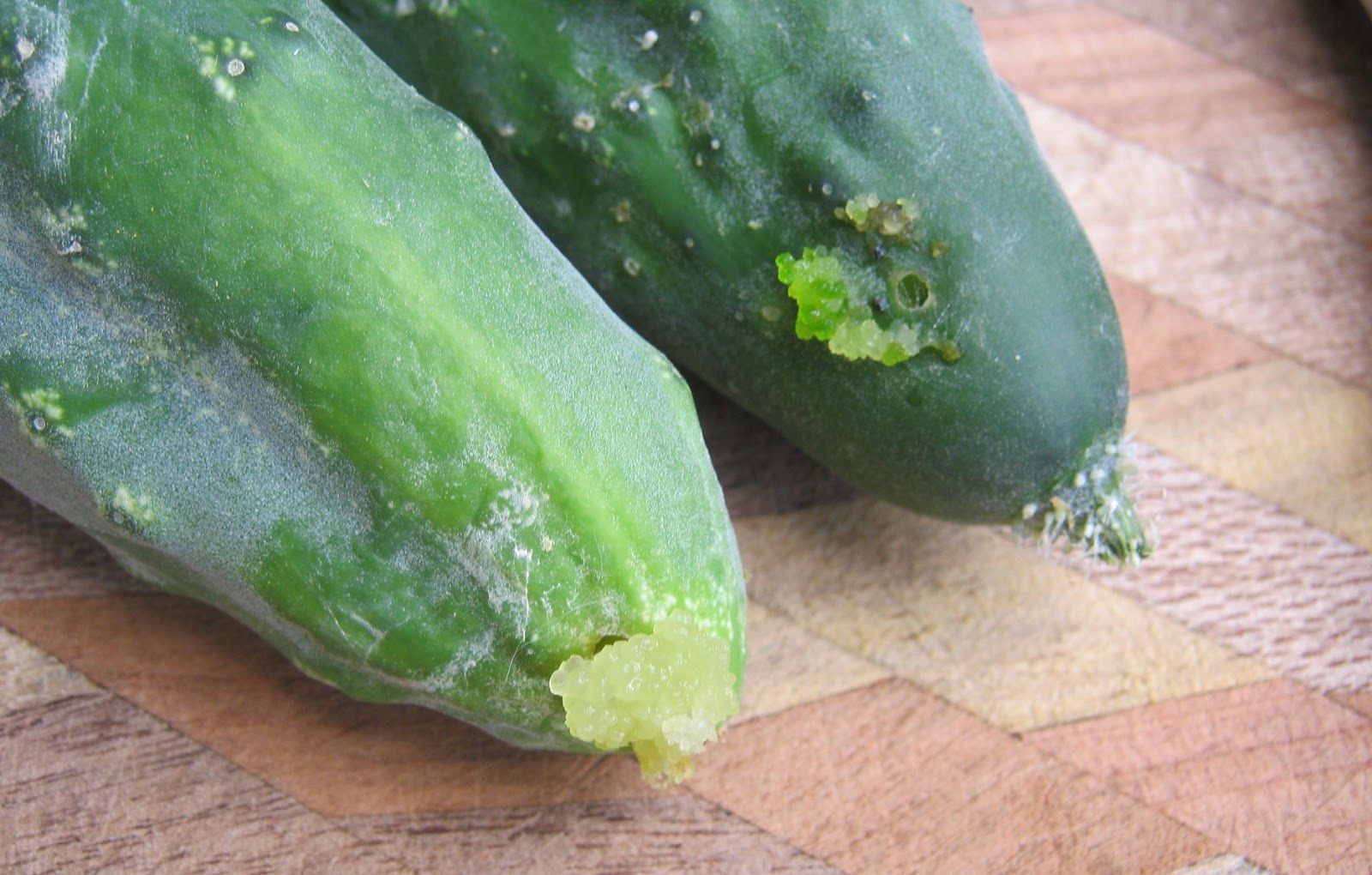
If your cucumbers have been attacked, what you'll see on the outside of the cucumber is likely to look a lot like this:
Evidence of pickleworms: Pale green frass and little round holes.   PHOTO/atlantaveggies.blogspot.com
If you slice into the cuke carefully, you may find the whole caterpillar. Of course, you might also find just half the caterpillar, which is a little disconcerting.

Actual pickleworm, tucked neatly into a cave of his/her own making. 
 PHOTO/atlantaveggies.blogspot.com


Since I don't like to use much in the way of pesticides in my garden, my options for controlling the problem are limited. One year, I thought I'd try covering the plants at night, then uncovering them in the morning. Since the worms are the babies of a night flying moth, covering them at night would keep the moths away from my plants.

It turns out that I don't love cucumbers enough to go to all that work - I would forget to cover them at night, and sometimes, when I'd managed that, I'd forget to uncover them in the day, which meant the new flowers didn't get pollinated.

If the rain would hold off for a few days, I'd spray the plants with Bt for caterpillars, which is supposed to not harm any other kind of insect, but the weather-radar this afternoon is showing little storms all over the Southeast, several of which are pretty nearby, and one of which is pouring water all over my yard right now.

The real trick would have been to get the cucumbers planted earlier, so my harvest-window would be longer, but the cool wet spring delayed planting, and my garden was plagued by crows as the seedlings began to show above ground. The crows kept pulling them up, and I kept replanting them. It may be a miracle that we have any fresh-garden cucumbers at all!

The good news, sort of, is that the onslaught of pickleworms coincides with some other cucumber-related problems. Even if I could keep back the pickleworms, there's still downy mildew, and we have some cucumber beetles, too, eating the leaf tissue while leaving behind a netted lace of the leaves' veins.

Sometimes, the best thing is to prepare to say "goodbye" to the cucumbers. While I wait for the other problems get worse, I will be trimming away the wormy spots, to get as much good cucumber as possible for as many more cucumber salads as I can.


Thursday, July 18, 2013

Time to Start Thinking about Cool Weather Crops

Last night, I pulled a box of Jiffy Pellets from my garden-supplies shelf and a few seed packets from their storage boxes, and I started some broccoli, cabbage, and cauliflower plants. Am I a total loon to be starting this early? It turns out that the answer is "no." Now is definitely the time to start some of the fall crops that typically are set into the garden as transplants.

Seeds that I hope to plant directly into the garden in mid-August (just four weeks from now!) include carrots, beets, and winter radishes. The lettuces, spinach, and other greens that would normally be planted outside at about the same time can be started in flats, to be transplanted out later. I usually don't start the fall greens in trays (or peat-pellets), but this year I might need to. 

My garden got off to a late start this year; I kept waiting for warm weather, and it was very slow in coming! That means that the whole garden is running behind. As a result, it will be more of a challenge than usual to get the fall crops planted, making the use of lots of transplants much more necessary. Transplants can go into the ground later than seeds, giving the summer crops more time to finish their work.

The good news for gardeners who don't have the right packets of seed on hand is that, in the past several years, local stores have begun keeping seeds in stock right through the summer. A decade or so ago, by mid-July there no longer were any seeds in stock on shelves in any of the usual places. We all had to plan ahead much more carefully!

For people who are new to Fall gardening or who have questions or want to know more, I'll be giving talks on Planning the Fall Vegetable Garden in the next couple of weeks. One will be at the Cobb County Extension office (Tuesday, July 23, 6:30 p.m.) and one at Chestnut Ridge Christian Church (Saturday, August 3, 10:30 a.m.). Both are free and open to anyone who'd like to attend.


Monday, July 15, 2013

Squash Downy Mildew

It has been hilariously rainy here, and the garden is having some of the expected disease problems that go along with all the wet soil and humid conditions. For example, a volunteer butternut squash plant growing among the tomatoes is showing signs of downy mildew on its oldest leaves.

The front of the leaf looks unwell, but not spectacularly bad: it is yellowing and is showing some small brown spots inside bright yellow halos. This alone would not be enough to really nail down a diagnosis. (Sorry for the quality of the photos - I was having trouble with the lighting.)


The backside of the leaf is the clincher: it shows the development of the purplish spores of the mildew.


A 2009 article about Downy Mildew, by Debbie Roos, out of NCSU's Growing Small Farms program, includes a useful set of suggestions for managing downy mildew in cucurbits (cucumbers, squash, melons) using organic-growing methods:
"Cultural strategies can help prevent downy mildew. Plant resistant varieties. Plant in locations with good air circulation. Use drip irrigation to minimize leaf wetness.

There are a number of OMRI-listed products purported to help control downy mildew in cucurbits: copper, neem, biofungicides (e.g., Serenade®), peroxides (e.g., OxiDate®), and bicarbonates (e.g., Kaligreen®). According to Dr. Louws, research has shown that copper is the best organic option, but only on the crops that show little to no symptoms. He said if the infection is far along not to bother spraying because it wouldn’t do much good. Spray early in the morning to avoid phytotoxicity problems caused by spraying in the heat of the day. If the disease is present on the farm, a prophylactic application of a copper product can be made to curcurbit crops that show mild or no symptoms. If the weather does not favor the disease (which likes it warm and wet and humid), then the copper is more likely to suppress the disease. In other words, the copper may help but it may not be enough. (See Pesticide Use Guidelines)."
Notice the mention of weather that is "warm and wet and humid"? That is exactly what we have going this month, so this one volunteer squash might not be the only plant in Cobb County to be experiencing the problem. It may be helpful (though disheartening) to know that Powdery Mildew isn't the same as Downy Mildew, so that treatments that work for Powdery Mildew, which many local gardens dealt with last summer, might not work on this different mildew/fungus. (The ATTRA article on Downy Mildew in cucurbits, by George Kuepper, offers similar suggestions to those in the above NCSU article, with caveats that don't appear in the Roos' version, in case anyone is interested in looking at an additional source.)

It is a little too late to plant resistant varieties this year, but if anyone has a garden that is particularly plagued by this fungus, selecting a resistant variety for next year might be a good idea. The bad news is that I have been unable to find a good list of resistant cultivars. Apparently, several cucumbers have decent resistance to Downy Mildew, but very few squash do.

However, it is still possible to improve air circulation around existing plants, by pruning or removing nearby other vegetation, even though we can't do much about the rain.

I would whine about how the weather this year is unusually bad for gardening, but it seems to be bad, in one way or another, pretty much every year. There will be a deluge, or a drought, crazy high winds, unusual high temperatures, or unusual cool temperatures, tornadoes, hurricanes or their remnants, hail, falling trees that come across the top of the house and smash parts of the garden.... you get the picture. No year will be The Perfect Gardening Year. Amazingly, we still get plenty of good food out of the garden, and I still love to be working in the yard on my little patches of crops.

Hope that all the other gardens and gardeners out there are growing well!


Sunday, July 14, 2013

Garden Update

The usual abundance of the summer garden is finally kicking in:

Straight Nine cucumbers; yellow, red, and black tomatoes; assorted peppers.  PHOTO/Amy W.
Chanterelle mushrooms.      PHOTO/Amy W.
The harvests aren't wildly varied right now, but that will change as the summer rolls on. The cucumbers are doing especially well. I don't know how long that will last, though, because the first vine up already has some interesting angular lesions on its leaves. That is not a good sign. However, Joe started a crock of brined pickles today, and I loaded the dehydrator with tomatoes and peppers. Things are looking up!

The woods have been a source of abundance, too. We've eaten chanterelle mushrooms with a few meals in the past week or so, and a lot were dried (have I said lately how much we love our dehydrator?) for later use.

Out in the neighborhood, the Cobb County Water department has been working on the water lines. We have a new fire hydrant in the Northwest corner of our yard, which is definitely good, but we also have a bit of a mess up by the curb. When we found out about the plan to replace our pipes, I delayed planting some of the crops that had been slated for the beds nearest the road.
Cucumber on a still-healthy vine.     PHOTO/Amy W.

The workmen did a great job of avoiding my gardens, even though they technically encroach into the easement, and I decided last week that it was probably safe to plant those spaces.

It is too late for the peanuts, so those will have to wait until next year. It is probably too late for the sorghum, too, but I planted some anyway. There were a lot more seeds in that packet than in the peanut packet, so it seemed like a safer gamble.

I also planted some bush beans. There is still plenty of time for those!  There is a plan to put a couple of tomato plants where the first bush beans came out (those pesky Bean Beetles did a lot of damage!), but the weekend has been very busy, and that isn't done yet.

In a weird bit of good news, I have a bad habit of tossing tomatoes affected by things like chipmunk bites and blossom end rot into the shrubbery by the creek.

Poblano peppers.       PHOTO/Amy W.
A couple of tomato plants have come up over there, and they both already have a few flowers. I have no idea what kind they are, but I will be digging them up one evening this week to transplant into the garden.

Meanwhile, I am expecting the zucchini plants to expire soon (due to Squash Vine Borers), and when they do, I will be planting buckwheat as a short-term cover crop in that space. In mid-August, when it is time to start putting out the fall crops, I'll turn the buckwheat into the soil and plant carrots in that bed.

I hope that all the other gardens out there are enjoying our break from the rains and doing well!

Thursday, July 11, 2013

Tomato Problems Abound

The tomato-ripening has been slow to begin, but it finally is coming along at a faster clip. The Cherokee Purple tomatoes are big and beautiful; however, the plants on which they are growing look terrible. I wasn't able to get a good picture of the tops of the two plants, partly because the plants are so tall and partly because it keeps raining. Aiming up results in a wet camera lens!

Many of the leaves are bedraggled, and there is marked wilting of some individual stems, while other stems continue to look just fine. I sliced into one of the wilted stems and saw brown in the vascular tissue (located between the green skin and the white, central pith). Those indications, along with the fact that the tomatoes continue to look good, leads me to believe that the problem is one of the soil-borne wilts, probably Fusarium. That is a huge relief, because I have heard that Late Blight (a very bad tomato disease) has been "going around."

Great-looking Cherokee Purple tomato, finally ripening, on a very sad plant.  PHOTO/Amy W.
Ironically, the Costoluto Genovese tomatoes also look good, and also on a very raggedy-looking plant, but it has a completely different problem; it has a leaf-spot disease. I'm thinking that it is Early Blight, because the brown areas on the leaves continue to expand (slowly), and they get the typical concentric rings as they enlarge.

Costoluto Genovese tomatoes, on a plant with a leaf-spot-type fungus.  PHOTO/Amy W.
For the Cherokee Purple tomatoes, my current plan is to harvest all the big tomatoes and then pull up the plants. My next patch of bush beans will go in their place. I just need for it to stop raining long enough to manage the task!

The Costoluto Genovese tomatoes aren't quite as far along. I keep hoping for a dry day (notice a theme here?) on which I can go out and trim away all the "bad" leaves and then see if there is anything besides fruit left to salvage after I complete the pruning.

While I was in Texas, the rain gauge out in the garden accumulated more than five inches of rain. The tomato-disease problems aren't a big surprise, considering how wet it has been all spring and summer. However, they are annoying. Since the forecast is for more, and yet more rain, I am thinking that it is time to come up with a Plan B. Wish me luck?

Meanwhile, there is a little lesson here about these two varieties of tomatoes: Costoluto Genovese seems to resist Fusarium wilt, and Cherokee Purple seems to be resistant to Early Blight. In future years, that information might come in handy.

I hope that all the other gardens out there are having fewer tomato problems!

Sunday, July 7, 2013

Tracking the Harvest: May and June 2013

Who knows what a normal gardening year looks like? I'm beginning to wonder if it will ever be possible again to predict with any accuracy when a crop will come in!

This year's harvests are coming along, but fairly slowly. In other words -- it's all a bit late. I know I'm not the only gardener in the area with this problem, because I've been getting calls at the office from other gardeners who are waiting (and waiting ...) for some of their crops to reach maturity. The potatoes in my yard were a week or so late.

About two-thirds of this year's potato harvest.         PHOTO/Amy W.
The tomatoes, though, are driving us all nuts! Some people are getting decent ripening in their cherry tomatoes and some of the hybrid varieties, but most of the big heirlooms seem to be waiting for less rain and warmer temperatures.

Cherokee Purple tomatoes, just hanging out, not in any hurry to ripen in this cool, wet weather.  PHOTO/Amy W.


The native plants out in the wooded back yard seem unfazed by the weather, but the Rabbiteye blueberries in front are very late, and they aren't too many generations from "native".

Goldenseal making its beautiful red fruits in my back yard.        PHOTO/Amy W.
So, to update the harvest tally, this is what my yard has given us - measured in kilograms - in the past couple of months:


May
radishes
0.25
Lettuce
1.4
carrots
0.45
Onions, multipliers
0.65
strawberries
0.15
Peas, edible pod
0.35
Beets plus greens
0.35

June
Bush beans, green
3.25
Zucchini
10
Peppers
1.05
Cucumbers
0.7
Swiss chard
0.2
Eggplant
0.8
Berries, misc.
0.85
Onions, bulbing
2.85
Tomatoes, ripe
0.15
Potatoes
14.35
Onions, multipliers
0.8
Garlic
1.5


The total harvested weight for May was 3.6 kg, which converts to 7 pounds, 15 ounces; for June it was 36.5 kg, which converts to 80 pounds, 7 ounces.  
The running total for the year, January through June, is 59.75 kg, which converts to 131 pounds 11 ounces.
Last year's harvests from these months were very different, but last year was warm unusually early, so it isn't a good year for comparison. I am pretty sure, though, that the tomatoes should be stampeding into my kitchen by now.

Hope we get a few days break from the rain soon, and that all your gardens are doing well!

Saturday, July 6, 2013

I've Been in Texas

Sorry for the lack of garden-posting, but I've been to Texas for a big family gathering. One special feature of this particular gathering was that ALL my brothers and sisters were able to be there, so we stood together - in birth-order - for a photo with Mom. Mom is on the far left, the oldest daughter is next, and so on; I'm between two of the boys (fourth person from the left, but the third of Mom's children).

Mom and all eight of her children. July 4, 2013.          PHOTO/Amy W.
There were lots of kids and a few grandkids (great grandkids for Mom), and we ate too much food, some of which probably wasn't all that healthful. However, it was all great!

I'll be back with our "regularly scheduled programming" in the next day or two. Hope everyone else had a great Independence Day!

Monday, June 24, 2013

An Animal Surprise in the Garden

In my front-yard garden, I have seen many different kinds of animals, or evidence of their having stopped by, over the years. Some of the animals are pests, and but not all.

Of course, there has been a vast assortment of the neighborhood pets, both dogs and cats. We've had rabbits (the native kind), chipmunks, voles, possums, rats, box turtles, lizards, frogs, salamanders, and snakes. (How could I forget even ONE of the snakes? They are always such a surprise.) I've seen deer walking up the road, thankfully not stopping to check out my garden. And there have been birds of all kinds: those pesky crows, the whole list of species that eat my blueberries, goldfinches, hummingbirds, crested flycatchers, loud wrens, and many more. There are coyotes and racoons in the woods out back, but I haven't seen them or their footprints in front.

If anyone had asked, I would have said that I had seen pretty much all of the kinds of animal-visitors-to-the-garden that I would see.

So this visitor to the garden was unexpected:
Snapping turtle visits the garden.                PHOTO/Amy W.
I had been about to walk down that path to pick a cucumber when the sight of this snapper stopped me in my tracks. I think she was looking for a place to lay her eggs, but the clay in the paths is pretty tough stuff to dig in.

After a few minutes, she got herself turned around,  picked herself up -- on surprisingly long legs -- and made her slow way back toward the creek.

Friday, June 21, 2013

Found Food: Black Trumpet Mushrooms

When I was out walking the dog the other day, I noticed some very tiny yellow chanterelle mushrooms beginning to form. In years past, a place I know that has tended to produce small numbers of black trumpet mushrooms has been "past its prime" by the time the chanterelles were large and well-formed, so I went (as soon as I could) straight to the black-trumpet-spot to check it out, hoping that I hadn't missed the magical black-trumpet time.

If I had been a day or two later, the mushrooms might have been larger, but waiting also meant risking a total loss if I couldn't get back to the spot in time.  This is what I was able to harvest:

Small Black Trumpet mushrooms.                                  PHOTO/Amy W.
I don't think I can complain! These mushrooms weigh very little, but they are packed with amazingly wonderful flavor.

Monday, June 17, 2013

Persistent Herbicides, OR, Manure Isn't What it Used to Be

Pepper plant affected by persistent herbicide in Cobb County, GA. PHOTO/Amy W.
I have a friend who has been farming for a very long time, and his life experience has told him that Manure Is Good.

He has friends - owners of stables of horses - who offer to provide him with enormous amounts of composted manure, and he accepts.

Even though he has had trouble with manure before (a couple of years ago), he spread it on some of his planting beds again this year, and the tomato-family plants, not too surprisingly, have become twisty and weird.

The leaves from before the spreading of the compost look fine, but all the growth since the application looks pretty bizarre.

The North Carolina State Univ. publication about Herbicide Carryover explains that the chain of herbicide-treated hay to horse to compost needs to be very clear. Unfortunately, in the casual exchanges of small-plot farmers, the information chain can become a little vague. That can be a problem for garden-farmers who are hoping to produce healthful food from their land.

For any of us who have always thought that manure can be a great amendment to the soil for their vegetables, it is good to remember that times have changed, and that not all composted manures are what they used to be.

Sunday, June 9, 2013

Finally, a Summer Harvest!

I have been bringing in green beans for a few days now, and this is not the first pepper, and the zucchini isn't quite full-sized, but today is the first day I could bring in more than one or two kinds of veggies from the garden in the same day.

In honor of the occasion, I have arranged it all in Grammy J's cut glass bowl (Grammy J was my mother's mother's mother -- my great grandmother). That is just how happy I am with the little harvest.

First real harvest of summer crops, 2013.            PHOTO/Amy W.
I brought in the regular bulbing onions today, too, but they need to dry a few days on the front porch before I trim and weigh them.

The 2013 harvest of bulb-type onions from my yard.        PHOTO/Amy W.
We've had crows in the yard over the past couple of weeks, which means that seedlings have been pulled up and tossed about. I've replanted some of the cucumbers (and melons, and butternut squash) more than once.

To protect the most recent batch, I cut the bottoms from small plastic cups then pushed the cups down around the seedlings as they emerged. This seems to have been enough protection; the smallest cucumber plants finally all have a couple of true leaves. This may be enough that they are no longer so attractive to crows.

At home and at the garden/farm where I volunteer, I have been pruning the tomato plants. If I can't stand up tomorrow, it's because I have been hunched over pruning leaves and suckers from about 150 tomato plants in the past couple of days. Here in the South, diseases are an ever-present threat to tomatoes. It can help if the plants are pruned up a bit.

I like to get them to the point that there are no leaves within about 18 inches of the ground, and I prune away leaves that are growing in toward the center of the plant, to create a cone of air-space in the center. This takes several weeks of work as the plants grow, but the improved airflow can help keep the remaining foliage drier and less susceptible to the most common airborne fungal diseases.

Hope all the other gardens out there are growing well!

Monday, June 3, 2013

Plenty of Blossoms, But No Big Zucchini

My Raven zucchini plants are flowering, but it will be awhile before I have sizable squashes to eat. That's because the flowers that are farthest along in development are all female.

Squash family plants have separate female and male flowers. Annoyingly, if the two kinds aren't open and ready at the same time, no pollination takes place, and the little fruits at the base of the female flowers just languish, wilt, and drop off.

Two female flowers, fat yellow buds almost ready to open, sit on tiny, undeveloped squashes. PHOTO/Amy W.
The male flowers sit on top of slender stems, rather than on tiny squashes. In the second picture (below), there is a male flower in the foreground. It is still very green, and I don't expect it to mature for a few more days. In that time, a lot of female flowers in my squash patch will have opened and missed being pollinated.

Male squash flower in the foreground sits on a slender stem rather than a tiny fruit.  PHOTO/Amy W.
Anyone who's had the experience of seeing lots of blossoms, but a week or so passes without any squash developing, has probably had this same situation -- lots of one kind of flower and none of the other. Eventually, the other flowers develop and the squash/fruits finally begin to grow, but the wait can be tough.

For gardeners whose squash patches are small (just a few plants), if a quick check of the plants shows a few females but only one male in full bloom, that mature male flower can be plucked from the plant, the petals torn away, and pollen-holding parts (anthers) used to pollinate all the open female flowers.

In the early part of squash season, I tend to do just that -- "be the bee" for a couple of weeks -- until I see plenty of pollinators working to take back that job.