In a recent survey, the state’s Master Gardeners indicated that they’d like to know more about sustainable gardening. One big hurdle will be figuring out exactly what “sustainable gardening” means!
Some gardeners are going to want to see a focus on ecological sustainability – such that the garden’s soil develops a healthy mix of microbial and other life, and as many pests as possible are “handled” by resident populations of beneficial organisms. Such a garden might rely a lot on things like cover crops, local composts, and crop rotation and use very little in the way of purchased inputs, while staying as far away from any non-renewable resources as possible.
However, there will also be a group that prefers to emphasize that a sustainable garden is one that the gardener can most easily create and maintain. The selected inputs are reasonably priced, the planning and physical workload are easily manageable, but the garden still produces plenty of the desired foods. Non-renewable inputs are used prudently, but they definitely have a place in this version.
And then there's probably a group that will not consider a garden to be sustainable if it can't be maintained productively through a serious hard time (think "zombie apocolypse"). This group might (I don't know for sure) use a mix of several strategies, ranging from keeping a stash of stored inorganic nutrients and other inputs for just-in-case, to the setting up of composting toilets as a source of nutrients and organic matter.
All will agree, I think, that a sustainable garden should be sized so that the gardener isn’t overwhelmed by the work of maintaining it. After all, if the garden is over-run with weeds, or if it becomes like a deep dark pit into which money and time disappear, the gardener may opt to “throw in the trowel” and return the space to something like turf. The overly-consumptive garden isn’t at all sustainable.
A garden also can't continue if its soils become depleted of nutrients.The most easily obtained (for urban and suburban gardeners, anyway) and inexpensive inputs tend to be inorganic fertilizers, like a bag of 10-10-10. Over time, though, if not enough is done to improve - or even just maintain - soil health, yields will drop. Our experience at the Plant-A-Row-For-the-Hungry garden shows that fairly well.
In the first several years we mulched with newspaper and fallen leaves (saved over the winter for use in spring and summer), and we followed fertilizer recommendations that came with our soil test results. Over those several years, yields dropped a little very year. Then, we switched to organic sources of nutrients and grew a winter cover crop of Austrian Winter peas. After just one winter, yields went back up to almost as high as those in the very first year of the garden. Talk about a turnaround!
The original plan/method turned out to be not sustainable in terms of the garden's continuing productivity - but the 50 pound bag of kelp meal wasn't cheap, and we had to travel a ways to find the giant bag of cover-crop peas for our 4,000 sq. ft. garden. If we had had a tighter budget, the garden might have suffered for another year.
It's a pretty safe bet that there will be huge areas of disagreement in what a sustainable garden would look like - or whether it's even possible to create one - and in the end, creating a garden that is acceptably sustainable is probably going to require a bit of a balancing act. It probably also will look different for different gardeners.
In the near term, my mostly-organic, home vegetable garden is an OK size. I can manage its ~350 sq. ft. of various beds mostly on my own, and it provides a decent amount of food for my family.
Some years, I am less good about managing it in a way that requires fewer inputs, because the environmentally sustainable way, the way that builds soil organic matter and encourages a diverse and abundant liveliness within the soil, usually requires some planning. It requires cover crops, as much compost as my yard can deliver, and good crop rotations; it requires planning for pollinators and habitat for beneficial insects; it requires enough forethought to get the nutrients into the soil soon enough that the microbial life can make it available to transplants, and more.
Even in my best, most "on" years, when all the planning happens and when I actually manage to follow through, I'm not sure the whole enterprise is completely sustainable - but the food is good, being out-of-doors is great, and for me, anyway, it's close enough.

Wednesday, October 31, 2012


Friday, October 26, 2012
State of the Garden Report
It's been a great year for peppers in my yard, but the season is just about at its close.
 We'll be pulling up the pepper plants (see pathetic plants in photo below) this weekend, because the cool nights have taken their toll on the heat-loving plants. It won't help that the forecast includes a dip down into the mid-thirties within the next few days.
Other plants due for removal this weekend include the last of the eggplants.

If all goes well, I'll get the garlic planted - it's time - but it's probably better if I don't absolutely count on getting that done.
At this point, most of my cool-weather crops are looking very promising. The broccoli will be big enough to harvest soon!

The extra-cold weather heading my way can only help. There are enough of these in the garden this year to make several good meals-worth of the central heads.
If this winter is anything like last winter and we don't get any hard freezes (with temperatures down into the teens or below), we could get more meals from the little side-shoots, too.

Joe, though, is looking forward to the cabbage harvest. He LOVES sauerkraut, and last year he wasn't able to make enough from the cabbage that was available.
This year, we have a dozen of our own plants to add to any harvested from the little farm where we volunteer on the weekends.
He will have to wait a few more weeks for the cabbage, but the first heads should be ready by Thanksgiving. At our house, the best batches of sauerkraut are the ones that are made in cooler weather. I don't know if that is because the whole process procedes at a slower pace or if it's because the mix of bacteria/fungi in the air is different.

Regardless, we've figured out that he needs to make his sauerkraut in fall, rather than in spring, even though we can grow cabbages that mature in April.
We've been eating some of the lettuces and spinach (not pictured), too. I've fed some of the tiny lettuces - that were pulled to thin the bed - to my bunnies, but I'm planning for most of the lettuce to feed the humans in the house.

This year's carrot patch is looking like it could be the best I've ever planted in this yard. If I am really lucky, next year when it's time to plant the fall carrots I'll be able to decipher my notes about what I did with the soil to make this happen. It's always great to be able to replicate a success.
Weather reports are calling for some fairly stunning storms (can I use the plural form, when what's really supposed to happen is a collision/combination of two?) north and east of here. I'm hoping for the best possible outcome for everyone in the affected areas!
May your hatches be safely battened down, your larders and water-stores sufficient to meet the need, and everyone make it through un-injured.

Other plants due for removal this weekend include the last of the eggplants.

If all goes well, I'll get the garlic planted - it's time - but it's probably better if I don't absolutely count on getting that done.
At this point, most of my cool-weather crops are looking very promising. The broccoli will be big enough to harvest soon!

The extra-cold weather heading my way can only help. There are enough of these in the garden this year to make several good meals-worth of the central heads.
If this winter is anything like last winter and we don't get any hard freezes (with temperatures down into the teens or below), we could get more meals from the little side-shoots, too.

Joe, though, is looking forward to the cabbage harvest. He LOVES sauerkraut, and last year he wasn't able to make enough from the cabbage that was available.
This year, we have a dozen of our own plants to add to any harvested from the little farm where we volunteer on the weekends.
He will have to wait a few more weeks for the cabbage, but the first heads should be ready by Thanksgiving. At our house, the best batches of sauerkraut are the ones that are made in cooler weather. I don't know if that is because the whole process procedes at a slower pace or if it's because the mix of bacteria/fungi in the air is different.

Regardless, we've figured out that he needs to make his sauerkraut in fall, rather than in spring, even though we can grow cabbages that mature in April.
We've been eating some of the lettuces and spinach (not pictured), too. I've fed some of the tiny lettuces - that were pulled to thin the bed - to my bunnies, but I'm planning for most of the lettuce to feed the humans in the house.

This year's carrot patch is looking like it could be the best I've ever planted in this yard. If I am really lucky, next year when it's time to plant the fall carrots I'll be able to decipher my notes about what I did with the soil to make this happen. It's always great to be able to replicate a success.
Weather reports are calling for some fairly stunning storms (can I use the plural form, when what's really supposed to happen is a collision/combination of two?) north and east of here. I'm hoping for the best possible outcome for everyone in the affected areas!
May your hatches be safely battened down, your larders and water-stores sufficient to meet the need, and everyone make it through un-injured.
Tuesday, October 16, 2012
Bok Choy! (or, Pak Choi!)
Regardless of how we're spelling it, this cool weather veggie is great in stir fries, and we had one of these beautiful plants in our stir fry last night.
 Some of the other cool weather crops are getting close to harvest size, too. I know that plenty of gardeners would already have harvested some lettuces from my lettuce plants by now, and also some of the spinach, but I like for the leaves to be larger and sturdier.
The broccoli is starting to make tiny heads, too. If I had noticed their progress earlier - before dusk - I would have taken a photo to add to the post.
After the (late) tour to check on how the garden was doing and picking peppers for tonight's (late) supper, I planted some veggies that I had bought for a demonstration for work. There was one kale (Winterbor hybrid), one cilantro, and nine or so Red Sails lettuces, all of which I planted by streetlamp-light. There are some tiny new broccoli plants still to go, and I'm hoping to get those planted after work tomorrow.
Hope everyone else's gardens are doing well!

The broccoli is starting to make tiny heads, too. If I had noticed their progress earlier - before dusk - I would have taken a photo to add to the post.
After the (late) tour to check on how the garden was doing and picking peppers for tonight's (late) supper, I planted some veggies that I had bought for a demonstration for work. There was one kale (Winterbor hybrid), one cilantro, and nine or so Red Sails lettuces, all of which I planted by streetlamp-light. There are some tiny new broccoli plants still to go, and I'm hoping to get those planted after work tomorrow.
Hope everyone else's gardens are doing well!
Sunday, October 14, 2012
A "Good Year" for Chipmunks
If I had been purposely growing chipmunks this year, I'm pretty sure I could say that I had a bumper crop. I am not alone in this. At least part of the problem was the drought. Chipmunks (and squirrels in some people's yards) all figured out that the gardens were watered and full of moisture-laden produce, which they proceeded to munch on.
The situation could have been worse. In some yards, chipmunks (and/or other pestiferous mammals) took one or two bites out of nearly every tomato produced. At least my tomatoes were spared! Here in my yard, it turns out that the chipmunks pretty much stuck with the sweet potatoes.

Today was fairly warm, and we've been without rain for several days - all good for harvesting sweet potatoes - so I dug the sweets up this afternoon. Every plant had at least one big potato with significant munching damage.
It's hard to complain about the approximately 22 pounds of good sweets that I was able to put into the basket to bring in, but I couldn't help thinking (somewhat wistfully) of one really spectacular year for sweets, years ago, when the plants averaged something like 6 pounds each of total production.
Is it like that for everyone? Do we all look back, with a little regret or longing, thinking about that one really great harvest year, even though the current harvest is absolutely fine? Twenty-two pounds of sweet potatoes will take us pretty far into the winter; it seems like "sour grapes" to complain, but there was that one year...
The sweets I brought in still need to be set up for curing. That typically involves either our small space heater or a small lamp with an incandescent bulb (they get nice and toasty), but I'm not sure yet how to set that up in the new arrangement of my house. Everything is just a little bit different.
One way or another, it will get done, because curing the sweets in a warm place does amazing things to the flavor, but the exact set-up is yet-to-be-determined.
Here's hoping that everyone else had a great year for sweet potatoes and a less-than-good-year for chipmunks!
The situation could have been worse. In some yards, chipmunks (and/or other pestiferous mammals) took one or two bites out of nearly every tomato produced. At least my tomatoes were spared! Here in my yard, it turns out that the chipmunks pretty much stuck with the sweet potatoes.

Today was fairly warm, and we've been without rain for several days - all good for harvesting sweet potatoes - so I dug the sweets up this afternoon. Every plant had at least one big potato with significant munching damage.
It's hard to complain about the approximately 22 pounds of good sweets that I was able to put into the basket to bring in, but I couldn't help thinking (somewhat wistfully) of one really spectacular year for sweets, years ago, when the plants averaged something like 6 pounds each of total production.
Is it like that for everyone? Do we all look back, with a little regret or longing, thinking about that one really great harvest year, even though the current harvest is absolutely fine? Twenty-two pounds of sweet potatoes will take us pretty far into the winter; it seems like "sour grapes" to complain, but there was that one year...
The sweets I brought in still need to be set up for curing. That typically involves either our small space heater or a small lamp with an incandescent bulb (they get nice and toasty), but I'm not sure yet how to set that up in the new arrangement of my house. Everything is just a little bit different.
One way or another, it will get done, because curing the sweets in a warm place does amazing things to the flavor, but the exact set-up is yet-to-be-determined.
Here's hoping that everyone else had a great year for sweet potatoes and a less-than-good-year for chipmunks!
Sunday, October 7, 2012
Not Quite Summer, Not Quite Fall
Even though the summer harvest season is nearing its conclusion, there's still a bit more out in the garden to bring in. Last night and tonight we have temperatures down into the forties (degrees F), which peppers and eggplants in particular don't appreciate. Their leaves all looked a little droopy this morning, so I am guessing that it's nearly time to pull those plants from the garden.
 My eggplants haven't done as well this year as last, but the peppers have been performing like champs in more gardens than just mine. Gardeners all over the county are just about bursting with joy over the peppers. I am pretty sure I'm not alone in having many bags of chopped peppers in the freezer and many jars of dehydrated pepper-bits on the pantry shelves to make sure we're well-seasoned all winter long.
This massive storage of peppers is in addition to the numerous peppers that we have eaten grilled, stuffed with cheese, just "on the side" of a plate of salad, Mexican-style beans & rice, and (on a very good day) mole' chicken.
My little family is enjoying its late-summer fling with green beans, too. The little patch that I planted in August, that got tromped through by the workmen who were paying more attention to our house repairs than where they were walking (hard to complain about that ...), has provided quite a few meals-worth of beans. They've been delicious!
The fall-planted garden will be providing more food for us soon. I'm hoping for a little more seasonal-overlap than just radishes, but we'll see how it goes. Hope everyone else's gardens are doing well!

This massive storage of peppers is in addition to the numerous peppers that we have eaten grilled, stuffed with cheese, just "on the side" of a plate of salad, Mexican-style beans & rice, and (on a very good day) mole' chicken.
My little family is enjoying its late-summer fling with green beans, too. The little patch that I planted in August, that got tromped through by the workmen who were paying more attention to our house repairs than where they were walking (hard to complain about that ...), has provided quite a few meals-worth of beans. They've been delicious!
The fall-planted garden will be providing more food for us soon. I'm hoping for a little more seasonal-overlap than just radishes, but we'll see how it goes. Hope everyone else's gardens are doing well!
Saturday, September 29, 2012
Plant Health Management
I went to a workshop about organic farming/gardening down at Fort Valley State University this past week. Most of the speakers addressed the administrative end of things - how to get a farm certified as being organic, who needs to get certified, who qualifies for financial help and where to get that help. That was all great information, but that wasn't all we heard about.
Dr. Elizabeth Little, a plant pathologist with UGA, was also there, and her talk was very different. She said some things I've been trying to tell people for years, but she said it all better and with the authority of a PhD who has been doing actual, official research into the topic. The gist of it was this:
Encouraging predator insects, parasitoids, and microbes as allies was also brought up. Relying on an ecological approach of planting flowers that are attractive to these beneficial organisms was part of the biological approach of disease prevention. Some diseases are in the wind and can't really be intercepted or diverted, but others are spread through the feeding of insects, kind of like the way mosquitoes spread disease from one animal to another. The "beneficials" help by attacking the disease-spreading insects.
When I spoke with Dr. Little later in the day, when we were touring the campus farm, she emphasized the "right plant in the right place" approach to plant health in a great example: She said that she had seen lone tomato plants out in the full sun, with good mulch around them, well-fertilized and mulched, and they were completely unblemished - no signs of disease anywhere - when other tomato plants in the area were definitely ailing.
It was great that she chose Tomato as her example, because that seems to be the garden vegetable that is most affected by disease, in a way that causes the most distress to the gardener, in Georgia. Usually, when someone asks me about disease in the garden, we end up talking about tomatoes.
I left the workshop feeling extra-motivated to keep emphasizing the importance of all the little steps - using compost, paying attention to plant varieties and their disease resistance, making sure there is adequate sunlight for the plant, and using mulches and cover crops.
All in all, it was a great day.
Dr. Elizabeth Little, a plant pathologist with UGA, was also there, and her talk was very different. She said some things I've been trying to tell people for years, but she said it all better and with the authority of a PhD who has been doing actual, official research into the topic. The gist of it was this:
There are no organic products that REALLY work for disease management; switching to organic farming or gardening isn't about simple substitutions of one chemical for another. Essentially, in organic operations, it's all about prevention.She emphasized that healthy plants resist disease, and that we can promote good root growth and beneficial microflora (and by doing so improve plant health) through providing compost and other organic amendments, by mulching, by reducing the amount of tillage, and by using cover crops.
The organic farmer/gardener takes a systems approach to plant health - based on fertility, plant selection, crop rotation, sanitation, and site selection. The organic system also relies a lot on biological interference with disease; by promoting a good ecological system in the soil (a wide range of fungi, bacteria, and creepy-crawlies), the organic gardener/farmer heads off many potential problems.
Any problems that crop up typically indicate an underlying health issue.
Encouraging predator insects, parasitoids, and microbes as allies was also brought up. Relying on an ecological approach of planting flowers that are attractive to these beneficial organisms was part of the biological approach of disease prevention. Some diseases are in the wind and can't really be intercepted or diverted, but others are spread through the feeding of insects, kind of like the way mosquitoes spread disease from one animal to another. The "beneficials" help by attacking the disease-spreading insects.
When I spoke with Dr. Little later in the day, when we were touring the campus farm, she emphasized the "right plant in the right place" approach to plant health in a great example: She said that she had seen lone tomato plants out in the full sun, with good mulch around them, well-fertilized and mulched, and they were completely unblemished - no signs of disease anywhere - when other tomato plants in the area were definitely ailing.
It was great that she chose Tomato as her example, because that seems to be the garden vegetable that is most affected by disease, in a way that causes the most distress to the gardener, in Georgia. Usually, when someone asks me about disease in the garden, we end up talking about tomatoes.
I left the workshop feeling extra-motivated to keep emphasizing the importance of all the little steps - using compost, paying attention to plant varieties and their disease resistance, making sure there is adequate sunlight for the plant, and using mulches and cover crops.
All in all, it was a great day.
Sunday, September 23, 2012
We're Back in the House!
We've been allowed (after almost two and a half months!) to move back into the house. We've been living in a hotel ever since the tree smashed the house, and it is GREAT to be back home. Most of the undamaged contents of the house have been returned, and we've unpacked all the boxes that we've received so far. The stack of empties is a joy to behold! They mean we're making progress.
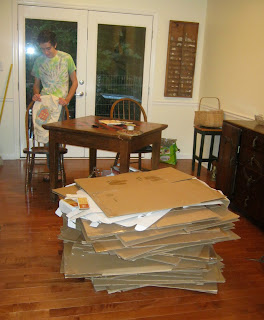
Getting ready for the move back, contacting power and phone companies, arranging for everything to be turned back on, meeting with assorted contractors and workers, has been very time-consuming, but totally worthwhile. I'm sorry, though, that I am so late in posting to the blog.
While we lived at the hotel, I made almost daily trips to the house, and I worked on the garden. If the work has the intended results, these plants will be giving us cabbages in five or six weeks:
 Other crops are coming along, too. The lettuces are about four inches high, the carrots, planted in two waves, are fairly well established, and other brassicas (broccoli, cauliflower, radishes) are looking just as I would have hoped. Of course, the weeds also are looking quite robust, so I have more work ahead.

Getting ready for the move back, contacting power and phone companies, arranging for everything to be turned back on, meeting with assorted contractors and workers, has been very time-consuming, but totally worthwhile. I'm sorry, though, that I am so late in posting to the blog.
While we lived at the hotel, I made almost daily trips to the house, and I worked on the garden. If the work has the intended results, these plants will be giving us cabbages in five or six weeks:

Saturday, September 8, 2012
Bean Leaf Rollers - Late Summer Pests on Beans
The bean leaf rollers are late-summer pests that don't always show up in my Georgia garden, but they apparently are all over Florida, because most of the information about them is from research done there. The caterpillars grow up to become long tailed skippers - pretty little brown butterflies - which is part of the reason I'm going to let these live, as long as the damage doesn't become too extreme.
Below is one more video, this one about my favorite cowpeas. Not only are these Pigott Family Heirloom peas hilariously vigorous climbers, but they also are delicious. For the vegetarian crowd, these are great as the base for a vegetarian gravy as well as when they are prepared as just cooked beans to have with cornbread.
I enlisted one of my sons as a cameraman this morning to make these little videos for me. These are both totally unrehearsed and mostly unplanned, so they might seem a little random in spots, but Zack did a GREAT job of figuring out where to aim the camera as I spoke. It totally isn't his fault that I make weird faces when I'm talking.
Monday, September 3, 2012
Tracking the Harvest: August
It's been a long, tough August at my house, but the garden has pulled through for us pretty well. The harvests haven't been spectacular, but they've been steady. The weights, as always, are recorded in kilograms:
August
|
Tomatoes, ripe
|
9.95
|
|
Peppers
|
5.85
|
|
Southern peas
|
1.25
|
|
Trombocino
squash
|
1.4
|
|
Eggplants
|
0.7
|
|
Figs
|
0.9
|
|
Butternut
squash, dwarf
|
1.85
|
The August total is 21.9 kg, which converts to 48 lb and 4.5 oz.
The 2012 running total, from Jan. through Aug., is 316 pounds, 12 ounces.
Parts of the garden, including the fig tree, were smashed when the tree fell, but I don't think the smashed parts would have added tremendously to the total. Besides the figs, we lost bush beans, parching corn, okra, and some herbs.
Transition to Fall
We're still getting peppers, tomatoes, an eggplant and trombocino squash every now and then, and cowpeas, and I am hoping that soon we will be able to add bush beans to the harvest. This is the most recently planted patch of beans - to replace the patch that was wiped out when the tree fell across the top of the house and smashed part of the garden:

The little bean patch is looking pretty promising; if all goes well, it will make a nice transition to the fall crops.
Meanwhile, the lettuces have been growing.

Other planted-from-seed crops also have grown beyond the seed-leaf (cotyledon) stage, and the transplanted veggies are all in, too. Yesterday I was able to plant the cauliflower -- the last of the fall veggies to be planted.
When the rest of the summer crops come out, some spaces will be planted with onions and garlic, and the rest will go into cover crops. Amazingly, it seems as though the fall garden is mostly on track! Here's hoping for decent weather and no more falling trees.

The little bean patch is looking pretty promising; if all goes well, it will make a nice transition to the fall crops.
Meanwhile, the lettuces have been growing.

Other planted-from-seed crops also have grown beyond the seed-leaf (cotyledon) stage, and the transplanted veggies are all in, too. Yesterday I was able to plant the cauliflower -- the last of the fall veggies to be planted.
When the rest of the summer crops come out, some spaces will be planted with onions and garlic, and the rest will go into cover crops. Amazingly, it seems as though the fall garden is mostly on track! Here's hoping for decent weather and no more falling trees.
Sunday, August 26, 2012
Forward Movement
I've been an organic gardener - doing the research and putting what I've learned into practice in my own yard - for a long time. Locating amendments and special "inputs" like seeds for cover crops on a garden-scale has been getting easier over the years, but there have always been items that had to be mail-ordered.
When the things you need suddenly are available in appropriately-sized packages in main-stream stores, that's a clue that a lot more people have become interested in the same things.
These cost way more than I would usually pay, but I couldn't resist. This is so great!:
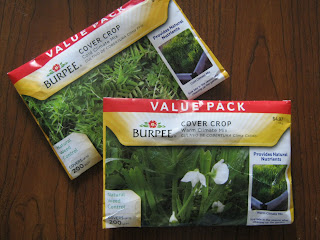
I found these at the Home Depot in Kennesaw, when I was just checking the seed rack to see what was there. The cool season mix contains seeds for hairy vetch and ryegrass; the warm season mix has seeds for Austrian winter peas and ryegrass. (I like how they couldn't decide which was actually good for our area, so we get both!) The packets each contain enough seed for 200 square feet of garden. With the easy-availability of these seeds, maybe more people will experiment with cover crops and find that they are a great help in the garden.
In other news - yesterday I attended a Small Scale Intensive Farming workshop, sponsored by Georgia Organics, the National Center for Appropriate Technology, and the USDA Risk Management Agency. Andy Pressman, of NCAT and a farmer who uses multiple small urban plots as his farmland, was the featured speaker.
The morning was filled with discussion of the business considerations of small-farming, and the afternoon was filled with technical considerations, including what tools are best for what purposes in very-small-scale farming enterprises like his.

Pressman's planting beds are 2 x 25 feet, and most of his "paths" are just 12 inches wide. With this tight spacing, tools need to be small and maneuverable. The biggest piece of equipment he uses is a walk-behind tractor by BCS (a European company). Everything else he showed us was hand-powered.
The seeder he demonstrated is the Earthway model that I have - I used it to plant my carrots this spring. He also brought along a whole assortment of hoes and demonstrated their correct use while talking about the benefits of each one.

While there, I met lots of great people who are all working on farming. Some are brand-new farmers, some are still in the planning stages, and some are fairly experienced. All in all, it was a great day!
Here at home, the cabbages I planted last week are doing well. I'm pretty sure they're bigger than they were when I saw them on Friday - I feel a little like one of those old ladies who exclaims to a child - "My how you've grown!"

And these are the carrots, seeded a couple of weeks ago with the seeder that my family gave me for my birthday this year:

I hope everyone else's gardens and gardening-knowledge are making as much forward progress!
When the things you need suddenly are available in appropriately-sized packages in main-stream stores, that's a clue that a lot more people have become interested in the same things.
These cost way more than I would usually pay, but I couldn't resist. This is so great!:

I found these at the Home Depot in Kennesaw, when I was just checking the seed rack to see what was there. The cool season mix contains seeds for hairy vetch and ryegrass; the warm season mix has seeds for Austrian winter peas and ryegrass. (I like how they couldn't decide which was actually good for our area, so we get both!) The packets each contain enough seed for 200 square feet of garden. With the easy-availability of these seeds, maybe more people will experiment with cover crops and find that they are a great help in the garden.
In other news - yesterday I attended a Small Scale Intensive Farming workshop, sponsored by Georgia Organics, the National Center for Appropriate Technology, and the USDA Risk Management Agency. Andy Pressman, of NCAT and a farmer who uses multiple small urban plots as his farmland, was the featured speaker.
The morning was filled with discussion of the business considerations of small-farming, and the afternoon was filled with technical considerations, including what tools are best for what purposes in very-small-scale farming enterprises like his.

Pressman's planting beds are 2 x 25 feet, and most of his "paths" are just 12 inches wide. With this tight spacing, tools need to be small and maneuverable. The biggest piece of equipment he uses is a walk-behind tractor by BCS (a European company). Everything else he showed us was hand-powered.
The seeder he demonstrated is the Earthway model that I have - I used it to plant my carrots this spring. He also brought along a whole assortment of hoes and demonstrated their correct use while talking about the benefits of each one.

While there, I met lots of great people who are all working on farming. Some are brand-new farmers, some are still in the planning stages, and some are fairly experienced. All in all, it was a great day!
Here at home, the cabbages I planted last week are doing well. I'm pretty sure they're bigger than they were when I saw them on Friday - I feel a little like one of those old ladies who exclaims to a child - "My how you've grown!"

And these are the carrots, seeded a couple of weeks ago with the seeder that my family gave me for my birthday this year:

I hope everyone else's gardens and gardening-knowledge are making as much forward progress!
Monday, August 20, 2012
Four Little Squashes
When I went out to check on the garden after work today, I realized that the little butternut squashes had changed. They had become both more tan and less shiny - indicators that the squashes might actually be mature, even though it is still fairly early in the season.
 They've been growing for long enough, though, so I went ahead and cut them off the vine.
The NCSU extension publication Storing Winter Squash and Pumpkins explains that, normally, winter squashes will do better in storage if they first have a curing time of one to two weeks at fairly high (>80 degrees F) temperature and similarly high humidity.
I have found that butternut squashes, like sweet potatoes, get a little sweeter after curing, too. The good news is that my garage has just about perfect conditions for curing the squashes in, so after I am done admiring them for a day or two they will be parked in the garage for a couple of weeks, before being brought back into an air-conditioned space.
They won't sit around for long, though. When I have time, I will probably go ahead and roast them and then mash them to freeze for something like pie.
Elsewhere in the garden, plants are still producing. My house is still pretty much in chaos, and I couldn't find a pretty container/basket/bowl for posing my veggies in, so the photo shows them in the bag I had carried through the yard for harvesting.
It's not a huge pile of food, but it will still make a nice addition to our meals, to the pile of frozen veggies (bagged) in the freezer, and to the dehydrated veggies in jars on the storage shelves.

The tomatoes and peppers are assorted varieties. Underneath those are some Pigott Family cowpeas. We've already harvested a full quart of those (shelled-out and fully dried) Southern peas, but there are plenty more out in the garden.
As the cool-weather crops, the lettuces, other greens, carrots and more are making their slow beginning, it's nice to have the anchor of the summer crops still producing.

The NCSU extension publication Storing Winter Squash and Pumpkins explains that, normally, winter squashes will do better in storage if they first have a curing time of one to two weeks at fairly high (>80 degrees F) temperature and similarly high humidity.
I have found that butternut squashes, like sweet potatoes, get a little sweeter after curing, too. The good news is that my garage has just about perfect conditions for curing the squashes in, so after I am done admiring them for a day or two they will be parked in the garage for a couple of weeks, before being brought back into an air-conditioned space.
They won't sit around for long, though. When I have time, I will probably go ahead and roast them and then mash them to freeze for something like pie.
Elsewhere in the garden, plants are still producing. My house is still pretty much in chaos, and I couldn't find a pretty container/basket/bowl for posing my veggies in, so the photo shows them in the bag I had carried through the yard for harvesting.
It's not a huge pile of food, but it will still make a nice addition to our meals, to the pile of frozen veggies (bagged) in the freezer, and to the dehydrated veggies in jars on the storage shelves.

The tomatoes and peppers are assorted varieties. Underneath those are some Pigott Family cowpeas. We've already harvested a full quart of those (shelled-out and fully dried) Southern peas, but there are plenty more out in the garden.
As the cool-weather crops, the lettuces, other greens, carrots and more are making their slow beginning, it's nice to have the anchor of the summer crops still producing.
Subscribe to:
Posts (Atom)