At the little farm where Joe and I volunteer on Saturday mornings, the lower field has so many rows of greens - mustards, collards, radishes, and a little bit of kale - that there is no way for us to fully harvest the crop.
The guys who manage the farm, who pay attention to the farming lore of local old-timers, plant the field each fall from end-to-end knowing full well that many perfectly good greens will go uneaten, just like in years past. For them, even though they enjoy eating greens, the main point of that crop is not so much Food as it is Pest Control.
They call those greens their "fumigant crop", and it is planted to keep the root-knot nematodes at bay. In spring, when they are ready to plant the warm-weather crops, they just turn under all the remaining greens to let them finish their good work of pest-control. Not too surprisingly, research supports the practice of the old-timers.
The book Managing Cover Crops Profitably, published by SARE (3rd edition, 2010), which can be downloaded for FREE, cites research that demonstrates the "nematicidal effects" of Brassica-family plants like mustard greens and radishes.
When I was talking with a county resident last week about his garden, he mentioned that he'd been having trouble with root-knot nematodes in his 1.5 acre garden over the past couple of years. I told him about my friends and their field of greens, and he went silent for a minute. Then he said that he hadn't planted greens as a winter crop for the past few years because his freezer was full, but he had in each of the previous 20 or so years of gardening in that spot.
I am pretty sure that, regardless of the state of his freezer, next September my new gardening friend will be planting a whole lot of greens.

Showing posts with label cover crops. Show all posts
Showing posts with label cover crops. Show all posts
Wednesday, November 18, 2015


Tuesday, November 4, 2014
Lost Varieties - Wheat, Corn
The phone call ended up being about corn, but it started with wheat. The old-timer who called the office today asked whether it was too late to plant wheat as a cover crop for his half-acre garden. He wanted to plant the wheat to keep out the henbit that would take
over if he left the soil bare. The birds could have any seeds that the
wheat might produce.
According to UGA's 2012-13 Wheat Production Guide, "The optimum window for wheat planting in Georgia is typically one week before the average first frost date for a given area and one week after." In other words, this week is perfect for planting, since our first frost is usually around November 1.
I asked about his seeds, and he said they were just an ordinary winter wheat, and he didn't know the variety, but it wasn't like the one his daddy had grown on the family farm many years ago. That wheat had a bluish-purple tint to it, and the grain was very hard. Apparently, the guys at the mill didn't like it because it was hard on their roller-equipment. I was told, though, by my old-timer, that the blue wheat made great biscuits.
When I asked if he still had any seed for that variety, he said no, it had been lost, like his daddy's corn.
Then, I had to ask about the corn.
His daddy had crossed Hickory King, which has very wide kernels and is a good corn for hominy, with Tennessee Gourdseed, because he had liked the look of the tall kernels on that gourdseed corn. The resulting corn, even after carefully selecting the best ears to save, still wasn't quite perfect, so his daddy had taken the best of new corn and planted it intermixed with Hastings' Prolific (a Georgia variety). The planting was two rows of the first cross and then one row of the Hastings corn, alternated across the field.
The resulting corn had been good for both cornmeal and feed corn, and the ears had been pretty enough to win many ribbons at the fair. Seed from that corn was saved and replanted for many years.
It's unlikely that my old-timer's daddy had had formal training in horticulture when he created his own corn, and yet he was successful in breeding a variety of corn that met his own needs.
This story is a good reminder to keep working to save seeds for old family garden crops that come my way, like the Hogseds' Sweet Potatoes and my friend Becky's Joanie Beans.
Also, the next time I have a zany garden experiment in mind, I'm going to remind myself that there's always a chance that something will go exactly right!
According to UGA's 2012-13 Wheat Production Guide, "The optimum window for wheat planting in Georgia is typically one week before the average first frost date for a given area and one week after." In other words, this week is perfect for planting, since our first frost is usually around November 1.
I asked about his seeds, and he said they were just an ordinary winter wheat, and he didn't know the variety, but it wasn't like the one his daddy had grown on the family farm many years ago. That wheat had a bluish-purple tint to it, and the grain was very hard. Apparently, the guys at the mill didn't like it because it was hard on their roller-equipment. I was told, though, by my old-timer, that the blue wheat made great biscuits.
When I asked if he still had any seed for that variety, he said no, it had been lost, like his daddy's corn.
Then, I had to ask about the corn.
His daddy had crossed Hickory King, which has very wide kernels and is a good corn for hominy, with Tennessee Gourdseed, because he had liked the look of the tall kernels on that gourdseed corn. The resulting corn, even after carefully selecting the best ears to save, still wasn't quite perfect, so his daddy had taken the best of new corn and planted it intermixed with Hastings' Prolific (a Georgia variety). The planting was two rows of the first cross and then one row of the Hastings corn, alternated across the field.
The resulting corn had been good for both cornmeal and feed corn, and the ears had been pretty enough to win many ribbons at the fair. Seed from that corn was saved and replanted for many years.
It's unlikely that my old-timer's daddy had had formal training in horticulture when he created his own corn, and yet he was successful in breeding a variety of corn that met his own needs.
This story is a good reminder to keep working to save seeds for old family garden crops that come my way, like the Hogseds' Sweet Potatoes and my friend Becky's Joanie Beans.
Also, the next time I have a zany garden experiment in mind, I'm going to remind myself that there's always a chance that something will go exactly right!
Wednesday, October 1, 2014
So Close, and Yet So Far
I keep saying that the fall garden is nearly all planted, and that gets closer to the truth every time I say it, but summer peanuts are still maturing in the garden, and a patch of oats (part cover crop, part bunny food) is scheduled to go in their place; the sweet potatoes are yet to be harvested, and the garlic and shallots will be planted in that space.
Also, there are some bare stretches to fill in along the rows of carrots and in patches of other crops. A gardener's excuses to be outside are nearly endless! More good news: the weather is cooling enough that spending time outside is even easier.
Rain has been mostly nonexistent lately, so all the cool-season crops have needed to be watered to help the seeds and seedlings make a good start and to encourage transplants to mingle their roots with the garden soil. Otherwise, the cool season weeds are growing slowly enough to keep them from taking over, and
we are still bringing in little bunches of green beans, cowpeas, and small tomatoes. The peppers continue their steady stream into the kitchen, as well, and it looks as though we will finally get some eggplants.
I had planted the eggplants too close to the tomatoes, and they were so overshadowed that it was all they could do to hang on through the summer. The tomato plants are gone, and the eggplants look very happy! If we are lucky, the first frost will hold off long enough for all the flowers and little fruits now on the plants to reach maturity.
I'm expecting to harvest the sweet potatoes this weekend, and that is always fun, assuming the chipmunks have left something for me to harvest.
I hope that everyone else is out enjoying their gardens, too, and that all is growing well.
 |
| Almost time to start eating kale and radishes. |
Also, there are some bare stretches to fill in along the rows of carrots and in patches of other crops. A gardener's excuses to be outside are nearly endless! More good news: the weather is cooling enough that spending time outside is even easier.
Rain has been mostly nonexistent lately, so all the cool-season crops have needed to be watered to help the seeds and seedlings make a good start and to encourage transplants to mingle their roots with the garden soil. Otherwise, the cool season weeds are growing slowly enough to keep them from taking over, and
we are still bringing in little bunches of green beans, cowpeas, and small tomatoes. The peppers continue their steady stream into the kitchen, as well, and it looks as though we will finally get some eggplants.
 |
| Glacial vines from the sweet potato patch, slowly consuming the yard. |
I had planted the eggplants too close to the tomatoes, and they were so overshadowed that it was all they could do to hang on through the summer. The tomato plants are gone, and the eggplants look very happy! If we are lucky, the first frost will hold off long enough for all the flowers and little fruits now on the plants to reach maturity.
I'm expecting to harvest the sweet potatoes this weekend, and that is always fun, assuming the chipmunks have left something for me to harvest.
I hope that everyone else is out enjoying their gardens, too, and that all is growing well.
Saturday, March 8, 2014
Potatoes and Lettuce and Peas (and More!)
It's been a beautiful day for getting things done in the garden, so of course I am running behind. I spent part of my day just sitting on the back deck, listening to birds and admiring the trays of seedlings that I had moved out to a dappled spot.
The good news is that the trout lilies are blooming in my yard, and that is my signal that the soil is warm enough that peas and other cool-season crops planted now will actually germinate and grow rather than rot in too-cold soil.
I've planted some peas, planted out some little lettuces that I had started indoors a few weeks back, and planted some radish seeds. If all goes well tomorrow, I'll plant some more peas, lettuces, and radishes, and possibly also some spinach and beets.
Not all of the peas that I plant this weekend will be left in place long enough to produce peas; some are going to serve as a late-spring cover crop and will be turned back into the soil about six weeks from now. They will help get the soil in shape for the summer crops that will follow them.
The garlic, shallots, and multiplying onions all made it through the worst of winter and look good. I am hoping that the cold will actually help the hard-neck garlic! When the winter is warm, they don't make as many cloves-per-bulb.
When those onion-family crops all come out in June, they will be followed by a late planting of tomatoes. The June-planted tomatoes won't produce until late August, but they will give my tomato-supply a welcome boost when they finally begin to ripen!
I've also set out (possibly too early) some seed potatoes. On a quick run through Home Depot I saw a display of boxes of seed potatoes, and I found myself buying a pound of Kennebec potatoes in addition to whatever it was we went in for. When I got the box home, the seed potatoes already had good eyes, so after a few days I went ahead and planted them. They haven't poked any green up above the surface yet, which is good, because there is more cold ahead, I'm sure.
I had already placed a small order through the Potato Garden for a pound of Garnet Chili seed potatoes (I grew them once before, and my recollection is that they were wonderful), a pound of Red Pontiac seed potatoes (good to eat and super productive in my yard), and a pound of Rose Finn Apple Fingerlings that a friend wanted a half-pound of, so we will be sharing those. The box of seed potatoes arrived in yesterday's mail. None of the spuds in the box have developed good eyes yet, so it will be another week or two before those can be planted outside.
Really, though, the urge to fill the garden with cool season crops is very hard to resist; there is so much good food that can be planted and grown successfully now! Sadly, most of those crops wouldn't be ready to harvest until sometime in May -- well past the time when I will want to have some of my summer crops planted. If I want those summer crops ready to harvest in a timely manner, I can't fill the garden with cool-season crops now.
It helps that I spent part of my time at home in the last winter storm mapping out a plan for my 2014 garden; the map/plan supports my resolve to keep my hands off the packs of broccoli, collards, etc plants at the garden stores, so I'll have space for all the peppers, squash, okra, tomatoes, eggplants, cucumbers, sweet potatoes, white potatoes, melons, beans, parching corn, etc. that I have planned to grow in my little garden.
Hope that everyone else is enjoying the beautiful weather!
The good news is that the trout lilies are blooming in my yard, and that is my signal that the soil is warm enough that peas and other cool-season crops planted now will actually germinate and grow rather than rot in too-cold soil.
I've planted some peas, planted out some little lettuces that I had started indoors a few weeks back, and planted some radish seeds. If all goes well tomorrow, I'll plant some more peas, lettuces, and radishes, and possibly also some spinach and beets.
Not all of the peas that I plant this weekend will be left in place long enough to produce peas; some are going to serve as a late-spring cover crop and will be turned back into the soil about six weeks from now. They will help get the soil in shape for the summer crops that will follow them.
The garlic, shallots, and multiplying onions all made it through the worst of winter and look good. I am hoping that the cold will actually help the hard-neck garlic! When the winter is warm, they don't make as many cloves-per-bulb.
When those onion-family crops all come out in June, they will be followed by a late planting of tomatoes. The June-planted tomatoes won't produce until late August, but they will give my tomato-supply a welcome boost when they finally begin to ripen!
I've also set out (possibly too early) some seed potatoes. On a quick run through Home Depot I saw a display of boxes of seed potatoes, and I found myself buying a pound of Kennebec potatoes in addition to whatever it was we went in for. When I got the box home, the seed potatoes already had good eyes, so after a few days I went ahead and planted them. They haven't poked any green up above the surface yet, which is good, because there is more cold ahead, I'm sure.
I had already placed a small order through the Potato Garden for a pound of Garnet Chili seed potatoes (I grew them once before, and my recollection is that they were wonderful), a pound of Red Pontiac seed potatoes (good to eat and super productive in my yard), and a pound of Rose Finn Apple Fingerlings that a friend wanted a half-pound of, so we will be sharing those. The box of seed potatoes arrived in yesterday's mail. None of the spuds in the box have developed good eyes yet, so it will be another week or two before those can be planted outside.
Really, though, the urge to fill the garden with cool season crops is very hard to resist; there is so much good food that can be planted and grown successfully now! Sadly, most of those crops wouldn't be ready to harvest until sometime in May -- well past the time when I will want to have some of my summer crops planted. If I want those summer crops ready to harvest in a timely manner, I can't fill the garden with cool-season crops now.
It helps that I spent part of my time at home in the last winter storm mapping out a plan for my 2014 garden; the map/plan supports my resolve to keep my hands off the packs of broccoli, collards, etc plants at the garden stores, so I'll have space for all the peppers, squash, okra, tomatoes, eggplants, cucumbers, sweet potatoes, white potatoes, melons, beans, parching corn, etc. that I have planned to grow in my little garden.
Hope that everyone else is enjoying the beautiful weather!
Thursday, October 10, 2013
Mostly Ready for Fall/Winter
Most of the garden is ready for fall and winter (finally!). You'd think that by now I would know exactly what it's going to take to get that all done, but I'm still a little surprised that there is so much work in clearing away the summer and making the start on fall and winter.
I cut down the buckwheat cover crop that has been growing in the top half of the beet and spinach bed to let it wilt down before turning it under, and I've planted a mixed cover crop of winter rye and Austrian winter peas in a couple of beds. Before those cover crops could go in, there was a general clearing-away of summer crops, then I brought compost out from the backyard compost pile, spread that on the beds, mixed it into the top few inches of soil, leveled the beds, then broadcast the seeds and "pounced" them in with a rake. The bed where the garlic and shallots will go in a couple of weeks has also been made ready.
Over the past ten-or-so days, I also replanted seeds for some of the lettuces, carrots, beets, spinach, and radishes, because the sweet potato bed isn't the only one that has been chipmunked. The rascally rodents have been having way too much fun in my garden this year; somehow, they've gotten the impression that it's their own little party place.
My neighbor across the creek has two outdoor cats, and I had thought that, between them, Lily and Johnny would have put a big dent in the chipmunk population, but they don't seem to have been keeping up with the rate of reproduction. We don't have as many hawks as usual, and that may be part of the problem. I think the crows (another nuisance) have been chasing them away. Next year, I may have to work at thinning some vegetation (daylilies, azaleas, and more) that has served as protective cover for the little, striped "party animals."
Things have been busy at work. Last week, on Thursday, I was the guest on the Master Gardener Hour on America's Web Radio. The show is scheduled to be posted on the 19th of October. On Friday, I talked about "Moving Toward Organics in the Vegetable Garden" for the Master Gardener Lunch & Learn series. Have I mentioned lately that I love my job?
Hope all the other gardens out there are just about ready for fall and winter!
I cut down the buckwheat cover crop that has been growing in the top half of the beet and spinach bed to let it wilt down before turning it under, and I've planted a mixed cover crop of winter rye and Austrian winter peas in a couple of beds. Before those cover crops could go in, there was a general clearing-away of summer crops, then I brought compost out from the backyard compost pile, spread that on the beds, mixed it into the top few inches of soil, leveled the beds, then broadcast the seeds and "pounced" them in with a rake. The bed where the garlic and shallots will go in a couple of weeks has also been made ready.
Over the past ten-or-so days, I also replanted seeds for some of the lettuces, carrots, beets, spinach, and radishes, because the sweet potato bed isn't the only one that has been chipmunked. The rascally rodents have been having way too much fun in my garden this year; somehow, they've gotten the impression that it's their own little party place.
My neighbor across the creek has two outdoor cats, and I had thought that, between them, Lily and Johnny would have put a big dent in the chipmunk population, but they don't seem to have been keeping up with the rate of reproduction. We don't have as many hawks as usual, and that may be part of the problem. I think the crows (another nuisance) have been chasing them away. Next year, I may have to work at thinning some vegetation (daylilies, azaleas, and more) that has served as protective cover for the little, striped "party animals."
Things have been busy at work. Last week, on Thursday, I was the guest on the Master Gardener Hour on America's Web Radio. The show is scheduled to be posted on the 19th of October. On Friday, I talked about "Moving Toward Organics in the Vegetable Garden" for the Master Gardener Lunch & Learn series. Have I mentioned lately that I love my job?
Hope all the other gardens out there are just about ready for fall and winter!
Wednesday, September 25, 2013
Garden Update
 |
| September peppers. |
The summer crop that is still coming in strong is the peppers. All varieties across the whole bed are doing well. The tomatoes, even the ones planted latest, are mostly limping along. I'm bringing in a few tomatoes each week, but not great piles of them like I would normally be harvesting in September.
 |
| Buckwheat cover crop, ready to be mowed down. |
The buckwheat that was planted across the top of the spinach-beet bed is doing great. Soon, I will be mowing that down (or Joe will, with the weed-whacker), then turning it under to get the space ready for a winter cover crop.
Some animal(s) out in the yard have been treating the rows of spinach and beet seedlings like a personal snack bar, and I may, as a result, end up reseeding all those rows. This is an annoying turn of events, but not a total surprise. A creek borders our yard on one side, which means we have plenty of drop-in "guests" of the four-legged, furry persuasion. The creek is like a natural highway that connects parks and fields in the area. My yard is just a scenic-turnout that happens to also include a couple of fast-food establishments.
 |
| Cabbage-family snacks for rabbits. |
However, I have another nine-pack of broccoli to plant, and it is enough to replace all of the most severely munched plants, with some left to plant further down the bed.
 |
| Healthy horseradish. |
The plant is getting too big for its pot, and I'm expecting to re-pot it this coming spring, dividing the root to share and to make some horseradish sauce. Maybe I'll find a recipe for sauce that we like!
This year, most of my plants were in the ground, but I have seen horseradish so healthy that it threatened to take over whole yards. Mine is going to stay in a pot.
Over in the side yard, the sweet potato vines seem to be contemplating some kind of take-over. They have flowed into the next bed and across the newly-laid centipede-&-nutsedge sod that the water department put down after replacing the neighborhood water mains.
 |
| This year's sweet-potato glacier, slowly creeping across the yard. |
In the picture to the right, a few okra plants can be seen along the left of the photo; they are holding their own among the vines and producing just enough okra for us to include some in a meal every few days.
It will be time to dig up those sweet potatoes very soon. I'm planning to manage that sometime in the first week of October. The slips were planted back in May, which means the plants have had PLENTY of time to make sweets for me by now.
 |
| Carrots to the left, winter radishes to the right. |
The last seeds in won't yield mature carrots until sometime in the spring, but that's okay. I will have harvested plenty of other carrots by then, from the earlier-planted seeds.
Hope everyone else's gardens are doing well!
Sunday, August 25, 2013
Planting the Fall Garden Continues
After getting the last few weeds out of the former squash/melon bed, I dumped a wheelbarrow-load of compost on top of the bed, spread it across the entire surface, worked the whole bed over with my grub hoe, tossed on some kelp and cottonseed meal, raked/pounced the amendments into the top couple of inches, used my widest short-tine rake to smooth the top, then got busy planting.
The above set of tasks is why gardening isn't for those who require instant gratification; very little about gardening is instant! Getting the bed prepared (not including pulling out the old crops, which I had already done) took awhile. Getting it planted took about five minutes.
I used my seeder to plant two rows of spinach (mixed with some regular radish seeds) and two rows of beets. Those four rows went along the edge nearest the house. This particular bed is fairly wide, so the farther half was broadcast with buckwheat, for a fast cover crop while I am waiting for time to plant a longer-term, winter cover in that space.
My seedlings (currently in little pots) for the cabbage family plants and the lettuces (and etc.) are coming along nicely, but their spaces won't be vacant for another week or two. I think they will be fine, but I will be happier when they are safely in the ground.
The carrots and winter-radishes came up just fine on their own, but no rain is in the forecast for the next several days, so I might actually need to water the spinach, beet, and buckwheat seeds to keep them damp enough to germinate.
Hope that everyone else's fall planting is on track!
The above set of tasks is why gardening isn't for those who require instant gratification; very little about gardening is instant! Getting the bed prepared (not including pulling out the old crops, which I had already done) took awhile. Getting it planted took about five minutes.
I used my seeder to plant two rows of spinach (mixed with some regular radish seeds) and two rows of beets. Those four rows went along the edge nearest the house. This particular bed is fairly wide, so the farther half was broadcast with buckwheat, for a fast cover crop while I am waiting for time to plant a longer-term, winter cover in that space.
My seedlings (currently in little pots) for the cabbage family plants and the lettuces (and etc.) are coming along nicely, but their spaces won't be vacant for another week or two. I think they will be fine, but I will be happier when they are safely in the ground.
The carrots and winter-radishes came up just fine on their own, but no rain is in the forecast for the next several days, so I might actually need to water the spinach, beet, and buckwheat seeds to keep them damp enough to germinate.
Hope that everyone else's fall planting is on track!
Thursday, March 7, 2013
"Organic" Organic-Matter for the Garden
I spoke with someone this week who wanted to know where to find the absolute BEST compost for her organic garden. She has a compost pile in her own yard, but it doesn't make enough for the whole garden. I suggested that she try Farmer D's compost, which - even though it is expensive - is locally available and an absolutely beautiful product. It is made partly with leftover produce from multiple Whole Foods stores.
However, she was concerned about pesticide residues, since not all of the produce at Whole Foods is organically grown. She also pointed out -- when I brought up mushroom compost as an alternative -- problems with the substrate that commercial mushrooms are grown on, which then is often made into (some pretty good) compost. Apparently, she had read that sometimes bits of particle board and other pressed wood products, some of which contain formaldehyde, are used as the growing medium.
Many of us are going to be a little less picky about the residues in the compost, since most of the worst chemicals will have broken down into components that (hopefully) are less of a problem, but my friend has some issues with past chemical exposure that have made her understandably wary of bringing any more potentially risky chemicals into her environment.
After discussing and rejecting a couple of other possibilities, it became pretty clear to me that there is almost no way to obtain large quantities of completely non-contaminated, composted organic matter for use in the home garden.
The only good alternative I could think of was intensive use of cover crops to add the needed organic matter. For new ground that can be kept out of food-production for a full year, starting now with some kind of peas (it won't matter which kind), plowing those in then leaving them for a week or so to begin decomposition, followed by buckwheat in May that is plowed in after it has begun to flower, followed by another round of buckwheat or some cowpeas, followed by a winter cover of rye plus either hairy vetch or Austrian winter peas, would get the soil into pretty good shape. The cover crops would, of course, need to be amended following recommendations on soil test results, especially with regard to bringing our area's naturally low soil pH into a better range for the desired plants.
Most organic gardeners here in Cobb County need to incorporate cover crops in the rotation anyway, to keep the soil phosphorus levels in bounds, but to get a big slug of organic matter into the soil using cover crops alone will take some planning.
However, she was concerned about pesticide residues, since not all of the produce at Whole Foods is organically grown. She also pointed out -- when I brought up mushroom compost as an alternative -- problems with the substrate that commercial mushrooms are grown on, which then is often made into (some pretty good) compost. Apparently, she had read that sometimes bits of particle board and other pressed wood products, some of which contain formaldehyde, are used as the growing medium.
Many of us are going to be a little less picky about the residues in the compost, since most of the worst chemicals will have broken down into components that (hopefully) are less of a problem, but my friend has some issues with past chemical exposure that have made her understandably wary of bringing any more potentially risky chemicals into her environment.
After discussing and rejecting a couple of other possibilities, it became pretty clear to me that there is almost no way to obtain large quantities of completely non-contaminated, composted organic matter for use in the home garden.
The only good alternative I could think of was intensive use of cover crops to add the needed organic matter. For new ground that can be kept out of food-production for a full year, starting now with some kind of peas (it won't matter which kind), plowing those in then leaving them for a week or so to begin decomposition, followed by buckwheat in May that is plowed in after it has begun to flower, followed by another round of buckwheat or some cowpeas, followed by a winter cover of rye plus either hairy vetch or Austrian winter peas, would get the soil into pretty good shape. The cover crops would, of course, need to be amended following recommendations on soil test results, especially with regard to bringing our area's naturally low soil pH into a better range for the desired plants.
Most organic gardeners here in Cobb County need to incorporate cover crops in the rotation anyway, to keep the soil phosphorus levels in bounds, but to get a big slug of organic matter into the soil using cover crops alone will take some planning.
Sunday, August 26, 2012
Forward Movement
I've been an organic gardener - doing the research and putting what I've learned into practice in my own yard - for a long time. Locating amendments and special "inputs" like seeds for cover crops on a garden-scale has been getting easier over the years, but there have always been items that had to be mail-ordered.
When the things you need suddenly are available in appropriately-sized packages in main-stream stores, that's a clue that a lot more people have become interested in the same things.
These cost way more than I would usually pay, but I couldn't resist. This is so great!:
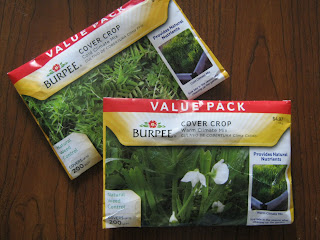
I found these at the Home Depot in Kennesaw, when I was just checking the seed rack to see what was there. The cool season mix contains seeds for hairy vetch and ryegrass; the warm season mix has seeds for Austrian winter peas and ryegrass. (I like how they couldn't decide which was actually good for our area, so we get both!) The packets each contain enough seed for 200 square feet of garden. With the easy-availability of these seeds, maybe more people will experiment with cover crops and find that they are a great help in the garden.
In other news - yesterday I attended a Small Scale Intensive Farming workshop, sponsored by Georgia Organics, the National Center for Appropriate Technology, and the USDA Risk Management Agency. Andy Pressman, of NCAT and a farmer who uses multiple small urban plots as his farmland, was the featured speaker.
The morning was filled with discussion of the business considerations of small-farming, and the afternoon was filled with technical considerations, including what tools are best for what purposes in very-small-scale farming enterprises like his.

Pressman's planting beds are 2 x 25 feet, and most of his "paths" are just 12 inches wide. With this tight spacing, tools need to be small and maneuverable. The biggest piece of equipment he uses is a walk-behind tractor by BCS (a European company). Everything else he showed us was hand-powered.
The seeder he demonstrated is the Earthway model that I have - I used it to plant my carrots this spring. He also brought along a whole assortment of hoes and demonstrated their correct use while talking about the benefits of each one.

While there, I met lots of great people who are all working on farming. Some are brand-new farmers, some are still in the planning stages, and some are fairly experienced. All in all, it was a great day!
Here at home, the cabbages I planted last week are doing well. I'm pretty sure they're bigger than they were when I saw them on Friday - I feel a little like one of those old ladies who exclaims to a child - "My how you've grown!"

And these are the carrots, seeded a couple of weeks ago with the seeder that my family gave me for my birthday this year:

I hope everyone else's gardens and gardening-knowledge are making as much forward progress!
When the things you need suddenly are available in appropriately-sized packages in main-stream stores, that's a clue that a lot more people have become interested in the same things.
These cost way more than I would usually pay, but I couldn't resist. This is so great!:

I found these at the Home Depot in Kennesaw, when I was just checking the seed rack to see what was there. The cool season mix contains seeds for hairy vetch and ryegrass; the warm season mix has seeds for Austrian winter peas and ryegrass. (I like how they couldn't decide which was actually good for our area, so we get both!) The packets each contain enough seed for 200 square feet of garden. With the easy-availability of these seeds, maybe more people will experiment with cover crops and find that they are a great help in the garden.
In other news - yesterday I attended a Small Scale Intensive Farming workshop, sponsored by Georgia Organics, the National Center for Appropriate Technology, and the USDA Risk Management Agency. Andy Pressman, of NCAT and a farmer who uses multiple small urban plots as his farmland, was the featured speaker.
The morning was filled with discussion of the business considerations of small-farming, and the afternoon was filled with technical considerations, including what tools are best for what purposes in very-small-scale farming enterprises like his.

Pressman's planting beds are 2 x 25 feet, and most of his "paths" are just 12 inches wide. With this tight spacing, tools need to be small and maneuverable. The biggest piece of equipment he uses is a walk-behind tractor by BCS (a European company). Everything else he showed us was hand-powered.
The seeder he demonstrated is the Earthway model that I have - I used it to plant my carrots this spring. He also brought along a whole assortment of hoes and demonstrated their correct use while talking about the benefits of each one.

While there, I met lots of great people who are all working on farming. Some are brand-new farmers, some are still in the planning stages, and some are fairly experienced. All in all, it was a great day!
Here at home, the cabbages I planted last week are doing well. I'm pretty sure they're bigger than they were when I saw them on Friday - I feel a little like one of those old ladies who exclaims to a child - "My how you've grown!"

And these are the carrots, seeded a couple of weeks ago with the seeder that my family gave me for my birthday this year:

I hope everyone else's gardens and gardening-knowledge are making as much forward progress!
Saturday, August 11, 2012
What Comes of the Compost
Since we still are not 100% at home yet, we haven't had a good way to add to the compost piles that usually collect our kitchen trimmings, and we still seem to be generating plenty of odd little brown spots and stem ends. The good parts are going into either the crockpot (on loan from a co-worker - Thank you, Louise!) or the dehydrator.

Our compost is still collecting little bits of yard trimmings/weeds, but not nearly as much as usual, and the contents of our bunnies' litter boxes aren't going there either, because our bunnies are still with a friend. Right now, instead of having one compost pile that's growing while the other, more finished pile gets moved out to the garden, we have two dwindling piles. By the end of this weekend, there won't be any compost left in the backyard - just a little stack of wilting weeds.
We have become so accustomed to always adding to the compost piles that it seems a little weird, and very wasteful, to run veggie trimmings down the disposal at the hotel where we currently are being housed (not for much longer!).
I know, though, that there are plenty of people for whom saving organic material for the compost pile is a foreign concept. I forget sometimes that other people's lives aren't centered around gardening and all the daily behaviors that make gardening work.
However, it is great to hear about other people who not only are doing similar things but also working to educate still more people about using leftover/waste material in the garden. Not long ago at work I heard from a guy who is educating others about the usefulness of coffee grounds in gardening. He has put together an informational webpage and a little project to collect, dry, and distribute coffee grounds for use in gardens. It's a local Greenbean Project. I am hoping that his project becomes wildly successful.
A great thing about coffee grounds, especially as the season for collecting fallen leaves is almost here, is that coffee grounds are a good nitrogen source, which helps balance out the high carbon content of the dried leaves that we will all be dumping into our compost piles.
Meanwhile, the multiple seasons' worth of compost that have been added to my vegetable garden have been working their magic on the red clay, helping the soil produce good food for us, even though I haven't been out there tending to the watering and weeds every day like I would normally be doing.
The trombocino squash are beginning to produce for us:

The dwarf butternut has made several squashes, too. In a comic-twist, the squash fruits themselves are "dwarf," but the vines have sprawled ten-to-twelve feet. I was kind of expecting a reverse version of that outcome, where the vines were more dwarfed and the fruits more normal, but I am not exactly surprised by the reality. It's the kind of thing that sometimes happens with seeds and plants.

The buckwheat that had been acting as a place-holder for the last few weeks has already flowered, and I've turned that cover-crop under to get the area ready for the carrots. If all goes well, those seeds will be in the ground tomorrow.

Tomato plants are still producing, and the remaining plants look surprisingly healthy for this late in the season. These are Akers Plum tomatoes:

These are Wuhib, another plum/paste tomato:

We have a week of cooler weather coming up, and it will be a good time to plant some of the cooler weather crops. Germination will be a lot more successful than it would have been a week or so ago - the highs are forecast to be below 90 degrees F for the next few days. It won't hurt to have dug in the last of the compost.

Our compost is still collecting little bits of yard trimmings/weeds, but not nearly as much as usual, and the contents of our bunnies' litter boxes aren't going there either, because our bunnies are still with a friend. Right now, instead of having one compost pile that's growing while the other, more finished pile gets moved out to the garden, we have two dwindling piles. By the end of this weekend, there won't be any compost left in the backyard - just a little stack of wilting weeds.
We have become so accustomed to always adding to the compost piles that it seems a little weird, and very wasteful, to run veggie trimmings down the disposal at the hotel where we currently are being housed (not for much longer!).
I know, though, that there are plenty of people for whom saving organic material for the compost pile is a foreign concept. I forget sometimes that other people's lives aren't centered around gardening and all the daily behaviors that make gardening work.
However, it is great to hear about other people who not only are doing similar things but also working to educate still more people about using leftover/waste material in the garden. Not long ago at work I heard from a guy who is educating others about the usefulness of coffee grounds in gardening. He has put together an informational webpage and a little project to collect, dry, and distribute coffee grounds for use in gardens. It's a local Greenbean Project. I am hoping that his project becomes wildly successful.
A great thing about coffee grounds, especially as the season for collecting fallen leaves is almost here, is that coffee grounds are a good nitrogen source, which helps balance out the high carbon content of the dried leaves that we will all be dumping into our compost piles.
Meanwhile, the multiple seasons' worth of compost that have been added to my vegetable garden have been working their magic on the red clay, helping the soil produce good food for us, even though I haven't been out there tending to the watering and weeds every day like I would normally be doing.
The trombocino squash are beginning to produce for us:

The dwarf butternut has made several squashes, too. In a comic-twist, the squash fruits themselves are "dwarf," but the vines have sprawled ten-to-twelve feet. I was kind of expecting a reverse version of that outcome, where the vines were more dwarfed and the fruits more normal, but I am not exactly surprised by the reality. It's the kind of thing that sometimes happens with seeds and plants.

The buckwheat that had been acting as a place-holder for the last few weeks has already flowered, and I've turned that cover-crop under to get the area ready for the carrots. If all goes well, those seeds will be in the ground tomorrow.

Tomato plants are still producing, and the remaining plants look surprisingly healthy for this late in the season. These are Akers Plum tomatoes:

These are Wuhib, another plum/paste tomato:

We have a week of cooler weather coming up, and it will be a good time to plant some of the cooler weather crops. Germination will be a lot more successful than it would have been a week or so ago - the highs are forecast to be below 90 degrees F for the next few days. It won't hurt to have dug in the last of the compost.
Friday, February 17, 2012
Thinking about Soil
On Wednesday morning I gave a little talk about building soil fertility using organic gardening methods. I was pretty surprised by the large turnout, but one feature of the talk was a demonstration of converting a recommendation for inorganic fertilizers (like 10 pounds 10-10-10 per 1000 sq ft, plus 15 pounds 15-0-15 per 1000 sq ft) from a UGA Soil Test Report to organic fertilizer ingredients. It turns out that a lot of people were interested in seeing someone put this math into action.
The Georgia Extension Service offers a handout on this conversion, so the demonstration wasn't anything I had to work especially hard to put together. The hardest part is choosing the ingredients to use in the conversion, since the list of possible sources is quite large, and some of them aren't widely available.
It turns out that the plant-a-row-for-the-hungry garden this year is going to need about 50 pounds of cottonseed meal per 1000 sq ft and 10.2 pounds of Sul-Po-Mag per 1000 sq ft to meet the requirements of "medium feeders," which describes most garden crops. "Heavy feeders" like tomatoes will need an extra (full) dose partway through the summer, and "light feeders" - mostly legumes - will need half as much as the other crops.
If building soil fertility were as easy as dumping in a few bags of amendments, though, we would all have perfect gardens! Unfortunately, to get really root-friendly soil, a little more is involved.
The biggest hurdle is working in enough organic matter that - in heavy clay soils - the clay particles are held apart so roots can grow and water can move freely through the soil, and that -in sandy soils - the big sand particles are held together enough that the water doesn't run right through and leave the roots in a desert after a few hours in the sun. The organic matter helps hold nutrients, helps maintain more even moisture levels, and it also contributes nutrients - especially the micronutrients that are missing in most bags of 10-10-10.
Getting more organic matter into heavy clay soils and into sandy soils is easy to manage in small gardens. A few bags of Nature's Helper (or similar organic amendment) and a couple of loads of compost from a pile in the backyard, with the addition of some mulch to keep the weeds down, is just about enough.
For larger gardens, getting enough organic matter into the dirt is more problematic. It is possible to buy soil amendments by the truckload, but that can be expensive. I, for one, would not like to be able to commiserate with the guy who wrote that "$64 tomato" book!
For people who can't really buy enough organic matter to dig into their soil, there are cover crops, also known as green manures. I grow one of these, hairy vetch, most winters in at least one of my garden beds. At the plant-a-row-for-the-hungry garden, we have grown Austrian Winter Peas for this purpose. And the guy who wrote The Joy of Gardening, Dick Raymond, plants his dwarf peas and bush beans in blocks, then turns the plants back into the soil after they've produced, giving them a dual purpose.
One of the great things about cover crops is that they conserve nutrients by tying them up in the actual plants. It's hard to for nutrients to wash away when they are firmly rooted to the ground! If the crop is a legume, in the bean and pea family, there is the bonus of ending up with more nitrogen in the soil than was there originally.
We found, at the plant-a-row-for-the-hungry garden, that we weren't really able to add enough organic matter as mulch (we used leaves that had been saved from the fall) to keep the soil in good condition. Over time, productivity of the garden fell, but switching to organic fertilizers and to using a cover crop made a huge difference. In my own garden, I've used mostly organic methods all along, but I haven't made as full a use of cover crops as I could have. This year, I think that will change.
The Georgia Extension Service offers a handout on this conversion, so the demonstration wasn't anything I had to work especially hard to put together. The hardest part is choosing the ingredients to use in the conversion, since the list of possible sources is quite large, and some of them aren't widely available.
It turns out that the plant-a-row-for-the-hungry garden this year is going to need about 50 pounds of cottonseed meal per 1000 sq ft and 10.2 pounds of Sul-Po-Mag per 1000 sq ft to meet the requirements of "medium feeders," which describes most garden crops. "Heavy feeders" like tomatoes will need an extra (full) dose partway through the summer, and "light feeders" - mostly legumes - will need half as much as the other crops.
If building soil fertility were as easy as dumping in a few bags of amendments, though, we would all have perfect gardens! Unfortunately, to get really root-friendly soil, a little more is involved.
The biggest hurdle is working in enough organic matter that - in heavy clay soils - the clay particles are held apart so roots can grow and water can move freely through the soil, and that -in sandy soils - the big sand particles are held together enough that the water doesn't run right through and leave the roots in a desert after a few hours in the sun. The organic matter helps hold nutrients, helps maintain more even moisture levels, and it also contributes nutrients - especially the micronutrients that are missing in most bags of 10-10-10.
Getting more organic matter into heavy clay soils and into sandy soils is easy to manage in small gardens. A few bags of Nature's Helper (or similar organic amendment) and a couple of loads of compost from a pile in the backyard, with the addition of some mulch to keep the weeds down, is just about enough.
For larger gardens, getting enough organic matter into the dirt is more problematic. It is possible to buy soil amendments by the truckload, but that can be expensive. I, for one, would not like to be able to commiserate with the guy who wrote that "$64 tomato" book!
For people who can't really buy enough organic matter to dig into their soil, there are cover crops, also known as green manures. I grow one of these, hairy vetch, most winters in at least one of my garden beds. At the plant-a-row-for-the-hungry garden, we have grown Austrian Winter Peas for this purpose. And the guy who wrote The Joy of Gardening, Dick Raymond, plants his dwarf peas and bush beans in blocks, then turns the plants back into the soil after they've produced, giving them a dual purpose.
One of the great things about cover crops is that they conserve nutrients by tying them up in the actual plants. It's hard to for nutrients to wash away when they are firmly rooted to the ground! If the crop is a legume, in the bean and pea family, there is the bonus of ending up with more nitrogen in the soil than was there originally.
We found, at the plant-a-row-for-the-hungry garden, that we weren't really able to add enough organic matter as mulch (we used leaves that had been saved from the fall) to keep the soil in good condition. Over time, productivity of the garden fell, but switching to organic fertilizers and to using a cover crop made a huge difference. In my own garden, I've used mostly organic methods all along, but I haven't made as full a use of cover crops as I could have. This year, I think that will change.
Subscribe to:
Posts (Atom)