Sunday, June 26, 2011

Death of a Tomato Plant

The plant on the right is a Cherokee Purple. It's hard to tell in this picture, but the leaves are all droopy. We've had a lot of rain recently, and that's allowed Verticillium Wilt to really take off inside this plant.


I've pulled out the wilty plant, and so far, the other Cherokee Purple (I planted two) is still fine, but one of the Olivette Jaune may be toast. Interestingly, this is only the second year that this garden bed has been in existence, and last year it held melons and other non-tomato-family crops. The wilt is just pervasive in the soil here, and in the right conditions it can do some serious damage.

The good news is that Rutgers and Wuhib have both always made it through "wilt season" just fine, so I will still have tomatoes, even if some plants have to be pulled from the garden.

And, while the rain "taketh away," the rain also gives. The local blackberries have really picked up the pace!


We are still harvesting green beans, cucumbers, and zucchini from the yard, and the blueberries are adding to the blackberries.

The little pepper plants are loaded with little peppers, so pretty soon we will have a lot of those to also add to our meals.

Hope all the other gardens out there are doing well!

Monday, June 20, 2011

The Crops Are Saved!

Along with "Trouble in the neighborhood!" (when he sees a police car), "The crops are saved!" is one of Joe's favorite catch-phrases. I hear that phrase most when it's finally raining after a long dry spell, so I've heard it some recently. In the last week, we've had almost four inches of rain.

We had a little hail with the first storm, but the damage in my yard was limited to holes in leaves and some leaves knocked off their plants. The storm wasn't too bad in my yard, but the hail that did fall ranged in size from the diameter of nickels to the diameter of quarters:


Plants in other yards had more damage. None of us like to go out and find our plant babies broken in two, but one friend walked out after the storm and found exactly that. It was pretty sad.

The same crops as last week (zucchini, green beans, and cucumbers) are being harvested in my yard. I did, though, dig up the potatoes. I got nearly 18 pounds out of the 4-by-4 foot patch. For Georgia, that's not too terrible. Some of these were roasted tonight to go with supper after being rolled in olive oil and sprinkled with fresh, chopped rosemary and some salt. We had zucchini (sauteed) and blackberry cobbler, too. Have I said yet how much I enjoy eating food that we grew and/or harvested ourselves?


The Provider bush beans have been interesting to harvest. They seem to have a very different production strategy than the Burpee Tenderpod bush beans that I usually grow. Provide puts out a huge burst of beans and then seems to taper off, while the Tenderpod have a slower, steadier pace of production over a long time. I've had Tenderpod plants produce most of the summer, but I don't think the Providers are going to keep going after this big flush of beans is gone.

The good news here is that the pole beans will be sending food to the table soon, so if the Provider plants really do quit, we will still have beans in the yard.

Wednesday, June 15, 2011

A Varied Diet

On Monday, I brought in a cucumber and some green beans.


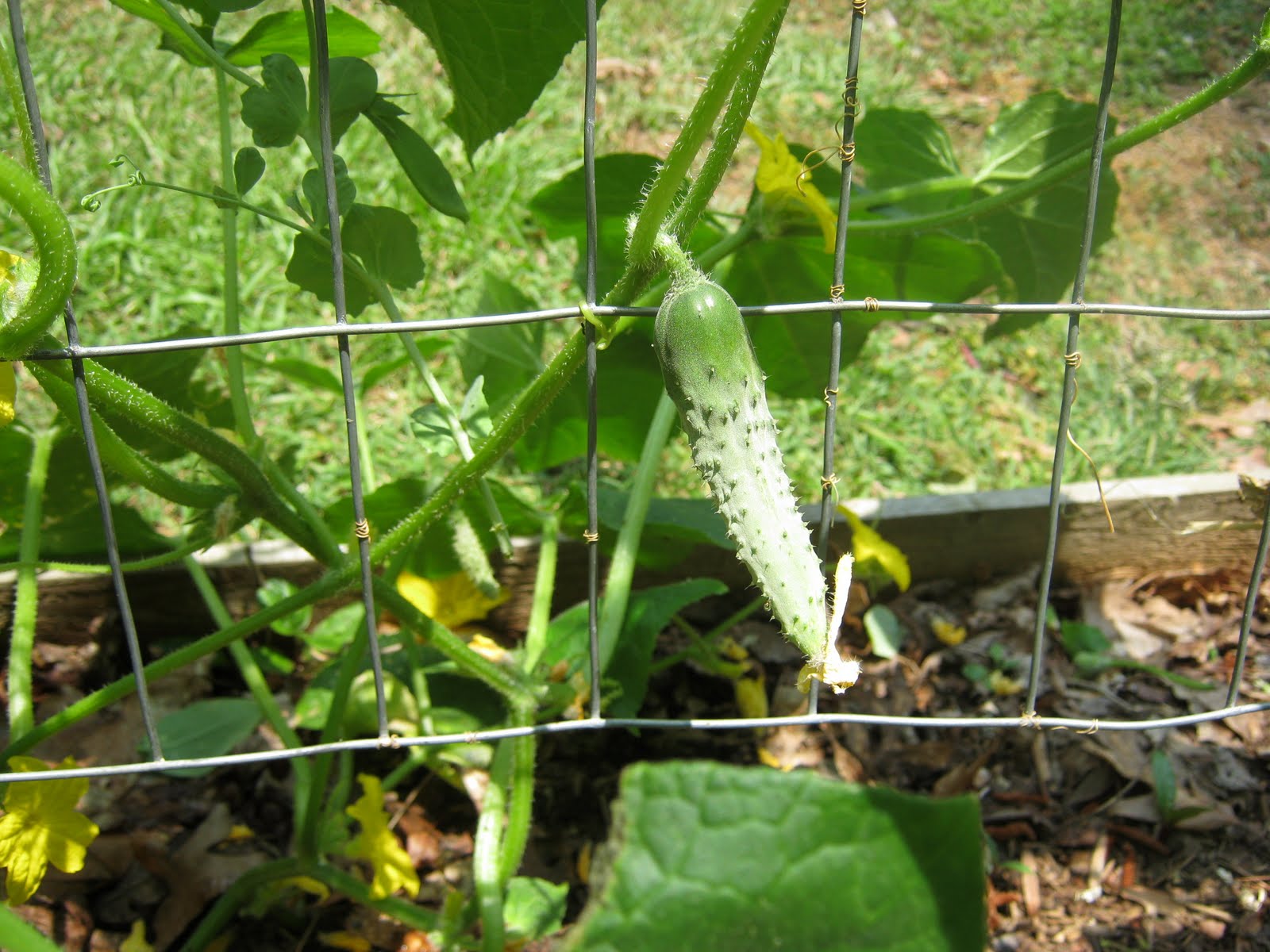
On Tuesday, there were a couple of zucchini to go with the green beans and cucumbers. The little white cuke is the first of the North Carolina picklers. There weren't any more of those to bring in today, but the plants have a lot of little baby cukes that will be ready in a few days.


This morning, there were more green beans, cucumbers, and another zucchini.


Tomorrow, there will be more of the same. (Amazingly, all the green beans so far are from a patch that is just two feet deep and four and a half feet long.)

Usually, when people engage me in conversation about what our garden does for us, I don't talk about it in terms of providing all our food, or even all our vegetables. There are quite a few garden beds out in my front yard, but the actual growing space for veggies that these provide is less than 500 square feet. It would take a lot more than that to feed my family for the year!

Instead, I think of the garden as a source of vitamins, minerals, and variety in our diets. These last several days don't look especially varied, but the garden also provides herbs that can make two meals composed of nearly the same basic ingredients taste different.

The odd times when only one or two veggies are coming into the kitchen don't tend to last very long, and I don't think I've ever had too much zucchini; too many pests here in the South love it too, and the plants usually die before I get too much squash. If there ever is too much of one crop, it can be frozen/dehydrated/canned for later, to become an out-of-season treat.

Also, there is the chard. The small planting means it doesn't come to the kitchen every day, just every now and then. The plant on the right is yet-to-be-harvested; the one in the middle, that is just nubs, went mostly into a pot of lentil soup on Sunday while part of it went into a stir-fry last night. The last few leaves will go into a fried potatoes-and-veggies meal with cheese melted on top tonight. The one on the far left was harvested a week or so ago, and it is regrowing.


If all goes as planned, we can harvest a bundle of chard nearly every week all summer long from the four plants. I had planted five, but something (I suspect a dog) smashed one plant early on, and I never replaced it. Since we are down to just four plants, I might have a week without chard after that fourth plant is harvested, waiting for the first one to complete its regrowth.

We'll have peppers soon, too. Most of the 15 plants on "pepper alley" are sporting little peppers.


We've also had raspberries, but those get eaten before I can even think about bringing out the camera, and a few blueberries have begun to turn blue each day. In less than a week, if the birds are willing to share, we should have enough blueberries to not buy any fruit at the store for awhile. Joe and I have been out picking wild blackberries to put on ice cream and our morning granola (even though, when I made it, I added almost the last of last year's dehydrated blueberries).

The tomato plants finally all have green tomatoes on them, but I don't expect to eat the first ripe tomato until the second week in July. My plants got a late start this year.

For those who are keeping track, the large heads of Slobolt lettuce have turned bitter. We wanted some lettuce for sandwiches over the weekend, and I went out to check the leaves. I brought one back to Joe who popped it into his mouth and nearly immediately made what looked a lot like the "Mr. Yuck" face that goes on bottles of dangerous chemicals! He was raised Catholic, but his family has always celebrated Passover, and he said that the lettuce reminded him of whatever it was that his Mom found to use as the bitter herb at the Seder meal.

The smallest Slobolt, which has only about five leaves, all smaller than six inches high, is still not bitter, but I don't know how long that situation will last. I might just put it on a sandwich later this week, and call it the end of the lettuce season.

I hope all the other gardens out there are growing well!

Friday, June 10, 2011

Beans and Zucchini

I know I am not alone in having pretty much these exact veggies ready for harvest:

Even though they are what everyone else has, too, I am SOOOO happy to have them coming into my kitchen.

One of the zucchini went into what we call "smashed sandwiches." We saute veggies in olive oil (sliced onion, squash, and sugar snap peas in this particular version), pile them into French bread that's been sliced open longways, add some cheese (Provolone is a family favorite for this) and slivers of marinated artichoke from a jar, then cook the finished (closed) sandwiches in one of those George Foreman grills.

This version included sugar snap peas because I brought the last of those in before cutting down the plants.


The sugar snap peas shared a trellis with the cucumbers, and I wanted to make some more space for the cukes. Good air circulation can be helpful in slowing down the assorted mildews that attack the leaves of those vines. The vines are getting long and bushy, so they definitely will benefit from the extra "breathing room."


Also, it has been very hot every day for a while now, and the production of those sugar snap peas has slowed way down. Obviously, though, it hadn't come to a complete standstill before I removed the plants.

Something else that seems to have cropped up in the garden, something unwanted, is the adult of the squash vine borer. I am hoping that the Bt that I have been spraying will slow the damage from the babies of those day-flying moths.


At the Plant-a-Row-for-the-Hungry garden where I volunteer, we started our yellow straightneck squash early enough that the garden is pretty much pelting us with squash.


One of the gardeners took the 90 pounds of produce we harvested on Wednesday (65 pounds of which was summer squash) to the pantry in Marietta. We were very happy to have been able to provide some good veggies to the pantry!

Monday, June 6, 2011

Summer Harvest Begins

I'll start with the crops that are kind of on the shoulder of the season. The first is the "perpetual spinach" chard. The one on the left, that's been chopped down to about an inch and a half high, featured in last night's supper.

Most chard varieties produce good food right through the summer. In the very worst of the heat, the plants look pretty sad and aren't quite as tasty, but they perk up again in the fall.


The harvested chard went inside a batch of stuffed shells (greens sauteed in olive oil with onions, garlic, and Italian herbs; mixed with ricotta cheese and a little grated Parmesan; stuffed into mostly-cooked shells; covered with pasta-sauce; cooked until bubbly; grated mozzarella strewn on top). The onions that were in the skillet with the wilting greens and garlic were also from the yard.


It wasn't my greatest onion year. I didn't plant a very big patch (concentrating more on garlic), and the bulbs didn't get as big as usual, but they are still onions!

The "potato onions," or multipliers, are still out in the garden, so there will be a few more to add to the onion pile in another week or so.

This morning, while walking around the yard with my cup of tea, I stopped to check the little patch of bush beans and saw some that were finally big enough for harvest. These came inside with me when I got home from work.


A zucchini also looked just about "eatin' size."


Joe watered the garden while I was gone (when the afternoon temperature gets over 90 degrees F, watering is important!), and he said he thought it had grown since I left.

When I went to look at it, I had to agree, so the zucchini came in, and it will join the handful of green beans, an onion, and some sugar snap peas (nearly the last...) in a stir-fry.

When the green beans and zucchini start producing for the kitchen, that's when I know it's really summer!

Thursday, June 2, 2011

Odd Squash Problem: Split Stems

A the Plant-a-Row-for-the-Hungry garden, we noticed, a few weeks back, something odd about our summer squash plants. The stems had split. In the lower right part of this first picture, the split shows as a wide place:


Here, in this close-up, the split is easier to see:


If this were caused by squash vine borers, the split areas would look a lot more "chewed" and frass (caterpillar poop) would be all over the place. The Squash Vine Borer Damage page from the University of Nebraska's entomology department shows the damage from squash vine borer activity very clearly (sorry I don't have a photo of my own to post. Maybe later this summer...).

Also, when we first noticed the damage, it was VERY early in the season for squash vine borers. In another week or two, I won't be surprised to hear that evidence of the borers has been seen (except that we are spraying the plants with Bt this year, to head that off some), but early May is just too soon.

When I went online to sort out the problem, I didn't find any university or research related sites that discussed the split stems in any context other than as damage from squash vine borers, but I found some discussion sites, populated by gardeners and farmers, that did.

Several mentioned that split stems can be a result of mechanical damage, and is common when young plants with long stems twist and turn in the wind. Others mentioned that such damage is often seen when the plants experience temperature extremes.

The squash at the PAR garden were set out as transplants with fairly elongated stems, so the first category of damage is a possibility. However, this spring and early summer, the daily high temperatures have been all up and down the thermometer, so the second category is another possibility.

Since my zucchini plants at home all experienced the same temperature extremes without also having split stems, I am thinking that the wind-action on spindly stems was a larger factor.

The good news is that the plants seem to be producing well in spite of the weirdness. The plants are blooming abundantly and don't seem to be at all stressed by the heat. Yesterday when we met for our usual workday, the first harvest from those plants totaled 38 pounds!

Sunday, May 29, 2011

Spring's End?

I brought in the last of the Bronze Arrow lettuce yesterday.


There is still the Slobolt lettuce, but I'm not sure that counts as a spring crop. I've brought in the beets, and the Sugar Snap peas seem to be slowing down in the heat, so I'd say that the spring crops are just about done.

Considering that the daytime high temperatures have gone back into the lower nineties, the persistence of my spring crops has been a little surprising.

Until the traditional summer crops kick in, I am left with chard as a green vegetable from the yard to go with that Slobolt. The good news is that the beans and cucumbers are making good time. In a week or so, they will be ready to add to our meals.

In addition, the onion tops have mostly keeled over, so those have been pulled and left to dry for a day or two on the front porch. The potatoes will be ready to dig soon, too. The domino-like progress of food from the yard into the kitchen, the same almost every year as the seasons progress, is always great to see!

In order to make space in the freezer for any superabundance (I can always hope . . .) we cleaned out the little chest freezer. I usually keep extra flour and cornmeal in there to avoid bug-problems (I tend to buy a LOT when it's on sale), but we moved that into a bucket with one of those "gamma seal" lids (supposed to be bug-proof -- we'll find out!). It turns out that there is a Survival Store surprisingly nearby that sells the lids. If this really works, I might get another one for the rice (usually purchased in 10-20 pound bags, so I don't have to remember to buy more as often).

While working our way to the bottom of the freezer, we did get one pretty big surprise. We still had two gallons of blueberries in there! I had forgotten how productive those bushes were last year. To move those berries along -- one step closer to our stomachs -- I turned most of them into "fruit roll-ups." We already had the dehydrator moved back into the kitchen for the summer, to dry the dill, and making the puree was a snap. We now have 48 pretty large blueberry roll-ups (a.k.a. fruit leather) individually wrapped in wax paper and ready for lunch boxes. I think I'm officially ready for summer!

Since Memorial Day is tomorrow, I'd say my timing isn't too bad.

My Mom (in Oklahoma) usually spends one day during this weekend taking flowers to the graves of family members. I'm betting she's not the only one. Hope it's a beautiful day for everyone, and not too sad.

Thursday, May 26, 2011

Beans of Tomorrow

My bush beans (this year's variety is Provider) are making flower buds. Of course, just like when I look at those pictures of clean-cut, smiling kids captioned "Tomorrow's leaders," I know better than to expect every last one of the buds to make a bean, especially if the high temperatures of the last week continue. The flower buds are, however, a hopeful sign of beans-to-come.


A label of "Tomorrow's beets" would be mostly right, because I'm expecting my little family to eat golden beets from the garden this weekend.


We might eat a little dill, but mostly we have been running it through the dehydrator (at the lowest setting) to save for when the pickling cukes are ready to harvest. Since they aren't yet opening any flowers, it could be awhile.

Joe is having trouble waiting for the garden to provide his cukes, so he has bought some picklers at the store and started a batch of brined pickles, using our fresh dill.


The Sugar Snap peas have been cranking out the peas for a while now. Most of these are going into a stir-fry tonight. They've been great in salads and as snacks-while-walking-around-the-yard.


We still have a couple of heads of Bronze Arrow lettuce out in the garden, but I will be bringing these in to the house tomorrow morning. So far, they have held up very well in the heat, but I don't want to push my luck. Also, I need that space for the sweet potatoes.


Maybe this weekend I will get the rest of the summer planting done. We are about to have some rain (after several dry weeks), which will be welcome.

The weather has been crazy this year, and we have been lucky that our family members in Oklahoma and Missouri have been missed by the worst of the storms (even the niece in Joplin). I hope everyone else out there in electron-land is safe and well!

Thursday, May 19, 2011

The Vagaries of Spring

We have had some pretty hilarious weather here. Already there has been a week in which the high temperature most days was around 90 degrees F, and that was followed by a week in which the high temperature most days was around 60 degrees F. We should be heading back into more usual territory this weekend, but the extremes have been hard on some plants.

I would blame the weather for my tiny pepper plants, but their size is my own fault. If I had started them sooner, they would be more visible in this arc of garden near the front steps. Can you see them? There are fifteen, representing several varieties, though not all are visible in this particular photo.

The big plant to the right, on the outside of the curve, is a red-flowered bee balm that seems fairly resistant to the mildew that attacks most of these plants. I think the variety is Jacob Kline.

In my own yard, the weird weather has mostly served just to slow things down. In the garden of a friend, though, the weather has been a little harder on the plants. The leaves of his earliest-planted tomato plants have a purplish cast. We finally figured out that this is probably due to the reduced uptake of phosphorus that resulted from having been planted in cold soil. In addition, his peppers are looking a little pale, and we think that is cold-related, too.

However, all the plants of my friend who gardens in containers look great! Her tomato plants have little green fruits on them, and all is proceeding as it should.

Elsewhere around my yard, blueberries are looking abundant (though still green), the other berries are flowering and making little green fruits, and my persimmon trees, both the Ichi Ki Ke Jiro and the unknown variety that a friend grafted for me are also making little fruits.

The neighborhood kids (aka "Little Rascals") have figured out where the fruit is, so I expect to have some competition for the berries from these canes. The good news is that there seem to be more canes and more flowers than last year, and if we are lucky there will be plenty to share.


This is the first year of fruiting for the grafted persimmon tree, and I do not know whether any of those fruits will mature (or, if they do, if I can beat the squirrels to them). I'm looking forward to finding out!

Friday, May 13, 2011

What's for Lunch?

These are the salad days at our house.

We brought in all the Capitan and Tiny Tim lettuces, and most of the Marvel of Four Seasons (packed into bags in the fridge). The first two don't hold up well in the heat, and I am hoping to find out how well Marvel holds up. I'll be nibbling on the remaining Marvel plant on and off to find out when it turns bitter. Still in the yard are the oak-leaf lettuces (this year those are all Bronze Arrow), which should be fine for a couple more weeks, and the SloBolt, which should be fine into June.

We still have some radishes left in the garden, and the peas, both English and Sugar Snap, have just recently begun making additions to our meals.

Also making regular appearances are the many herbs, both the ones we planted on purpose and the ones that have re-seeded into the yard. There's a lot of dill that I will be thinning soon, and bringing the thinnings in to dry for later use. Last year's parsley is starting to make flowers, but the leaves are still just fine to use. We even still have a little cilantro! All the plants in the sunnier spots went to seed a while back, but the plants in shadier locations still have plenty of usable leaves.

For someone who cooks, herbs are a great choice of plants to grow, because getting them at the store in those little plastic packets costs a small fortune. Today, our lunchtime salad is a pesto-potato salad (on a bed of lettuce) (it has peas in it), for which buying basil leaves would have made me pretty unhappy. I will admit that making the pesto last summer wasn't exactly my favorite activity, but we have been using the frozen cubes of pesto all winter long, and we still have a few more cubes in the freezer.

The Hanover Salad Kale has bolted, along with most of the other earlier greens. That hasn't stopped me from taking more leaves off the spinach plants; they are just a bit tougher than earlier in the spring. Those plants are all coming out soon, though.

In another week or two, the newest Perpetual Spinach Chard will be big enough to add to meals, too. The carrots will be ready at about that same time, and so will the beets.

It is great to have food from the garden on my plate!

Tuesday, May 10, 2011

Temps in the 90s

As so often happens in the middle of May, afternoon temperatures are reaching into the low nineties. That means it's time for my little family to eat a lot of salad. Most lettuces left in the garden for many days at such high temperatures will turn bitter, and they will bolt to flower and seed.

For people planning to save lettuce seeds from their own plants for next year, that is kind of a mixed blessing.

The Slobolt lettuce should be good for several more weeks. One of my plans for this spring was to compare Slobolt with Jericho as the heat wore on into early summer. I started them at the same time, in exactly the same way, but the Jericho seeds didn't germinate. There is always next year . . .

Other spring crops just reaching their stride include the peas -- both kinds. I have some of the regular English peas in the pasta salad that I've packed for today's lunch, and the Sugar snap peas are just a little bit behind in maturity. These are beginning to get sweet, but as they get more plump, they will also get more sugary.


This is one of the four squash plants that came up. I had hoped for five, so I will probably plant another seed soon. One would think that by now I would have all the summer crops planted, and if all had gone as scheduled, almost all except the sweet potatoes would be in, but I always plan to have more energy and time that reality provides.


As it stands, I have planted the peppers, but not the eggplants. The okra and sunflowers are waiting for the space currently inhabited by carrots, beets, and some spring greens. The melons are waiting for me to get busy and finish preparing their bed. The winter squash and popcorn need to go in, too, along with some flowers and herbs.

Soon though, soon the summer garden will be in, and I will have the same lazy life as our little cat Louisiana (not really, but I can dream - right?). Here he is in one of his several favorite napping spots:

Sunday, May 8, 2011

Tools Inventory: Grub Hoe

My husband is pretty good about giving me new garden tools for all the major gift-giving days, and for my birthday I have a new grub hoe!


I've been talking about this particular tool for a while now, so it wasn't a huge surprise when I got a very long gift (I didn't stop to count the candles drawn on the box to make sure all 51 were there, but I have been assured that they are).


This is the 4" model for smaller gardens, and it works amazingly well. It isn't for chopping weeds; it's for digging. I tried it out first (notice that I'm not really dressed for gardening in the photo) in the bed that will soon hold eggplants. It turned the soil up like a charm!

When I got serious enough to put on some sturdier shoes, I was able to prepare the bed for peppers in less than half an hour. Working with a shovel or spading fork, it would probably have taken closer to two hours to get that done.

A lot of gardeners, I know, would get this all done even faster with a power tool, but some of my planting beds are small enough (and some are curved) that a power tool isn't any easier in the long-run than a hand-tool, especially when considering maintenance and fuel costs. The grub hoe, and most of my other tools, just need to be filed to keep them sharp and an occasional rub along the handles with linseed oil to keep the wood in good shape.

The funniest thing about the hoe is that it used muscles I didn't even know existed, and I use all hand tools. You'd think I'd have found all those muscles in my upper back by now!

We are having lovely, warm weather, and it has been nice to sit outside and enjoy the day, even though I've also had to do some work for my actual job. I hope everyone has had a great Mother's Day!